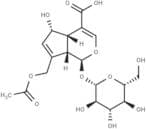
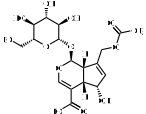
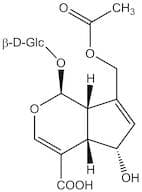
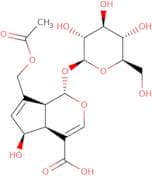
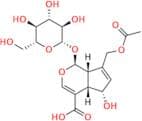
CAS 25368-11-0
:Asperulosidinsäure
Beschreibung:
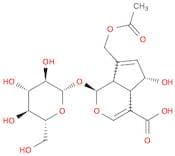
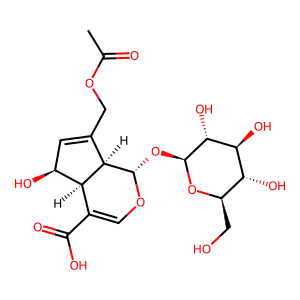
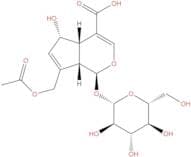
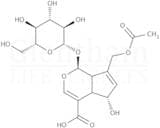
Asperulosidinsäure ist ein natürlich vorkommendes Iridoidglykosid, das hauptsächlich in verschiedenen Pflanzenarten, insbesondere in der Familie der Rubiaceae, vorkommt. Es ist durch seine komplexe molekulare Struktur gekennzeichnet, die eine Zuckereinheit enthält, die an einen Iridoidkern gebunden ist. Diese Verbindung ist bekannt für ihre potenziellen pharmakologischen Eigenschaften, einschließlich entzündungshemmender, antioxidativer und antimikrobieller Aktivitäten. Asperulosidinsäure wird häufig für seine Rolle in der traditionellen Medizin und seine potenziellen therapeutischen Anwendungen untersucht. Es ist typischerweise in polaren Lösungsmitteln löslich, was die Extraktion aus Pflanzenmaterialien erleichtert. Die Stabilität und Reaktivität der Verbindung können durch Umweltfaktoren wie pH und Temperatur beeinflusst werden. Darüber hinaus hebt ihre Präsenz in pflanzlichen Formulierungen ihre Bedeutung in der Phytochemie und der Forschung zu Naturstoffen hervor. Insgesamt stellt Asperulosidinsäure ein interessantes Studienobjekt dar, aufgrund seiner bioaktiven Eigenschaften und potenziellen gesundheitlichen Vorteile.
Formel:C18H24O12
InChl:InChI=1S/C18H24O12/c1-6(20)27-4-7-2-9(21)12-8(16(25)26)5-28-17(11(7)12)30-18-15(24)14(23)13(22)10(3-19)29-18/h2,5,9-15,17-19,21-24H,3-4H2,1H3,(H,25,26)/t9-,10+,11+,12-,13+,14-,15+,17-,18-/m0/s1
InChI Key:InChIKey=DGDWCRWJRNMRKX-DILZHRMZSA-N
SMILES:O([C@H]1[C@]2([C@@](C(C(O)=O)=CO1)([C@@H](O)C=C2COC(C)=O)[H])[H])[C@@H]3O[C@H](CO)[C@@H](O)[C@H](O)[C@H]3O
Synonyme:- Cyclopenta[c]pyran-4-carboxylic acid, 1α-(β-D-glucopyranosyloxy)-1,4aα,5,7aα-tetrahydro-5β-hydroxy-7-(hydroxymethyl)-, 7-acetate
- (1S,4aS,5S,7aS)-7-[(Acetyloxy)methyl]-1-(β-D-glucopyranosyloxy)-1,4a,5,7a-tetrahydro-5-hydroxycyclopenta[c]pyran-4-carboxylic acid
- Cyclopenta[c]pyran-4-carboxylic acid, 7-[(acetyloxy)methyl]-1-(β-D-glucopyranosyloxy)-1,4a,5,7a-tetrahydro-5-hydroxy-, (1S,4aS,5S,7aS)-
- Asperulosidic acid
- Cyclopenta[c]pyran-4-carboxylic acid, 7-[(acetyloxy)methyl]-1-(β-D-glucopyranosyloxy)-1,4a,5,7a-tetrahydro-5-hydroxy-, [1S-(1α,4aα,5β,7aα)]-
Sortieren nach
Reinheit (%)
0
100
|
0
|
50
|
90
|
95
|
100
9 Produkte.
Asperulosidic acid
CAS:Asperulosidic acid has been recently used in chinese medicine as a useful drug against some tumors. It has anticlastogenic activity, since the anticlastogenic irridoids have an alpha-unsaturated carbonyl group, this structure is considered to play an important role in the anticlastogenicity. Asperulosidic acid can inhibit the seed germination and growth of seedlings of large crabgrass. Asperulosidic acid, and 6-O-(beta-D-glucopyranosyl)-1-O-octanoyl-beta-D-glucopyranose are effective in suppressing 12-O-tedtradecanoylphorbol-13-acetate (TPA)- or epidermal growth factor (EGF)-induced cell transformation and associated AP-1 activity.Formel:C18H24O12Reinheit:95%~99%Farbe und Form:PowderMolekulargewicht:432.378Asperulosidic acid
CAS:Formel:C18H24O12Reinheit:≥ 98.0%Farbe und Form:White to off-white solidMolekulargewicht:432.38Asperulosidic acid
CAS:Asperulosidic acid (ASPA) has anti-tumor, anti-oxidant, and anti-inflammatory activities. ASPA is related to the inhibition of inflammatory cytokines.Formel:C18H24O12Reinheit:99.47%Farbe und Form:SolidMolekulargewicht:432.38Ref: TM-TN1410
1mg120,00€2mg170,00€5mg260,00€1mL*10mM (DMSO)286,00€10mg432,00€25mg708,00€50mg964,00€100mg1.288,00€Asperulosidic acid
CAS:Natural glycosideFormel:C18H24O12Reinheit:≥ 90.0 % (HPLC)Farbe und Form:PowderMolekulargewicht:432.38Asperulosidic acid
CAS:Asperulosidic acid is a glycoside derivative that belongs to the natural compounds. It has been shown to be an enzyme inducer in bacteria, yeast and plants. Asperulosidic acid can be found in the leaves of asperula odorata, a plant commonly known as sweet woodruff. It is also found in fructus asperuli, which is made from the fruit of asperula odorata. Asperulosidic acid has been shown to increase the activity of enzymes such as β-glucuronidase and esterase in bacteria, which may have an effect on their metabolism. This compound also increases the activity of proteases and other enzymes in plants and yeast. The matrix effect can be used to determine the concentration of this compound by measuring its effects on enzyme activity. Matrix effects can be measured using a plate test or by plasma mass spectrometry. Asperulosidic acid has been shown to have growthFormel:C18H24O12Reinheit:Min. 95%Farbe und Form:SolidMolekulargewicht:432.38 g/mol