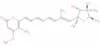
CAS 25425-12-1
:Citreoviridin
Beschreibung:
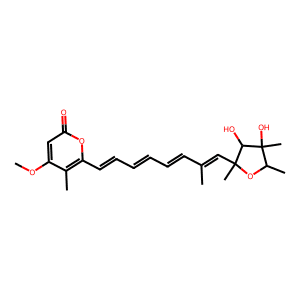
Citreoviridin ist ein Mykotoxin, das von bestimmten Pilzarten produziert wird, insbesondere von solchen der Gattung Penicillium. Es ist hauptsächlich bekannt für sein Vorkommen in kontaminierten Lebensmitteln, insbesondere in Getreide und Cerealien. Diese Verbindung ist durch ihre gelb-grüne Farbe gekennzeichnet und wird als Polyketid klassifiziert. Citreoviridin zeigt eine Reihe biologischer Aktivitäten, einschließlich potenzieller Toxizität für Menschen und Tiere, die zu Gesundheitsproblemen wie Leberschäden und anderen Organfunktionsstörungen nach der Einnahme führen kann. Die Substanz wurde auf ihre Auswirkungen auf zelluläre Prozesse untersucht, einschließlich ihrer Fähigkeit, die Proteinsynthese zu hemmen. Aufgrund ihres toxikologischen Profils ist Citreoviridin von erheblichem Interesse für die Lebensmittelsicherheit und die öffentliche Gesundheit, was zu regulatorischen Maßnahmen führt, um ihre Präsenz in Lebensmittelvorräten zu begrenzen. Ihre chemische Struktur umfasst mehrere funktionelle Gruppen, die zu ihrer Reaktivität und biologischen Wirkung beitragen. Insgesamt dient Citreoviridin als ein wichtiges Beispiel für die Notwendigkeit der Wachsamkeit bei der Überwachung von Mykotoxinen in landwirtschaftlichen Produkten.
Formel:C23H30O6
InChl:InChI=1S/C23H30O6/c1-15(14-22(4)21(25)23(5,26)17(3)29-22)11-9-7-8-10-12-18-16(2)19(27-6)13-20(24)28-18/h7-14,17,21,25-26H,1-6H3/b8-7+,11-9+,12-10+,15-14+/t17-,21+,22+,23+/m1/s1
InChI Key:InChIKey=JLSVDPQAIKFBTO-OMCRQDLASA-N
SMILES:C(=C(/C=C/C=C/C=C/C1=C(C)C(OC)=CC(=O)O1)\C)\[C@@]2(C)[C@H](O)[C@@](C)(O)[C@@H](C)O2
Synonyme:- (1R,5E)-1,4-anhydro-5,6,7-trideoxy-6-[(1E,3E,5E)-6-(4-methoxy-5-methyl-2-oxo-2H-pyran-6-yl)hexa-1,3,5-trien-1-yl]-1,4-dimethyl-2-C-methyl-L-arabino-hept-5-enitol
- 2,4,6,8,10,12-Tridecahexaenoic acid, 5-hydroxy-3-methoxy-4,12-dimethyl-13-(tetrahydro-3,4-dihydroxy-2,4,5-trimethyl-2-furyl)-, δ-lactone
- 2,5-Anhydro-1,6-dideoxy-2-C-[(1E,3E,5E,7E)-8-(4-methoxy-5-methyl-2-oxo-2H-pyran-6-yl)-2-methyl-1,3,5,7-octatetraen-1-yl]-4-C-methyl-<span class="text-smallcaps">D</span>-iditol
- 2H-Pyran-2-one, 4-methoxy-5-methyl-6-(7-methyl-8-(tetrahydro-3,4-dihydroxy-2,4,5-trimethyl-2-furanyl)-1,3,5,7-octatetraenyl)-
- 2H-Pyran-2-one, 4-methoxy-5-methyl-6-(7-methyl-8-(tetrahydro-3,4-dihydroxy-2,4,5-trimethyl-2-furyl)-1,3,5,7-octatetraenyl)-
- 2H-Pyran-2-one, 4-methoxy-5-methyl-6-[7-methyl-8-(tetrahydro-3,4-dihydroxy-2,4,5-trimethyl-2-furanyl)-1,3,5,7-octatetraenyl]-, [2S-[2α(1E,3E,5E,7E),3β,4α,5α]]-
- 4-Methoxy-5-methyl-6-(7-methyl-8-(tetrahydro-3,4-dihydroxy-2,4,5-trimethyl-2-furyl)-1,3,5,7-octatetraenyl)-2H-pyran-2-one
- <span class="text-smallcaps">D</span>-Iditol, 2,5-anhydro-1,6-dideoxy-2-C-[(1E,3E,5E,7E)-8-(4-methoxy-5-methyl-2-oxo-2H-pyran-6-yl)-2-methyl-1,3,5,7-octatetraen-1-yl]-4-C-methyl-
- <span class="text-smallcaps">D</span>-Iditol, 2,5-anhydro-1,6-dideoxy-2-C-[(1E,3E,5E,7E)-8-(4-methoxy-5-methyl-2-oxo-2H-pyran-6-yl)-2-methyl-1,3,5,7-octatetraenyl]-4-C-methyl-
- Brn 5311865
- Citreoviridin
- Citreoviridin A
- Citreoviridine
- Citreoviridine A
- Nsc 159630
- D-Iditol, 2,5-anhydro-1,6-dideoxy-2-C-[(1E,3E,5E,7E)-8-(4-methoxy-5-methyl-2-oxo-2H-pyran-6-yl)-2-methyl-1,3,5,7-octatetraenyl]-4-C-methyl-
- Weitere Synonyme anzeigen
Sortieren nach
Reinheit (%)
0
100
|
0
|
50
|
90
|
95
|
100
4 Produkte.
Citreoviridin
CAS:CitreoviridinFormel:C23H30O6Reinheit:By hplc: 99.67% (Typical Value in Batch COA)Farbe und Form: yellow powderMolekulargewicht:402.48g/molCitreoviridin
CAS:Citreoviridin from Penicillium citreoviride blocks brain Na+/K+-ATPase; boosts Na+/K+- and Mg2+-ATPase in microsomes dose-dependently.Formel:C23H30O6Reinheit:98%Farbe und Form:SolidMolekulargewicht:402.48Citreoviridin (80%, Contain Isocitreoviridin)
CAS:Kontrolliertes ProduktStability Light Sensitive
Applications Citreoviridin is a mycotoxin found in dairy products and is produced by Fusarium, Aspergillus, and Penicillium.
Not a dangerous good if item is equal to or less than 1g/ml and there is less than 100g/ml in the package
References Jia, W., et. al.: J. Chrom. A., 1345, 107 (2014); Malhotra, B.D., et. al.: App. Biochem. Biotech., (Ahead of Print) (2014)Formel:C23H30O6Farbe und Form:NeatMolekulargewicht:402.48Citreoviridin
CAS:Citreoviridin is a mycotoxin, which is derived from specific strains of the mold genera Penicillium and Aspergillus. This compound is classified as a yellow crystalline toxin and is known for its potent biological activity, particularly its role as an inhibitor of ATP synthase. Citreoviridin functions by interfering with ATP synthesis, a critical process in cellular energy metabolism. It binds to the F0 component of ATP synthase, disrupting proton translocation and thus inhibiting ATP production. This mode of action makes Citreoviridin a subject of interest in biochemical and physiological studies concerning energy metabolism and mitochondrial function.Reinheit:Min. 95%