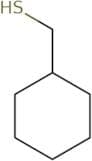
CAS 2550-37-0
:Cyclohexanmethanthiol
Beschreibung:
Cyclohexanmethanthiol, mit der CAS-Nummer 2550-37-0, ist eine organische Verbindung, die durch einen cyclohexanring charakterisiert ist, der mit einer Methanethiolgruppe substituiert ist. Diese Verbindung weist einen sechsgliedrigen Kohlenstoffring auf, der zu ihrer zyklischen Struktur beiträgt, sowie eine Thiolgruppe (-SH), die ihr charakteristische chemische Eigenschaften verleiht. Cyclohexanmethanthiol ist typischerweise eine farblose bis blassgelbe Flüssigkeit mit einem starken, schwefelartigen Geruch, der für Thiole charakteristisch ist. Sie ist relativ löslich in organischen Lösungsmitteln, hat jedoch eine begrenzte Löslichkeit in Wasser aufgrund ihres hydrophoben Cyclohexananteils. Die Anwesenheit der Thiolgruppe macht sie reaktiv, insbesondere in nucleophilen Substitutionsreaktionen und bei der Bildung von Disulfiden. Cyclohexanmethanthiol kann in verschiedenen Anwendungen eingesetzt werden, einschließlich als Baustein in der organischen Synthese und in der Herstellung von Duftstoffen und Aromastoffen. Sicherheitsvorkehrungen sind beim Umgang mit dieser Verbindung erforderlich, da Thiole giftig sein können und starke Gerüche haben, die irritierend sein können.
Formel:C7H14S
Synonyme:- Cyclohexylmethanethiol
- Cyclohexylmethyl mercaptan
- Cyclohexylmethylthiol
Sortieren nach
Reinheit (%)
0
100
|
0
|
50
|
90
|
95
|
100
1 Produkte.
Cyclohexylmethanethiol
CAS:Cyclohexylmethanethiol is a reactive chemical that is a colorless liquid with a strong odor. It is an organic compound belonging to the group of polybasic, hydroxamic acids and has been found to be an antimicrobial agent. Cyclohexylmethanethiol reacts with the hydroxyl groups on the surface of bacteria and damages the cell wall by disrupting the cross-linking of peptidoglycan. This reaction product inhibits bacterial growth by binding to proteins in the cell membrane, which prevents essential molecules from entering or exiting the cell. Cyclohexylmethanethiol also reacts with alkylthio groups on proteins in bacterial cells, which alters their function and leads to protein denaturation.Formel:C7H14SReinheit:Min. 95%Molekulargewicht:130.25 g/mol