CAS 25501-32-0
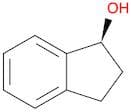
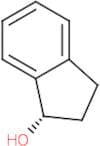
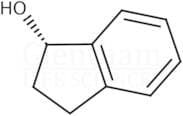
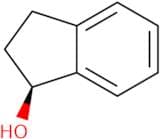
:S(+)-1-Indanol
Beschreibung:
S(+)-1-Indanol, mit der CAS-Nummer 25501-32-0, ist eine chirale organische Verbindung, die zur Klasse der Indanole gehört, die Derivate von Indan sind. Diese Verbindung weist eine Hydroxylgruppe (-OH) auf, die an die Indanstruktur gebunden ist, spezifisch an der Position 1, was zu ihren einzigartigen Eigenschaften beiträgt. S(+)-1-Indanol zeichnet sich durch seine optisch aktive Natur aus, was bedeutet, dass es die planpolarisierten Licht aufgrund seines chiralen Zentrums drehen kann. Es ist typischerweise eine farblose bis blassgelbe Flüssigkeit oder ein Feststoff, abhängig von seiner Reinheit und Form. Die Verbindung ist in organischen Lösungsmitteln löslich und hat eine begrenzte Löslichkeit in Wasser. S(+)-1-Indanol ist in verschiedenen Bereichen von Interesse, einschließlich der Pharmazie und der organischen Synthese, aufgrund seiner potenziellen Anwendungen in der Entwicklung von chiralen Katalysatoren und Intermediaten. Seine Stereochemie spielt eine entscheidende Rolle in seiner Reaktivität und Interaktionen in biologischen Systemen, was es zu einer wertvollen Verbindung für die Forschung in der asymmetrischen Synthese und der medizinischen Chemie macht.
Formel:C9H10O
InChl:InChI=1/C9H10O/c10-9-6-5-7-3-1-2-4-8(7)9/h1-4,9-10H,5-6H2/t9-/m0/s1
SMILES:c1ccc2c(c1)CC[C@@H]2O
Synonyme:- (S)-(+)-1-Hydroxyindan
- (1S)-2,3-Dihydro-1H-indene-1β-ol
- (1S)-Indan-1β-ol
- (3S)-Indan-3-ol
- (S)-2,3-Dihydro-1H-indene-1β-ol
- [1S,(+)]-1-Indanol
- (1S)-2,3-dihydro-1H-inden-1-ol
- (S)-(+)-1-Indanol
Sortieren nach
Reinheit (%)
0
100
|
0
|
50
|
90
|
95
|
100
5 Produkte.
(S)-2,3-Dihydro-1H-inden-1-ol
CAS:Formel:C9H10OReinheit:97%Farbe und Form:SolidMolekulargewicht:134.1751(S)-2,3-Dihydro-1H-inden-1-ol
CAS:(S)-2,3-Dihydro-1H-inden-1-olReinheit:97%Molekulargewicht:134.18g/mol(S)-(+)-1-Indanol
CAS:(S)-(+)-1-Indanol is a substrate for the human liver alcohol dehydrogenase and can be used to study the enzyme. The molecule has two phenyl groups that are capable of forming hydrogen bonds with other molecules. The hydrogen bond is a relatively weak, noncovalent interaction between two polar molecules. It can be formed by the donation of a lone pair of electrons from one side of an oxygen atom in one molecule to a lone pair of electrons on another oxygen atom in another molecule. This type of bond is responsible for many important biological processes, including DNA replication and protein folding. The (S)-(+)-1-Indanol can also undergo carbonyl reduction, which is the conversion of an organic compound containing a carbonyl group into a corresponding hydrocarbon derivative containing hydroxyl groups. The (S)-(+)-1-Indanol contains both hydroxyl and carbonyl functionalities that make it suitable for this process. (S)-Formel:C9H10OReinheit:Min. 95%Farbe und Form:PowderMolekulargewicht:134.18 g/mol