CAS 25518-54-1
:(-)-Lauroylcarnitin
Beschreibung:
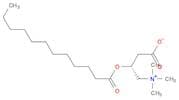
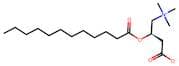
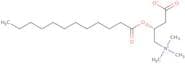
(-)-Lauroylcarnitin, mit der CAS-Nummer 25518-54-1, ist ein natürlich vorkommendes Derivat von Carnitin, das eine entscheidende Rolle beim Transport von Fettsäuren in die Mitochondrien zur Energieproduktion spielt. Diese Verbindung ist durch ihre langkettige Fettsäuregruppe, speziell Lauroyl (abgeleitet von Laurinsäure), gekennzeichnet, die zu ihren hydrophoben Eigenschaften beiträgt. (-)-Lauroylcarnitin kommt typischerweise in biologischen Systemen vor und ist am Lipidstoffwechsel beteiligt. Es weist ein chirales Zentrum auf, was es optisch aktiv macht, und die (-) Bezeichnung zeigt seine spezifische Stereochemie an. Die Substanz ist in organischen Lösungsmitteln löslich und hat eine begrenzte Löslichkeit in Wasser, was ihre amphiphile Natur widerspiegelt. Ihre biologischen Funktionen können Rollen im Energiestoffwechsel und potenzielle Auswirkungen auf verschiedene Stoffwechselstörungen umfassen. Die Forschung zu ihren pharmakologischen Eigenschaften ist im Gange, mit Interesse an ihren potenziellen therapeutischen Anwendungen, insbesondere in der metabolischen und kardiovaskulären Gesundheit. Insgesamt ist (-)-Lauroylcarnitin eine wichtige Verbindung in der Biochemie und Ernährung, die die komplexen Zusammenhänge zwischen Fettsäurestoffwechsel und Energiehomöostase hervorhebt.
Formel:C19H37NO4
InChl:InChI=1S/C19H37NO4/c1-5-6-7-8-9-10-11-12-13-14-19(23)24-17(15-18(21)22)16-20(2,3)4/h17H,5-16H2,1-4H3/t17-/m1/s1
InChI Key:InChIKey=FUJLYHJROOYKRA-QGZVFWFLSA-N
SMILES:[C@H](OC(CCCCCCCCCCC)=O)(C[N+](C)(C)C)CC([O-])=O
Synonyme:- (-)-Lauroylcarnitine
- (R)-Dodecanoylcarnitine
- 1-Propanaminium, 3-carboxy-N,N,N-trimethyl-2-[(1-oxododecyl)oxy]-, inner salt, (2R)-
- 1-Propanaminium, 3-carboxy-N,N,N-trimethyl-2-[(1-oxododecyl)oxy]-, inner salt, (R)-
- 25518-54-1
- <span class="text-smallcaps">L</span>-Carnitine dodecanoyl ester
- <span class="text-smallcaps">L</span>-Lauroylcarnitine
- Ammonium, (3-carboxy-2-hydroxypropyl)trimethyl-, hydroxide, inner salt, laurate, <span class="text-smallcaps">L</span>-
- C12 Carnitine
- Dodecanoyl carnitine
- Dodecanoyl-<span class="text-smallcaps">L</span>-carnitine
- Lauric acid, ester with (3-carboxy-2-hydroxypropyl)trimethylammonium hydroxide inner salt, <span class="text-smallcaps">L</span>-
- Lauroyl-<span class="text-smallcaps">L</span>(-)-carnitine
- Ammonium, (3-carboxy-2-hydroxypropyl)trimethyl-, hydroxide, inner salt, laurate, L-
- Lauric acid, ester with (3-carboxy-2-hydroxypropyl)trimethylammonium hydroxide inner salt, L-
- Lauroyl-L-carnitine
- Weitere Synonyme anzeigen
Sortieren nach
Reinheit (%)
0
100
|
0
|
50
|
90
|
95
|
100
5 Produkte.
(3R)-3-dodecanoyloxy-4-trimethylammonio-butanoate
CAS:Formel:C19H37NO4Reinheit:99%Farbe und Form:SolidMolekulargewicht:343.5014Dodecanoylcarnitine
CAS:Dodecanoylcarnitine linked to fatty acid oxidation issues; raises salmon calcitonin permeability.Formel:C19H37NO4Reinheit:99.72% - 99.72%Farbe und Form:SolidMolekulargewicht:343.5Ref: TM-T15157
2mg35,00€5mg52,00€1mL*10mM (DMSO)52,00€10mg80,00€25mg133,00€50mg210,00€100mg341,00€200mg505,00€C12 Carnitine
CAS:C12 Carnitine is a metabolite of the amino acid lysine that is synthesized in the liver from methionine. It is important for energy metabolism, and its levels are often reduced in patients with various types of metabolic disorders. C12 Carnitine has been detected in cancer tissues, as well as human serum and tissue biopsies. The concentration of C12 Carnitine can be used to assess disease activity and diagnose various diseases such as HIV infection and chronic hepatitis B infection. A matrix effect may affect the stability of this molecule during sample preparation or analysis by LC-MS/MS methods.Formel:C19H37NO4Reinheit:Min. 95%Molekulargewicht:343.5 g/mol