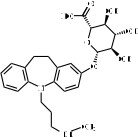
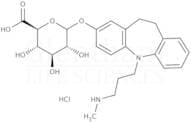
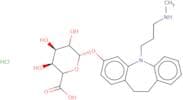
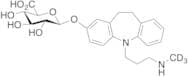
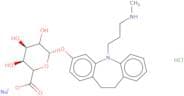
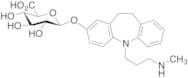
![(3R,6R)-3,4,5-trihydroxy-6-[[11-[3-(methylamino)propyl]-5,6-dihydrobenzo[b][1]benzazepin-3-yl]oxy]…](/_next/image/?url=https%3A%2Fstatic.cymitquimica.com%2Fcas-image%2Fthumb-webp%2F147920-3r-6r-345-trihydroxy-6-11-3-methylamino-propyl-56-dihydrobenzo-b-1-benzazepin-3-yl-oxy-tetrahydropyran-2-carboxylic-acid.webp&w=3840&q=75)
CAS 25521-31-7
:(3R,6R)-3,4,5-trihydroxy-6-[[11-[3-(methylamino)propyl]-5,6-dihydrobenzo[b][1]benzazepin-3-yl]oxy]tetrahydropyran-2-carbonsäure
Beschreibung:
Die chemische Substanz, die als (3R,6R)-3,4,5-trihydroxy-6-[[11-[3-(methylamino)propyl]-5,6-dihydrobenzo[b][1]benzazepin-3-yl]oxy]tetrahydropyran-2-carbonsäure bekannt ist und die CAS-Nummer 25521-31-7 trägt, zeichnet sich durch ihre komplexe molekulare Struktur aus, die mehrere funktionelle Gruppen umfasst. Sie weist einen Tetrahydropyranring auf, der zu ihrer zyklischen Natur beiträgt, sowie mehrere Hydroxylgruppen (-OH), die ihre Polarität und ihr Potenzial für Wasserstoffbrückenbindungen erhöhen. Das Vorhandensein einer Carbonsäuregruppe (-COOH) weist auf saure Eigenschaften hin, während die Methylaminogruppe auf basische Eigenschaften hindeutet. Diese Verbindung wird wahrscheinlich aufgrund ihrer strukturellen Merkmale, die mit verschiedenen biologischen Zielen interagieren können, eine signifikante biologische Aktivität aufweisen. Ihre komplexe Anordnung von Atomen und funktionellen Gruppen kann auch ihre Löslichkeit, Stabilität und Reaktivität in verschiedenen Umgebungen beeinflussen. Insgesamt stellt diese Substanz eine einzigartige Kombination organischer Funktionalitäten dar, die in der medizinischen Chemie und Pharmakologie von Interesse sein könnte.
Formel:C24H30N2O7
InChl:InChI=1/C24H30N2O7/c1-25-11-4-12-26-17-6-3-2-5-14(17)7-8-15-13-16(9-10-18(15)26)32-24-21(29)19(27)20(28)22(33-24)23(30)31/h2-3,5-6,9-10,13,19-22,24-25,27-29H,4,7-8,11-12H2,1H3,(H,30,31)/t19?,20-,21?,22?,24+/m1/s1
Sortieren nach
Reinheit (%)
0
100
|
0
|
50
|
90
|
95
|
100
8 Produkte.
2-Hydroxy Desipramine Glucuronide
CAS:Formel:C24H20N2O7Farbe und Form:White To Off-White SolidMolekulargewicht:458.512-Hydroxydesipramine glucuronide
CAS:2-Hydroxydesipramine glucuronide is a metabolite of desipramine, which is a tricyclic antidepressant that inhibits the uptake of noradrenaline and 5-hydroxytryptamine. 2-Hydroxydesipramine glucuronide is formed by conjugation with glucuronic acid. It has been found in human urine and has been proposed as a biomarker for the clinical monitoring of patients taking desipramine. The pharmacological effects of 2-hydroxydesipramine glucuronide are similar to those of desipramine, but it is less potent and selective than its parent compound. This metabolite also has biliary excretion properties, which may be due to its small molecular size.Formel:C24H30N2O7Reinheit:Min. 95 Area-%Farbe und Form:PowderMolekulargewicht:458.51 g/mol2-Hydroxy Desipramine-d3 β-D-Glucuronide
CAS:Kontrolliertes ProduktFormel:C24D3H27N2O7Farbe und Form:NeatMolekulargewicht:461.5232-Hydroxydesipramine b-D-glucuronide sodium salt
CAS:2-Hydroxydesipramine b-D-glucuronide sodium salt is a glucuronide metabolite of desipramine. It has been shown to be an active form of desipramine in animals and humans, but the exact mechanism of this activity is unknown. 2-Hydroxydesipramine b-D-glucuronide sodium salt is excreted in the bile and may have a therapeutic effect on liver disease. The pharmacological effects of 2-hydroxydesipramine b-D-glucuronide sodium salt have been studied using various animal models and human studies. This drug has been shown to produce sedative effects and to affect the cardiovascular system. In addition, it has an effect on the central nervous system, including its ability to lower seizure threshold. 2-Hydroxydesipramine b-D-glucuronide sodium salt also inhibits the metabolism of other drugs by inhibFormel:C24H30N2O7·NaReinheit:Min. 95%Molekulargewicht:481.49 g/mol2-Hydroxy Desipramine β-D-Glucuronide
CAS:Kontrolliertes ProduktApplications A metabolite of Desipramine.
References Gram, L.F., et al.: Clin. Pharmacol. Therap., 17, 555 (1975), Hackett, A.M., et al.: Xenobiotica, 14, 491 (1984), Chiba, M., et al.: Biochem. Pharmacol., 39, 367 (1990),Formel:C24H30N2O7Farbe und Form:NeatMolekulargewicht:458.50