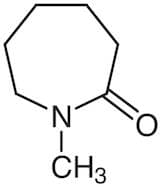
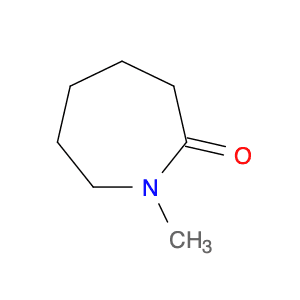
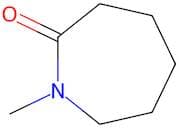
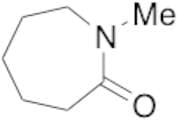
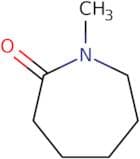
CAS 2556-73-2
:N-Methylcaprolactam
- 1-Methyl-2-azepanone
- 1-Methylazacycloheptan-2-one
- 1-Methylazepan-2-One
- 1-Methylcaprolactam
- 1-Methylhexahydro-2H-azepin-2-one
- 2H-Azepin-2-one, hexahydro-1-methyl-
- Hexahydro-1-methyl-2H-azepin-2-one
- Hexamethylenimine, 1-methyl-2-oxo-
- N-Methyl caprolactam
- N-Methyl-6-caprolactam
- N-Methyl-ε-caprolactam
- NSC 68794
- N-Methylcaprolactam
- N-Methyl-6-hexanelactam
- 2H-Azepin-2-one, hexahydro-N-methyl-
- N-Methylcaprolactam, 95+%
- hexahydro-n-methyl-2h-azepin-2-on
- N-METHYL-2-AZACYCLOOCTANONE
- N-Methyl-gamma-caprolactam
- hexahydro-n-methyl-2h-azepin-2-one
- n-methyl-epsilon-caprolacta
- epsilon-Caprolactam, N-methyl-
- hexahydro-1-methyl-2h-azepin-2-on
- 1-methyl-azepan-2-one(N-methyl-caprolactam)
- N-METHYL-EPSILON-CAPROLACTAM
- Weitere Synonyme anzeigen
N-Methyl-ε-caprolactam
CAS:Formel:C7H13NOReinheit:>97.0%(GC)Farbe und Form:Colorless to Almost colorless clear liquidMolekulargewicht:127.19N-Methylcaprolactam, 96%
CAS:N-Methylcaprolactam was used to study the inhibition mechanism of poly-[N-vinylcaprolactam] (PVCAP) and its related compounds against hydrate formation. This Thermo Scientific Chemicals brand product was originally part of the Alfa Aesar product portfolio. Some documentation and label information maFormel:C7H13NOReinheit:96%Farbe und Form:Clear colorless to yellow to pale orange, LiquidMolekulargewicht:127.19N-Methylcaprolactam
CAS:Applications N-Methylcaprolactam is a reagent that is used in the synthesis of 3-Chloro-4-(dichloromethyl)-5-hydroxy-2(5H)-furanone-13C5, which is a chlorinated furanone that accounts for more of the mutagenic activity of drinking water than any other disinfection byproduct.
Formel:C7H13NOFarbe und Form:NeatMolekulargewicht:127.18N-Methylcaprolactam
CAS:N-Methylcaprolactam is a white, crystalline compound with a melting point of 28.5°C. It is soluble in water and insoluble in organic solvents. N-Methylcaprolactam has a molecular weight of 152.2 g/mol and its chemical formula is C8H14N2O2. The divalent hydrocarbon has an aromatic hydrocarbon ring with two protonated nitrogen atoms bonded to this ring, which are responsible for the molecule's polarizability. N-Methylcaprolactam has been shown to activate rat liver microsomes, which may be due to its ability to bind to the enzyme adenylate cyclase and inhibit protein synthesis. This drug also causes a decrease in the level of water vapor and chloride ions in the environment and can be found as an environmental pollutant from metal hydroxides or water molecules reacting with aliphatic hydrocarbons such as methane or ethane. Struct
Formel:C7H13NOReinheit:Min. 95%Molekulargewicht:127.18 g/mol