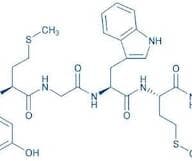
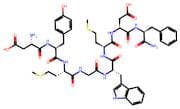
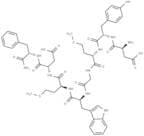
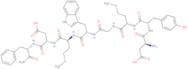
CAS 25679-24-7
:Cholecystokinin-Fragment 26-33 Amid*nicht sulfatierte
Beschreibung:
Das Fragment 26-33 der Cholecystokinin, nicht sulfatierte, ist ein Peptid, das aus dem größeren Cholecystokinin (CCK)-Molekül abgeleitet ist, das eine entscheidende Rolle bei der Verdauung und der Regulierung des Appetits spielt. Dieses spezifische Fragment besteht aus einer Aminosäuresequenz, die an der Stimulation der Kontraktion der Gallenblase und der Förderung der Freisetzung von Verdauungsenzymen aus der Bauchspeicheldrüse beteiligt ist. Die nicht sulfatierte Form zeigt an, dass es an Sulfatmodifikationen fehlt, die seine biologische Aktivität und Rezeptorinteraktionen beeinflussen können. Die CAS-Nummer 25679-24-7 identifiziert diese Verbindung eindeutig in chemischen Datenbanken und erleichtert deren Studium und Anwendung in der Forschung. Charakteristisch ist, dass dieses Peptid in Wasser löslich ist und bei nanomolaren Konzentrationen biologische Aktivität zeigt, was es in physiologischen Prozessen bedeutend macht. Seine Rolle im gastrointestinalen System und die potenziellen Implikationen in der Regulierung des Appetits und der Sättigung machen es zu einem interessanten Thema sowohl in der pharmakologischen als auch in der ernährungswissenschaftlichen Forschung. Das Verständnis seiner Struktur und Funktion kann Einblicke in therapeutische Ansätze für Verdauungsstörungen und das Management von Fettleibigkeit geben.
Formel:C49H62N10O13S2
InChl:InChI=1/C49H62N10O13S2/c1-73-18-16-34(55-47(70)37(21-28-12-14-30(60)15-13-28)58-44(67)32(50)23-41(62)63)45(68)53-26-40(61)54-38(22-29-25-52-33-11-7-6-10-31(29)33)48(71)56-35(17-19-74-2)46(69)59-39(24-42(64)65)49(72)57-36(43(51)66)20-27-8-4-3-5-9-27/h3-15,25,32,34-39,52,60H,16-24,26,50H2,1-2H3,(H2,51,66)(H,53,68)(H,54,61)(H,55,70)(H,56,71)(H,57,72)(H,58,67)(H,59,69)(H,62,63)(H,64,65)
SMILES:CSCCC(C(=NCC(=NC(Cc1c[nH]c2ccccc12)C(=NC(CCSC)C(=NC(CC(=O)O)C(=NC(Cc1ccccc1)C(=N)O)O)O)O)O)O)N=C(C(Cc1ccc(cc1)O)N=C(C(CC(=O)O)N)O)O
Synonyme:- Cholecystokinin Octapeptide (desulfated)
- H-Asp-Tyr-Met-Gly-Trp-Met-Asp-Phe-NH2
- N-[(2S)-2-hydrazino-3-phenylpropanoyl]-L-alpha-aspartyl-L-methionyl-L-tryptophylglycyl-N-[(1S,4S)-4-amino-5-carboxy-1-(4-hydroxybenzyl)-2,3-dioxopentyl]-L-methioninamide
- Alpha-Aspartyltyrosylmethionylglycyltryptophylmethionyl-Alpha-Aspartylphenylalaninamide
Sortieren nach
Reinheit (%)
0
100
|
0
|
50
|
90
|
95
|
100
6 Produkte.
Cholecystokinin Octapeptide (desulfated)
CAS:Bachem ID: 4003323.
Formel:C49H62N10O13S2Reinheit:98.1%Farbe und Form:White LyophilisateMolekulargewicht:1063.22Cholecystokinin Octapeptide, desulfated
CAS:Cholecystokinin Octapeptide, desulfatedReinheit:≥95%Molekulargewicht:1063.21g/molCholecystokinin Octapeptide, desulfated
CAS:Cholecystokinin Octapeptide, desulfated (CCK Octapeptide, non-sulfated) is an octapeptide composed of 8 amino acids from cholecystokinin-8.Formel:C49H62N10O13S2Reinheit:97.12%Farbe und Form:SolidMolekulargewicht:1063.21CCK octapeptide Cholecystokinin (26-33)
CAS:The octapeptide cholecystokinin (26-33), known as CCK-8, has the full biological activity of the full-length cholecystokinin (CCK). CCK acts as a hormone and neurotransmitter and is found in the GI and central nervous systems. CCK-8 is a satiety peptide that inhibits food intake.CCK-8 can also inhibit amanitin uptake into hepatocytes.Formel:C49H62N10O13S2Molekulargewicht:1,063.21 g/molCCK-Octapeptide (26-33) (Non-Sulfated Form)
CAS:CCK-Octapeptide (26-33) is a peptide that is a member of the cholecystokinin family of peptides. CCK-Octapeptide (26-33) is an activator of the CCK receptor and can be used for research purposes. This peptide has been shown to inhibit ion channels, which are proteins that regulate the flow of ions across cell membranes, and may be used as a pharmacological tool or research tool.
Formel:C49H62N10O13S2Reinheit:Min. 95%Molekulargewicht:1,063.2 g/molCholecystokinin Octapeptide (desulfated)
CAS:Cholecystokinin octapeptide (CCK-8) is a peptide hormone that is secreted from the pancreas. It is a conjugate of CCK and desulfated cholinesterase, which has been shown to have surfactant properties. The concentration-response curves for CCK-8 are biphasic, with an initial increase in contractility followed by a decrease. This response is caused by activation of both the B2 and B1 receptors in the paraventricular nucleus of the hypothalamus and subsequently release of pancreatic enzymes into the bloodstream. CCK-8 has also been shown to stimulate protein synthesis in gland cells such as those found in the pancreas.Formel:C49H62N10O13S2Reinheit:Min. 95%Molekulargewicht:1,063.21 g/mol