CAS 25694-72-8
:Lonicerin
Beschreibung:
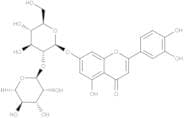
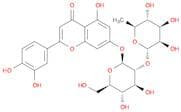
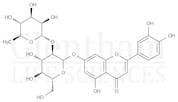
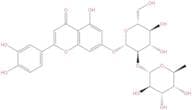
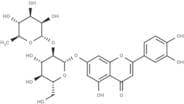
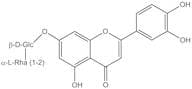
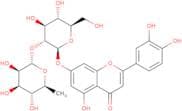
Lonicerin, mit der CAS-Nummer 25694-72-8, ist eine chemische Verbindung, die hauptsächlich aus der Pflanzen-Gattung Lonicera, allgemein bekannt als Geißblatt, abgeleitet ist. Es wird als Flavonoid-Glykosid klassifiziert, was bedeutet, dass es aus einem Flavonoid-Molekül besteht, das an ein Zuckermolekül gebunden ist. Lonicerin ist bekannt für seine potenziellen pharmakologischen Eigenschaften, einschließlich entzündungshemmender, antioxidativer und antimikrobieller Aktivitäten. Diese Eigenschaften machen es sowohl in der traditionellen Kräutermedizin als auch in der modernen Pharmakologie von Interesse. Die Verbindung wird typischerweise auf ihre Auswirkungen auf verschiedene biologische Systeme untersucht und kann zu den therapeutischen Vorteilen beitragen, die mit Geißblatt-Extrakten verbunden sind. Die Löslichkeit und Stabilität von Lonicerin können je nach Lösungsmittel und Umweltbedingungen variieren, was für seine Anwendung in Formulierungen wichtig ist. Während die Forschung fortschreitet, wird das gesamte Spektrum seiner biologischen Aktivitäten und potenziellen Anwendungen in Gesundheit und Medizin untersucht, was die Bedeutung natürlicher Produkte in der Arzneimittelentdeckung und -entwicklung hervorhebt.
Formel:C27H30O15
InChl:InChI=1S/C27H30O15/c1-9-20(33)22(35)24(37)26(38-9)42-25-23(36)21(34)18(8-28)41-27(25)39-11-5-14(31)19-15(32)7-16(40-17(19)6-11)10-2-3-12(29)13(30)4-10/h2-7,9,18,20-31,33-37H,8H2,1H3/t9-,18+,20-,21+,22+,23-,24+,25+,26-,27+/m0/s1
InChI Key:InChIKey=SHPPXMGVUDNKLV-KMFFXDMSSA-N
SMILES:O=C1C=2C(OC(=C1)C3=CC(O)=C(O)C=C3)=CC(O[C@H]4[C@H](O[C@H]5[C@H](O)[C@H](O)[C@@H](O)[C@H](C)O5)[C@@H](O)[C@H](O)[C@@H](CO)O4)=CC2O
Synonyme:- Lonicerin
- 7-[[2-O-(6-Deoxy-α-L-mannopyranosyl)-β-D-glucopyranosyl]oxy]-2-(3,4-dihydroxyphenyl)-5-hydroxy-4H-1-benzopyran-4-one
- 4H-1-Benzopyran-4-one, 7-[[2-O-(6-deoxy-α-L-mannopyranosyl)-β-D-glucopyranosyl]oxy]-2-(3,4-dihydroxyphenyl)-5-hydroxy-
- Glucopyranoside, luteolin-7 2-O-(6-deoxy-α-L-mannopyranosyl)-, β-D-
- Flavone, 3′,4′,5,7-tetrahydroxy-, 7-[2-O-(6-deoxy-α-L-mannopyranosyl)-β-D-glucopyranoside]
Sortieren nach
Reinheit (%)
0
100
|
0
|
50
|
90
|
95
|
100
8 Produkte.
Luteolin-7-O-neohesperidoside
CAS:Luteolin-7-O-neohesperidoside analytical standard provided with w/w absolute assay, to be used for quantitative titration.Formel:C27H30O15Reinheit:(HPLC) ≥98%Farbe und Form:PowderMolekulargewicht:594.537-[(2S,3R,4S,5S,6R)-4,5-dihydroxy-6-(hydroxymethyl)-3-[(2S,3R,4R,5R,6S)-3,4,5-trihydroxy-6-methyl-oxan-2-yl]oxy-oxan-2-yl]oxy-2-(3,4-dihydroxyphenyl)-5-hydroxy-chromen-4-one
CAS:Formel:C27H30O15Reinheit:99%Farbe und Form:SolidMolekulargewicht:594.5181Lonicerin
CAS:Lonicerin: antioxidant, anti-arthritic, antifungal; potential for combined fungal arthritis treatment from C. albicans.Formel:C27H30O15Reinheit:99.77% - 99.96%Farbe und Form:SolidMolekulargewicht:594.52Lonicerin
CAS:Natural glycosideFormel:C27H30O15Reinheit:≥ 95.0 % (HPLC)Farbe und Form:PowderMolekulargewicht:594.52Luteolin-7-O-neohesperidoside
CAS:Luteolin-7-O-neohesperidoside is a flavonoid glycoside, which is predominantly derived from various plant sources, particularly those belonging to the families Rosaceae and Lamiaceae. It is structurally characterized by the attachment of luteolin to a neohesperidose sugar moiety, which alters its solubility and bioavailability properties. The mode of action of Luteolin-7-O-neohesperidoside involves its capacity to act as a potent antioxidant, scavenging free radicals and protecting cells from oxidative stress. It also demonstrates anti-inflammatory properties by inhibiting key enzymes and signaling pathways involved in inflammatory responses.
Formel:C27H30O15Reinheit:Min. 95%Molekulargewicht:594.5 g/mol