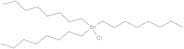
CAS 2587-76-0
:Trioctylzinnchlorid
Beschreibung:
Trioctylzinnchlorid, mit der CAS-Nummer 2587-76-0, ist eine Organotinverbindung, die durch ihre drei Octylgruppen, die an ein Zinnatom gebunden sind, sowie ein Chloridion gekennzeichnet ist. Sie erscheint als farblose bis blassgelbe Flüssigkeit und ist bekannt für ihre hydrophoben Eigenschaften, die sie in Wasser unlöslich, aber in organischen Lösungsmitteln löslich machen. Diese Verbindung wird hauptsächlich als Stabilisator in der PVC-Produktion und als Biozid in verschiedenen Anwendungen, einschließlich Antifouling-Farben und Holzschutzmitteln, verwendet. Trioctylzinnchlorid zeigt Toxizität, insbesondere gegenüber aquatischen Organismen, und wirft Umweltbedenken auf, da sie das Potenzial zur Bioakkumulation hat. Es ist wichtig, diese Substanz mit Vorsicht zu behandeln und geeignete Sicherheitsprotokolle zu befolgen, um die Exposition und die Umweltauswirkungen zu minimieren. Darüber hinaus ist ihre Verwendung in vielen Regionen aufgrund ihrer gefährlichen Natur reguliert, was die Einhaltung von Sicherheitsrichtlinien und -vorschriften in industriellen Anwendungen erforderlich macht.
Formel:C24H51ClSn
InChl:InChI=1S/3C8H17.ClH.Sn/c3*1-3-5-7-8-6-4-2;;/h3*1,3-8H2,2H3;1H;/q;;;;+1/p-1
InChI Key:InChIKey=MCNGJXAXOJDJKO-UHFFFAOYSA-M
SMILES:[Sn](CCCCCCCC)(CCCCCCCC)(CCCCCCCC)Cl
Synonyme:- Chloro(Trioctyl)Stannane
- Chlorotrioctylstannane
- Chlorotrioctyltin
- NSC 65479
- Stannane, chlorotrioctyl-
- Tin, chlorotrioctyl-
- Tri-n-octyltin chloride
- Trioctylchlorostannane
- Trioctyltin chloride
Sortieren nach
Reinheit (%)
0
100
|
0
|
50
|
90
|
95
|
100
4 Produkte.
Trioctyltin chloride 1000 µg/mL in Methanol
CAS:Kontrolliertes ProduktFormel:C24H51ClSnFarbe und Form:ColourlessMolekulargewicht:493.82Trioctyltin chloride
CAS:Kontrolliertes ProduktFormel:C24H51ClSnFarbe und Form:NeatMolekulargewicht:493.82Tri-n-octylchlorotin
CAS:Kontrolliertes ProduktStability Moisture Sensitive
Applications Tri-n-octylchlorotin is an octyltin compound used to study the growth and fatty acid of the microscopic fungus Cochliobolus lunatus. It is also an organotin reagents used to covalently functionalize oxide nanostructures and multi-walled C nanotubes.
Not a dangerous good if item is equal to or less than 1g/ml and there is less than 100g/ml in the package
References Felczak, A., et al.: Process Biochem., 49, 295-300 (2014); Gomathi, A., et al.: J. Mater. Chem., 19, 988-995 (2009);Formel:C24H51ClSnFarbe und Form:NeatMolekulargewicht:493.82Trioctyltin chloride
CAS:Trioctyltin chloride is a polymer that is synthesized by the reaction of two equivalents of tributyltin chloride with fatty acids. Trioctyltin chloride is reactive and can be extracted from a variety of sources using a variety of solvents. It has been used to extract chloride ions from mesenchymal stromal cells, which are cells that are involved in tissue repair. The trioctyltin chloride polymer can be used as an analytical method for 3β-hydroxysteroid dehydrogenase, which catalyzes the conversion of 3β-hydroxysteroids into 3-keto steroids. This reaction is reversible and it produces hydrogen ions as a product. The hydrogen ions cause the polymer to undergo ring-opening reactions, leading to the formation of polymeric matrixes on solid surfaces. These matrices have been used in membrane systems as well as in microextraction experiments for solid phase extraction with gas chromatography (SPE).Formel:C24H51ClSnReinheit:Min. 95%Molekulargewicht:493.82 g/mol