CAS 26034-16-2
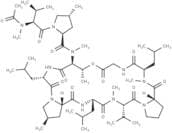
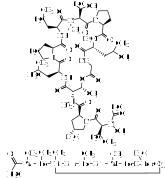
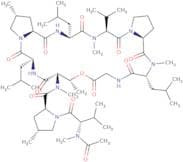
:N-acetyl-N-methylvalyl-N,4-dimethyl-N-[2,10,17,25-tetramethyl-6,16,27-tris(2-methylpropyl)-5,8,12,15,18,23,26,29-octaoxo-24-(propan-2-yl)hexacosahydro-1H,12H-dipyrrolo[2,1-i:2',1'-r][1,4,7,10,13,16,19,22]oxaheptaazacyclopentacosin-9-yl]prolinamid
Beschreibung:
N-acetyl-N-methylvalyl-N,4-dimethyl-N-[2,10,17,25-tetramethyl-6,16,27-tris(2-methylpropyl)-5,8,12,15,18,23,26,29-octaoxo-24-(propan-2-yl)hexacosahydro-1H,12H-dipyrrolo[2,1-i:2',1'-r][1,4,7,10,13,16,19,22]oxaheptaazacyclopentacosin-9-yl]prolinamid, mit der CAS-Nummer 26034-16-2, ist eine komplexe organische Verbindung, die durch ihre komplizierte molekulare Struktur gekennzeichnet ist, die mehrere funktionelle Gruppen und eine große Anzahl von Kohlenstoffatomen umfasst. Diese Substanz weist eine Kombination aus Amid- und Acetylgruppen auf, die zu ihrer potenziellen biologischen Aktivität beiträgt. Das Vorhandensein mehrerer Methyl- und Propylgruppen deutet auf einen gewissen Grad an Hydrophobizität hin, was ihre Löslichkeit und Wechselwirkung mit biologischen Membranen beeinflussen kann. Das umfangreiche zyklische und polyzyklische Gerüst der Verbindung weist auf ein Potenzial für einzigartige konformationale Eigenschaften hin, die ihre Reaktivität und Stabilität beeinflussen könnten. Solche komplexen Moleküle werden oft auf ihre potenziellen Anwendungen in der Pharmazie, Materialwissenschaft oder als Katalysatoren untersucht, obwohl spezifische Anwendungen von weiteren Forschungen zu ihren Eigenschaften und ihrem Verhalten in verschiedenen Umgebungen abhängen würden.
Formel:C57H96N10O12
InChl:InChI=1/C57H96N10O12/c1-19-34(10)43-54(75)62(16)46(31(6)7)56(77)65-24-22-23-39(65)52(73)63(17)47(36(12)21-3)50(71)58-27-42(69)79-37(13)48(51(72)60-44(35(11)20-2)55(76)66-28-32(8)25-40(66)49(70)59-43)64(18)53(74)41-26-33(9)29-67(41)57(78)45(30(4)5)61(15)38(14)68/h30-37,39-41,43-48H,19-29H2,1-18H3,(H,58,71)(H,59,70)(H,60,72)/t32-,33-,34?,35?,36?,37-,39?,40?,41?,43+,44+,45+,46+,47-,48-/m1/s1
Sortieren nach
Reinheit (%)
0
100
|
0
|
50
|
90
|
95
|
100
3 Produkte.
Griselimycin
CAS:Griselimycin is a natural antimycobacterial product that is currently being pursued as a therapy for tuberculosis.Formel:C57H96N10O12Reinheit:98%Farbe und Form:SolidMolekulargewicht:1113.453Griselimycin
CAS:<p>Griselimycin is an antibiotic, which is derived from the bacterial genus *Streptomyces*. This compound exhibits its mode of action by targeting bacterial protein synthesis, specifically binding to the DNA polymerase sliding clamp, thereby inhibiting replication and cell division in a range of bacterial pathogens. Griselimycin has been the focus of renewed scientific interest due to its potent activity against Mycobacterium tuberculosis, including multi-drug-resistant strains. The compound’s unique mode of action makes it a promising candidate for further development in the treatment of tuberculosis and potentially other bacterial infections that have developed resistance to more commonly used antibiotics. Advances in understanding its biosynthesis have facilitated semi-synthetic modifications, potentially enhancing its pharmacokinetic properties and antimicrobial spectrum. The applications of Griselimycin extend to research contexts where understanding resistance mechanisms and novel antibiotic development are critical. Continued exploration of this compound may contribute significantly to addressing the global challenge of antibiotic resistance.</p>Formel:C57H96N10O12Reinheit:Min. 95%Molekulargewicht:1112.72092