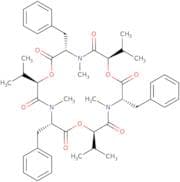
CAS 26048-05-5
:Beauvericin
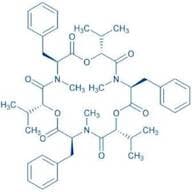
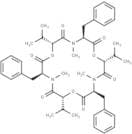
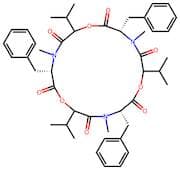
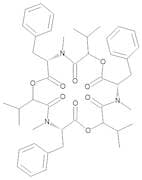
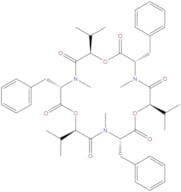
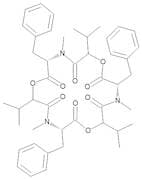
- Cyclo(-D-.alpha.-hydroxyisovaleryl-N-Me-Phe)3
- (3S,6R,9S,12R,15S,18R)-3,9,15-tribenzyl-4,10,16-trimethyl-6,12,18-tris(1-methylethyl)-1,7,13-trioxa-4,10,16-triazacyclooctadecane-2,5,8,11,14,17-hexone
Beauvericin
CAS:Beauvericin is a member of the enniatin family of antibiotics. Activity against Gram-positive bacteria and mycobacteria has been demonstrated. The cyclic depsipeptide forms complexes with alkali metal and alkaline earth metal ions. Additionally, beauvericin was reported to be toxic to brine shrimps and mosquito larvae.Formel:C45H57N3O9Reinheit:99.5%Farbe und Form:WhiteMolekulargewicht:783.96CYCLO[(2R)-2-HYDROXY-3-METHYLBUTANOYL-N-METHYL-L-PHENYLALANYL-(2R)-2-HYDROXY-3-METHYLBUTANOYL-N-METHYL-L-PHENYLALANYL-(2R)-2-HYDROXY-3-METHYLBUTANOYL-N-METHYL-L-PHENYLALANYL]
CAS:Formel:C45H57N3O9Reinheit:95%Farbe und Form:SolidMolekulargewicht:783.9488Beauvericin
CAS:Beauvericin, a Fusarium mycotoxin, inhibits acyl-CoA:cholesterol acyltransferase (ACAT) in rat liver microsomal enzyme assays with an IC50 value of 3 μM.Formel:C45H57N3O9Reinheit:≥98%Farbe und Form:SolidMolekulargewicht:783.95Beauvericin
CAS:BeauvericinFormel:C45H57N3O9Reinheit:97%Farbe und Form: white powderMolekulargewicht:783.95g/molBeauvericin
CAS:Formel:C45H57N3O9Reinheit:≥ 97.0%Farbe und Form:White to off-white powderMolekulargewicht:783.96Beauvericin
CAS:Applications Beauvericin is a toxic depsipeptide with antibiotic and insecticidal effects.
References Lee, H., et al.: J. Microbiol., Biotechnol., 18, 138 (2008), Moretti, A., et al.: Int. J. Food Microbiol., 127, 312 (2008), Jestoi, M., et al.: Food Chem., 115, 1120 (2009), Santini, A., et al.: Anal. Bioanal. Chem., 395, 1253 (2009),Formel:C45H57N3O9Farbe und Form:Off White CrystallineMolekulargewicht:783.95Beauvericin
CAS:Beauvericin is a cyclic peptide that is isolated from the fungus Fusarium. It has been shown to have antimicrobial activity against bacteria, as well as a variety of other biological properties. Beauvericin has been shown to inhibit mitochondrial membrane potential and induce toxicity in some animal models. Beauvericin also inhibits protein synthesis and causes cell death by inhibiting DNA polymerase activity. This compound is active against cancer cells, including HL-60 cells, which are derived from human lymphocytes and are used as a model for leukemia. Beauvericin can be extracted from an ETOA extract of the fungus Fusarium oxysporum; this extract has shown anti-cancer effects in vitro assays.
Formel:C45H57N3O9Reinheit:Min. 95%Molekulargewicht:783.95 g/mol