CAS 261521-21-5
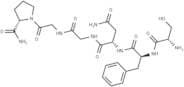
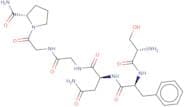
:L-Prolinamid, L-seryl-L-phenylalanyl-L-asparaginylglycylglycyl- (9CI)
Beschreibung:
L-Prolinamid, L-Serin-L-Phenylalanin-L-Asparaginylglycylglycyl (9CI) ist ein synthetisches Peptid, das aus einer Sequenz von Aminosäuren besteht, nämlich Prolin, Serin, Phenylalanin, Asparagin und Glycin. Diese Verbindung ist durch ihre strukturelle Komplexität gekennzeichnet, die zu ihrer potenziellen biologischen Aktivität beiträgt. Peptide wie dieses zeigen oft Eigenschaften wie Wasserlöslichkeit, abhängig von der spezifischen Aminosäurezusammensetzung und -sequenz. Das Vorhandensein verschiedener funktioneller Gruppen, wie Amide und Hydroxyle, kann seine Reaktivität und Wechselwirkungen mit anderen Molekülen beeinflussen. Darüber hinaus spielt die Stereochemie der Aminosäuren eine entscheidende Rolle bei der Bestimmung der Konformation des Peptids und damit seiner biologischen Funktion. L-Prolinamid, L-Serin-L-Phenylalanin-L-Asparaginylglycylglycyl könnte von Interesse in der Forschung im Zusammenhang mit Biochemie, Pharmakologie und Molekularbiologie sein, insbesondere in Studien zur Peptidsynthese, Proteininteraktionen und therapeutischen Anwendungen. Spezifische Anwendungen und biologische Effekte würden jedoch weitere Untersuchungen und Kontext erfordern.
Formel:C25H36N8O8
Synonyme:- Coagulation Factor Ii Receptor-Like 2 (1-6) Amide (Mouse)
- H-Ser-Phe-Asn-Gly-Gly-Pro-Nh2
- Par-3 (1-6) Amide (Mouse)
- Proteinase Activated Receptor 3 (1-6) Amide (Mouse)
- Thrombin Receptor-Like 2 (1-6) Amide (Mouse)
- Sfnggpamide
Sortieren nach
Reinheit (%)
0
100
|
0
|
50
|
90
|
95
|
100
3 Produkte.
SFNGGP-NH2
CAS:SFNGGP-NH2 is a biologically active peptide that interacts with Protease-Activated Receptor 3 (PAR-3), a high-affinity thrombin receptor.Formel:C25H36N8O8Farbe und Form:SolidMolekulargewicht:576.6H-Ser-Phe-Asn-Gly-Gly-Pro-NH2
CAS:H-Ser-Phe-Asn-Gly-Gly-Pro-NH2 is a peptide that activates Protease Activated Receptor 1 (PAR1) and Protease Activated Receptor 3 (PAR3). It also has been shown to decrease blood pressure in mice, inhibit coagulation, and increase the breakdown of fibrin clots. This product is a ligand for PAR1 and PAR3. It has been shown to activate these receptors by binding to them through its amino acid sequence. HSPNP binds to proteases that cleave the peptide from the receptor, which leads to activation of the receptor. HSPNP can also bind to PAR3 and PAR4.Formel:C25H36N8O8Reinheit:Min. 95%Molekulargewicht:576.61 g/molPAR-3 (1-6) amide (mouse) trifluoroacetate salt
CAS:Please enquire for more information about PAR-3 (1-6) amide (mouse) trifluoroacetate salt including the price, delivery time and more detailed product information at the technical inquiry form on this pageFormel:C25H36N8O8Reinheit:Min. 95%Molekulargewicht:576.6 g/mol