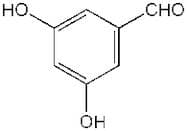
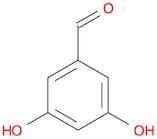
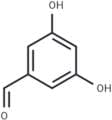
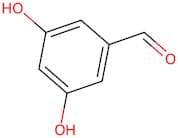
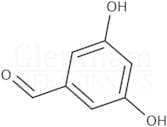
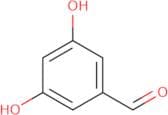
CAS 26153-38-8
:3,5-Dihydroxybenzaldehyd
- 3,5-Dihydroxybenzaldehyde
- Benzaldehyde, 3,5-dihydroxy-
- α-Resorcylaldehyde
3,5-Dihydroxybenzaldehyde, 98%
CAS:3,5-Dihydroxybenzaldehyde is used as a building block in the synthesis of more complex structures. It is also used in the synthesis of terbutaline (T109750), which is an important bronchodilator. This Thermo Scientific Chemicals brand product was originally part of the Alfa Aesar product portfolio.Formel:C7H6O3Reinheit:98%Farbe und Form:White to cream, Crystals or powder or crystalline powderMolekulargewicht:138.12Benzaldehyde, 3,5-dihydroxy-
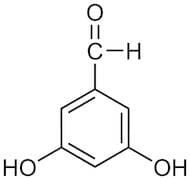
CAS:Formel:C7H6O3Reinheit:98%Farbe und Form:SolidMolekulargewicht:138.12073,5-Dihydroxybenzaldehyde
CAS:3,5-Dihydroxybenzaldehyde helps synthesize antileishmanial 2,4-dimethylbenzoylhydrazones with antioxidant properties.Formel:C7H6O3Farbe und Form:White To Tan To Grey Crystalline PowderMolekulargewicht:138.123,5-Dihydroxybenzaldehyde
CAS:3,5-DihydroxybenzaldehydeFormel:C7H6O3Reinheit:≥95%Farbe und Form: dark brown powderMolekulargewicht:138.12g/mol3,5-Dihydroxybenzaldehyde
CAS:Formel:C7H6O3Reinheit:>95.0%(GC)(T)Farbe und Form:White to Almost white powder to crystalMolekulargewicht:138.123,5-Dihydroxybenzaldehyde
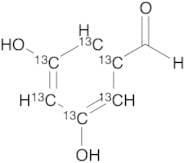
CAS:Formel:C7H6O3Reinheit:97%Farbe und Form:Solid, Light brown solidMolekulargewicht:138.1223,5-Dihydroxybenzaldehyde-13C6
CAS:Kontrolliertes ProduktFormel:C6CH6O3Farbe und Form:NeatMolekulargewicht:144.0773,5-Dihydroxybenzaldehyde
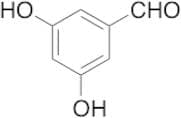
CAS:Applications 3,5-Dihydroxybenzaldehyde, is a benzaldehyde derivative, that can be used as a building block in the synthesis of more complex structures. It is used in the synthesis of Terbutaline (T109750), which is an important bronchodilator.
References Effenberger, F. et al.: J. Org. Chem., 62, 3867 (1997);Formel:C7H6O3Farbe und Form:NeatMolekulargewicht:138.123,5-Dihydroxybenzaldehyde
CAS:3,5-Dihydroxybenzaldehyde (DHBA) is a plant metabolite that is classified as a phenolic compound. It is found in many plants and has important biological functions such as the production of carotenoids or the cleavage of carotenoid to form other compounds. DHBA can be extracted from plant tissue with hydrochloric acid or carbon sources. It has been shown that DHBA inhibits the growth of soil bacteria by binding to amines and thus preventing them from reacting with substrates. This may be due to its ability to act as an electron donor, which could also explain its inhibitory activity on carotenoid cleavage.
Formel:C7H6O3Reinheit:Min. 98 Area-%Farbe und Form:Off-White To Beige To Brown SolidMolekulargewicht:138.12 g/mol