CAS 26271-50-1
:2,2-bis(chlormethyl)-1,3-dioxolan
Beschreibung:
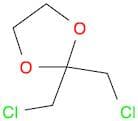
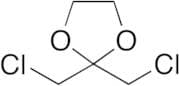
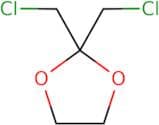
2,2-bis(chlormethyl)-1,3-dioxolan, mit der CAS-Nummer 26271-50-1, ist eine chemische Verbindung, die durch ihre Dioxolan-Ringstruktur gekennzeichnet ist, die zwei Chloromethylgruppen enthält, die an die Kohlenstoffatome des Rings gebunden sind. Diese Verbindung ist typischerweise eine farblose bis blassgelbe Flüssigkeit und ist bekannt für ihre Reaktivität aufgrund der Anwesenheit der Chloromethylgruppen, die an verschiedenen chemischen Reaktionen, einschließlich nucleophiler Substitution, teilnehmen können. Sie wird häufig als Zwischenprodukt in der organischen Synthese verwendet, insbesondere bei der Herstellung von Polymeren und anderen komplexen organischen Molekülen. Die Anwesenheit der Dioxolan-Einheit trägt zu ihrer Stabilität und Löslichkeit in organischen Lösungsmitteln bei. Aufgrund der Chloromethylgruppen kann sie jedoch bestimmte Gefahren darstellen, einschließlich potenzieller Toxizität und Reaktivität, was eine sorgfältige Handhabung und Lagerung erforderlich macht. Wie bei vielen chlorierten Verbindungen ist es ratsam, Umwelt- und Sicherheitsvorschriften zu berücksichtigen, wenn man mit dieser Substanz arbeitet.
Formel:C5H8Cl2O2
InChl:InChI=1/C5H8Cl2O2/c6-3-5(4-7)8-1-2-9-5/h1-4H2
SMILES:C1COC(CCl)(CCl)O1
Synonyme:- 1,3-Dioxolane, 2,2-Bis(Chloromethyl)-
- 2,2-Bis(chloromethyl)-1,3-dioxolane
Sortieren nach
Reinheit (%)
0
100
|
0
|
50
|
90
|
95
|
100
3 Produkte.
2,2-Bis(chloromethyl)-1,3-dioxolane
CAS:Formel:C5H8Cl2O2Farbe und Form:LiquidMolekulargewicht:171.02181,3-Dichloroacetone Ethylene Ketal
CAS:Kontrolliertes Produkt<p>Applications 1,3-Dichloroacetone Ethylene Ketal (cas# 26271-50-1) is a compound useful in organic synthesis.<br></p>Formel:C5H8Cl2O2Farbe und Form:NeatMolekulargewicht:171.022,2-Bis(chloromethyl)-1,3-dioxolane
CAS:<p>2,2-Bis(chloromethyl)-1,3-dioxolane is a chemical intermediate that can be used in the production of polyester resins. It is a colorless liquid with an unpleasant odor. 2,2-Bis(chloromethyl)-1,3-dioxolane reacts with ethylene and glycol to produce polyester resins. This reaction occurs at high temperatures and produces a mixture of products such as diols and triols. When heated in acidic conditions, the compound hydrolyzes to form dihydroxyacetone and p-toluenesulfonic acid. The compound is also used as an industrial solvent for acidic materials. Recrystallizing the product from ethylene glycol results in a white crystalline powder that can be used in the manufacture of other chemicals such as sulfate salts.</p>Formel:C5H8Cl2O2Reinheit:Min. 95%Molekulargewicht:171.02 g/mol