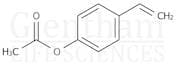
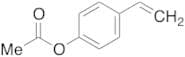
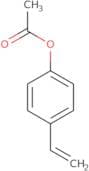
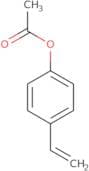
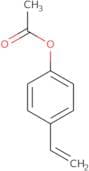
CAS 2628-16-2
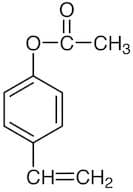
:4-Acetoxystyrol
- 4-Acetoxy-1-ethenylbenzene
- 4-Acetoxystyrene
- 4-Ethenyl-Phenoacetate
- 4-Ethenylphenol acetate
- 4-Ethenylphenyl Acetate
- 4-Vinylphenyl acetate
- Acetic acid 4-vinylphenyl ester
- Phenol, 4-ethenyl-, 1-acetate
- Phenol, 4-ethenyl-, acetate
- Phenol, p-vinyl-, acetate
- p-Acetoxystyrene
- p-Vinyl Phenyl Acetate
- VPAC
- Weitere Synonyme anzeigen
4-Vinylphenyl Acetate (stabilized with TBC)
CAS:Formel:C10H10O2Reinheit:>98.0%(GC)Farbe und Form:Colorless to Light yellow to Light orange clear liquidMolekulargewicht:162.194-Acetoxystyrene, 95%, stab.
CAS:This Thermo Scientific Chemicals brand product was originally part of the Alfa Aesar product portfolio. Some documentation and label information may refer to the legacy brand. The original Alfa Aesar product / item code or SKU reference has not changed as a part of the brand transition to Thermo SciFormel:C10H10O2Reinheit:95%Farbe und Form:Liquid, Clear, colorless to pale yellowMolekulargewicht:162.19Phenol, 4-ethenyl-, 1-acetate
CAS:Formel:C10H10O2Reinheit:97%Farbe und Form:LiquidMolekulargewicht:162.18524-Acetoxystyrene
CAS:Kontrolliertes ProduktApplications 4-Acetoxystyrene is a reagent that is used in the synthesis of trans-Resveratrol 3-O-β-D-Glucuronide (R150015), which is a metabolite of trans Resveratrol (R150000).
References Schroder, H., et al.: Clin. Nutr., 20, 429 (2001), Yu, C., et al.: Pharm. Res., 19, 1907 (2002), Rimando, A., et al.: J. Agric. Food Chem., 52, 4713 (2004), Walle, T., et al.: Drug Metab. Dispos., 32, 1377 (2004), Ito, H., et al.: Br. J. Nutr., 94, 500 (2005),Formel:C10H10O2Farbe und Form:NeatMolekulargewicht:162.194-Acetoxystyrene - Stabilized with MEHQ
CAS:4-Acetoxystyrene - Stabilized with MEHQ is a chemical with the molecular formula (C8H6O2). The compound is a low melting solid that has been shown to be resistant to hydrogen fluoride, hydrochloric acid, and fatty acids. It also has anion radical scavenging properties and can be used as a particle in kinetic experiments. 4-Acetoxystyrene - Stabilized with MEHQ is often used as a stabilizer for polyvinyl chloride because it resists oxidation. The compound can also be polymerized cationically with divinylbenzene.
Formel:C10H10O2Reinheit:Min. 95%Farbe und Form:Colorless Clear LiquidMolekulargewicht:162.19 g/mol4-Acetoxystyrene Stabilized with TB
CAS:Stabilised with TBFormel:C10H10O2Molekulargewicht:162.19 g/mol4-Acetoxystyrene, stabilized with TBC
CAS:4-Acetoxystyrene is a monomer that belongs to the group of hydroxylated styrenes. It is stabilized with TBC, which protects the hydroxyl group from reactive substances such as hydrogen fluoride and hydrochloric acid. 4-Acetoxystyrene has a phase transition temperature of 130°C, high resistance to oxidation and reduction, and a high affinity for metal hydroxides. The molecule has been shown to scavenge anion radicals in the presence of hydrogen fluoride or hydrochloric acid and can be used as a hydrogenation catalyst in the palladium-catalyzed coupling reaction. It also has polymerization properties and copolymerizes with malonic acid to produce polyester resins. 4-Acetoxystyrene is also used in electrochemical impedance spectroscopy (EIS) studies, where it acts as an effective solvent for fatty acids.Formel:C10H10O2Reinheit:Min. 98 Area-%Farbe und Form:Colorless Clear LiquidMolekulargewicht:162.19 g/mol4-Acetoxystyrene (stabilized with TBC)
CAS:Formel:C10H10O2Reinheit:97% (stabilized with TBC)Farbe und Form:Clear LiquidMolekulargewicht:162.188