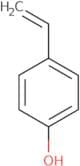
CAS 2628-17-3
:4-Vinylphenol
Beschreibung:
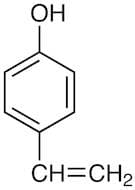
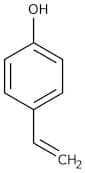
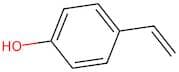
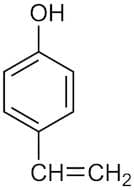
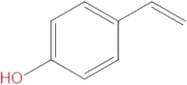
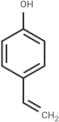
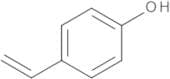
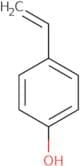
4-Vinylphenol, auch bekannt als p-Vinylphenol, ist eine organische Verbindung, die durch eine phenolische Struktur mit einer an die para-Position des aromatischen Rings gebundenen Vinylgruppe gekennzeichnet ist. Seine chemische Formel ist C8H8O und es weist eine Hydroxylgruppe (-OH) auf, die typische phenolische Eigenschaften wie Reaktivität und die Fähigkeit zur Bildung von Wasserstoffbrücken verleiht. Diese Verbindung ist bei Raumtemperatur eine farblose bis hellgelbe Flüssigkeit und hat einen charakteristischen Geruch. 4-Vinylphenol ist in organischen Lösungsmitteln löslich und zeigt eine moderate Löslichkeit in Wasser. Es wird hauptsächlich in der Herstellung von Polymeren und Harzen verwendet, insbesondere bei der Synthese von phenolischen Harzen und als Monomer in verschiedenen Copolymer-Anwendungen. Darüber hinaus kann es als Zwischenprodukt in der organischen Synthese dienen und hat potenzielle Anwendungen im Bereich der Materialwissenschaften. Aufgrund seiner reaktiven Vinylgruppe kann 4-Vinylphenol Polymerisation und andere chemische Reaktionen durchlaufen, was es zu einer wertvollen Verbindung in verschiedenen industriellen Prozessen macht. Sicherheitsvorkehrungen sollten beim Umgang mit dieser Substanz getroffen werden, da sie Haut- und Augenreizungen verursachen kann.
Formel:C8H8O
InChl:InChI=1S/C8H8O/c1-2-7-3-5-8(9)6-4-7/h2-6,9H,1H2
InChI Key:InChIKey=FUGYGGDSWSUORM-UHFFFAOYSA-N
SMILES:C(=C)C1=CC=C(O)C=C1
Synonyme:- 4-Ethenylphenol
- 4-Hydroxystyrene
- P-Vinilfenol
- Phenol, 4-ethenyl
- Phenol, p-vinyl-
- p-Hydroxystyrene
- p-Oxystyrene
- p-Vinylphenol
Sortieren nach
Reinheit (%)
0
100
|
0
|
50
|
90
|
95
|
100
12 Produkte.
4-Vinylphenol (ca. 10% in Propylene Glycol)
CAS:Formel:C8H8OFarbe und Form:Light yellow to Yellow to Orange clear liquidMolekulargewicht:120.154-Vinylphenol, min 10% soln. in propylene glycol
CAS:4-Vinylphenol acts as a monomer and used in the preparation of poly-4-vinylphenol polymer, which is used in electronics as a dielectric layer in organic transistors in organic thin-film-transistor liquid-crystal displays (TFT LCD). It is a phenolic compound and presents in wine and beer. This Therm
Formel:C8H8OFarbe und Form:Liquid, Clear colorless to yellow or orangeMolekulargewicht:120.154-Vinylphenol
CAS:Formel:C8H8OReinheit:>98.0%(GC)Farbe und Form:White to Light yellow powder to crystalMolekulargewicht:120.154-Vinylphenol
CAS:4-Vinylphenol, a metabolite from lactic acid bacteria in wine, induces apoptosis. Found in Hedyotis diffusa Willd.Formel:C8H8OReinheit:97.07%Farbe und Form:SolidMolekulargewicht:120.154-Vinylphenol, 10 wt.% In Propylene Glycol
CAS:Applications 4-Vinylphenol, 10 wt.% In propylene glycol (cas# 2628-17-3) is a useful research chemical.
Formel:C8H8OFarbe und Form:Single SolutionMolekulargewicht:120.144-Vinylphenol, 10 wt % in propylene glycol
CAS:4-Vinylphenol is a chemical compound that has the molecular formula CH2=CHC6H4OH. It is a hydroxyl derivative of phenol and has the chemical structure of a phenolic acid. This compound is used in the laboratory to study the effects of cationic polymerization on surface methodology and activation energies. 4-Vinylphenol inhibits Saccharomyces cerevisiae strain, which is commonly found in urine samples as well as in recombinant cells, by inhibiting cell growth and reducing ATP production. The inhibition of Saccharomyces cerevisiae strain by 4-vinylphenol can be reversed with p-hydroxybenzoic acid or cationic polymerization. The molecule also contains two nitrogen atoms that can form hydrogen bonds with other molecules, such as water molecules. It is possible that these hydrogen bonds are what allow 4-vinylphenol to inhibit Saccharomyces cerevisiae strain, although this hypothesis hasFormel:C8H8OReinheit:Min. 95 Area-%Farbe und Form:Colorless Clear LiquidMolekulargewicht:120.15 g/mol4-Vinylphenol
CAS:4-Vinylphenol is a phenolic compound that is used as an industrial chemical. It has been shown to inhibit the growth of bacteria in nonpolar solvents, including aerobacter aerogenes and Saccharomyces cerevisiae. 4-Vinylphenol inhibits bacterial growth through its ability to disrupt the hydrogen bonds between proteins and nucleic acids. This results in increased hydroxyl groups on the protein surface and cationic polymerization of the DNA gyrase enzyme, which disrupts its function. 4-Vinylphenol has also been shown to activate mouse CD-1 cells by increasing their sensitivity to chemical inhibitors, such as ethidium bromide or 2',7'-dichlorofluorescin diacetate (DCFH2DA).Formel:C8H8OReinheit:Min. 95%Farbe und Form:LiquidMolekulargewicht:120.15 g/mol4-Vinylphenol 10% solution in Propylene glycol
CAS:Formel:C8H8OReinheit:95.0%Farbe und Form:SolidMolekulargewicht:120.151