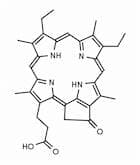
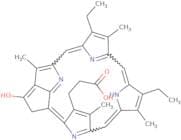
CAS 26359-43-3
:3-(9,14-diethyl-4,8,13,18-tetramethyl-20-oxo-3,4-didehydro-24,25-dihydrophorbin-3-yl)propansäure
Beschreibung:
Die chemische Substanz, die als 3-(9,14-diethyl-4,8,13,18-tetramethyl-20-oxo-3,4-didehydro-24,25-dihydrophorbin-3-yl)propansäure bekannt ist, mit der CAS-Nummer 26359-43-3, ist eine komplexe organische Verbindung, die zur Klasse der Porphyrin-Derivate gehört. Sie weist eine porphyrinähnliche Struktur auf, die durch eine makrocyclische Anordnung von Kohlenstoff- und Stickstoffatomen gekennzeichnet ist, was typisch für Verbindungen ist, die an biologischen Prozessen wie Photosynthese und Atmung beteiligt sind. Das Vorhandensein mehrerer Ethyl- und Methylsubstituenten trägt zu ihrer hydrophoben Natur bei, während die Carbonsäurefunktion einige polare Eigenschaften verleiht, die eine potenzielle Löslichkeit in polaren Lösungsmitteln ermöglichen. Diese Verbindung kann aufgrund ihres konjugierten Systems interessante optische Eigenschaften aufweisen, das Licht im sichtbaren Spektrum absorbieren kann. Darüber hinaus deutet ihre strukturelle Komplexität auf potenzielle Anwendungen in Bereichen wie Biochemie, Materialwissenschaften oder als Farbstoff hin. Spezifische Reaktivität, Stabilität und biologische Aktivität würden jedoch weitere Untersuchungen durch experimentelle Studien erfordern.
Formel:C33H34N4O3
InChl:InChI=1/C33H34N4O3/c1-7-19-15(3)23-12-25-17(5)21(9-10-30(39)40)32(36-25)22-11-29(38)31-18(6)26(37-33(22)31)14-28-20(8-2)16(4)24(35-28)13-27(19)34-23/h12-14,34-35H,7-11H2,1-6H3,(H,39,40)/b23-12-,24-13-,25-12-,26-14-,27-13-,28-14-,32-22-
Sortieren nach
Reinheit (%)
0
100
|
0
|
50
|
90
|
95
|
100
2 Produkte.
Phylloerythrin
CAS:Phylloerythrin is a photodynamic agent that originates from the breakdown of chlorophyll, primarily occurring in the digestive systems of herbivores. It is produced when chlorophyll is metabolized by gut microorganisms, leading to the formation of phylloerythrin, which is then absorbed into the bloodstream. Phylloerythrin is typically excreted by the liver into the bile; however, if liver function is compromised or overwhelmed, it can accumulate in the bloodstream.
Formel:C33H34N4O3Reinheit:Min. 95%Molekulargewicht:534.6 g/mol