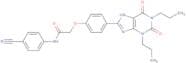
CAS 264622-58-4
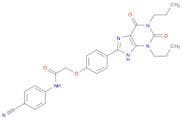
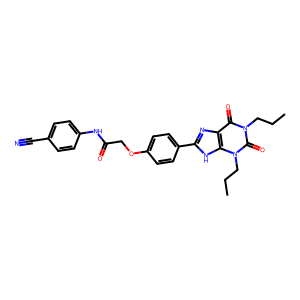
:N-(4-Cyanophenyl)-2-[4-(2,6-dioxo-1,3-dipropyl-2,3,6,7-tetrahydro-1H-purin-8-yl)phenoxy]acetamid
Beschreibung:
N-(4-Cyanophenyl)-2-[4-(2,6-dioxo-1,3-dipropyl-2,3,6,7-tetrahydro-1H-purin-8-yl)phenoxy]acetamid, mit der CAS-Nummer 264622-58-4, ist eine synthetische organische Verbindung, die durch ihre komplexe Struktur gekennzeichnet ist, die eine Cyanophenylgruppe und eine Phenoxyacetamid-Einheit umfasst. Diese Verbindung weist ein Purinderivat auf, das zu ihrer biologischen Aktivität beiträgt und potenziell ihre Wechselwirkung mit verschiedenen biologischen Zielen beeinflusst. Das Vorhandensein der Dioxogruppe deutet darauf hin, dass sie unter bestimmten Bedingungen eine signifikante Reaktivität und Stabilität aufweisen könnte. Ihre molekulare Struktur weist auf potenzielle Anwendungen in der medizinischen Chemie hin, insbesondere bei der Entwicklung von Arzneimitteln, die auf spezifische Wege oder Krankheiten abzielen. Die Löslichkeit, Stabilität und Reaktivität der Verbindung können je nach Umweltbedingungen wie pH und Temperatur variieren. Darüber hinaus müssten ihre pharmakologischen Eigenschaften durch experimentelle Studien bewertet werden, um ihre Wirksamkeit und Sicherheitsprofil in biologischen Systemen zu bestimmen. Insgesamt stellt diese Verbindung eine Klasse von Molekülen dar, die vielversprechende therapeutische Anwendungen, insbesondere im Bereich des gezielten Arzneimitteldesigns, bieten könnte.
Formel:C26H26N6O4
Synonyme:- Mrs-1754
Sortieren nach
Reinheit (%)
0
100
|
0
|
50
|
90
|
95
|
100
5 Produkte.
Acetamide, N-(4-cyanophenyl)-2-[4-(2,3,6,9-tetrahydro-2,6-dioxo-1,3-dipropyl-1H-purin-8-yl)phenoxy]-
CAS:Formel:C26H26N6O4Reinheit:98%Farbe und Form:SolidMolekulargewicht:486.5224N-(4-cyanophenyl)-2-[4-(2,6-dioxo-1,3-dipropyl-2,3,6,7-tetrahydro-1H-purin-8-yl)phenoxy]acetamide
CAS:Reinheit:98%Molekulargewicht:486.5320129MRS 1754
CAS:MRS 1754 is a drug that has been shown to have potential therapeutic value in the treatment of bowel disease. It is an antagonist of the toll-like receptor, which is a cell surface receptor that recognizes bacteria and other foreign substances and initiates an immune response. MRS 1754 has been shown to inhibit the activity of neuronal death in mammalian cells. The drug also binds to the cytosolic Ca2+ channel, which affects the function of neurotransmitter release from nerve terminals. MRS 1754 can cause drug interactions with other drugs by inhibiting their metabolism by cytochrome P450 enzymes or by competing for binding sites on plasma proteins. MRS 1754 has been shown to stimulate growth factor-β1 (GF-β1), which may be due to its ability to inhibit p2y receptors.Formel:C26H26N6O4Reinheit:Min. 95%Molekulargewicht:486.52 g/molMRS 1754
CAS:MRS 1754 is a selective antagonist radioligand for the A2B adenosine receptor. It has a very low affinity for A1 and A3 receptors of both humans and rats.
Formel:C26H26N6O4Reinheit:97.57% - 99.3%Farbe und Form:SolidMolekulargewicht:486.52


![N-(4-cyanophenyl)-2-[4-(2,6-dioxo-1,3-dipropyl-2,3,6,7-tetrahydro-1H-purin-8-yl)phenoxy]acetamide](/_next/image/?url=https%3A%2Fstatic.cymitquimica.com%2Fproducts%2F10%2Fthumb%2FF865906.jpg&w=3840&q=75)