CAS 26539-01-5
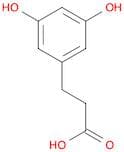
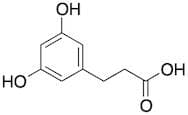
:3-(3,5-Dihydroxyphenyl)-1-propansäure
Beschreibung:
3-(3,5-Dihydroxyphenyl)-1-propansäure, auch bekannt als Dihydroxyphenylpropansäure, ist eine organische Verbindung, die durch ihre phenolische Struktur und die Carbonsäurefunktionalität gekennzeichnet ist. Sie weist ein Propansäuregerüst auf, das an einen Phenylring gebunden ist, der zwei Hydroxylgruppen an den Positionen 3 und 5 hat, was zu ihren potenziellen antioxidativen Eigenschaften beiträgt. Diese Verbindung ist typischerweise ein weißer bis cremefarbener Feststoff und in polaren Lösungsmitteln löslich, da die Hydroxylgruppen Wasserstoffbrückenbindungen bilden können. Ihre molekulare Struktur ermöglicht verschiedene Wechselwirkungen, was sie in der biochemischen Forschung von Interesse macht, insbesondere in Studien zu ihren potenziellen gesundheitlichen Vorteilen, wie entzündungshemmenden und antioxidativen Wirkungen. Darüber hinaus kann sie eine Rolle bei der Synthese anderer chemischer Verbindungen spielen oder als Vorläufer in der organischen Synthese dienen. Wie viele phenolische Verbindungen kann sie je nach Umweltbedingungen unterschiedliche Stabilitäts- und Reaktivitätsgrade aufweisen.
Formel:C9H10O4
InChl:InChI=1S/C9H10O4/c10-7-3-6(1-2-9(12)13)4-8(11)5-7/h3-5,10-11H,1-2H2,(H,12,13)
InChI Key:InChIKey=ITPFIKQWNDGDLG-UHFFFAOYSA-N
SMILES:C(CC(O)=O)C1=CC(O)=CC(O)=C1
Synonyme:- 3,5-Dihydroxybenzenepropanoic acid
- 3,5-Dihydroxyhydrocinnamic acid
- 3-(3,5-Dihydroxyphenyl)-1-propanoic acid
- Benzenepropanoic Acid, 3,5-Dihydroxy-
- Hydrocinnamic acid, 3,5-dihydroxy-
Sortieren nach
Reinheit (%)
0
100
|
0
|
50
|
90
|
95
|
100
3 Produkte.
3-(3,5-Dihydroxyphenyl)propanoic acid
CAS:Formel:C9H10O4Farbe und Form:SolidMolekulargewicht:182.17333-(3,5-Dihydroxyphenyl)-1-propanoic Acid
CAS:Kontrolliertes ProduktFormel:C9H10O4Farbe und Form:Off-WhiteMolekulargewicht:182.173-(3,5-Dihydroxyphenyl)-1-propanoic acid
CAS:3-(3,5-Dihydroxyphenyl)-1-propanoic acid is a metabolite of 3,5-dihydroxybenzoic acid (DHBA) that has been found to be elevated in the urine of women with breast cancer. This metabolite may serve as a potential biomarker for early detection of breast cancer and other types of cancer. It also has anti-inflammatory and glucose regulation effects in humans. The concentration of 3-(3,5-dihydroxyphenyl)-1-propanoic acid was found to be significantly higher in urine samples from women diagnosed with breast cancer than in urine samples from healthy controls, which suggests that this metabolite could be used as a marker for early detection of breast cancer.Formel:C9H10O4Reinheit:Min. 95%Farbe und Form:PowderMolekulargewicht:182.17 g/mol