CAS 265651-18-1
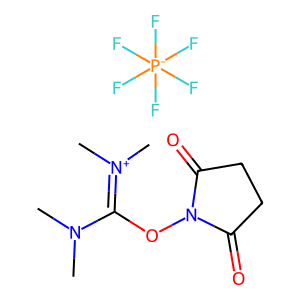
:N,N,N',N'-Tetramethyl-O-(N-succinimidyl)uronium-hexafluorophosphat
Beschreibung:
N,N,N',N'-Tetramethyl-O-(N-succinimidyl)uronium-hexafluorophosphat, allgemein bekannt als HATU, ist ein weit verbreiteter Kupplungsreagenz, das in der Peptidsynthese und anderen organischen Reaktionen verwendet wird. Es zeichnet sich durch seine Fähigkeit aus, Carbonsäuren zur Bildung von Amidbindungen zu aktivieren, was das Kupplung von Aminosäuren in der Peptidsynthese erleichtert. Die Verbindung ist typischerweise ein weißer bis off-weißer Feststoff und in polaren organischen Lösungsmitteln wie Dimethylformamid (DMF) und Dimethylsulfoxid (DMSO) löslich. HATU ist bekannt für seine Effizienz und milden Reaktionsbedingungen, die Nebenreaktionen minimieren und den Ertrag erhöhen. Es wird auch wegen seiner Stabilität unter Standardlaborbedingungen bevorzugt, obwohl es aufgrund seiner Reaktivität und potenziellen Toxizität mit Vorsicht behandelt werden sollte. Die Anwesenheit der Succinimidylgruppe ermöglicht selektive Reaktionen mit Aminen, was es zu einem wertvollen Werkzeug in der Synthese komplexer organischer Moleküle macht. Eine ordnungsgemäße Lagerung an einem kühlen, trockenen Ort, fern von Feuchtigkeit, wird empfohlen, um seine Integrität und Wirksamkeit zu erhalten.
Formel:C9H16F6N3O3P
InChl:InChI=1/C9H16N3O3.F6P/c1-10(2)9(11(3)4)15-12-7(13)5-6-8(12)14;1-7(2,3,4,5)6/h5-6H2,1-4H3;/q+1;-1
Synonyme:- Hstu
- O-(N-Succinimidyl)-1,1,3,3-tetramethyluronium hexafluorophosphate
- N-{(dimethylamino)[(2,5-dioxopyrrolidin-1-yl)oxy]methylidene}-N-methylmethanaminium hexafluorophosphate
Sortieren nach
Reinheit (%)
0
100
|
0
|
50
|
90
|
95
|
100
6 Produkte.
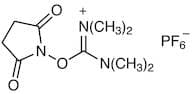
O-(N-Succinimidyl)-N,N,N',N'-tetramethyluronium hexafluorophosphate, 98+%
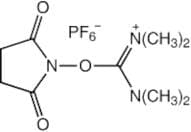
CAS:Coupling reagent for peptide synthesis and the formation of other amides. Reactant for synthesis of liposomal contrast agents for magnetic resonance imaging, synthesis of protein labeling molecules, synthesis of thiol-reactive Cy5 derivatives. This Thermo Scientific Chemicals brand product was origiFormel:C9H16F6N3O3PReinheit:98+%Molekulargewicht:359.21Methanaminium, (dimethylamino)[(2,5-dioxo-1-pyrrolidinyl)oxy]dimethyl-, hexafluorophosphate(1-) (1:1)
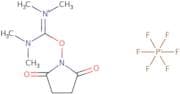
CAS:Formel:C9H16F6N3O3PReinheit:96%Farbe und Form:SolidMolekulargewicht:359.2058O-(N-Succinimidyl)-N,N,N',N'-tetramethyluronium hexafluorophosphate
CAS:O-(N-Succinimidyl)-N,N,N',N'-tetramethyluronium hexafluorophosphateReinheit:98%Farbe und Form:SolidMolekulargewicht:359.21g/molN,N,N',N'-Tetramethyl-O-(N-succinimidyl)uronium Hexafluorophosphate
CAS:Formel:C9H16F6N3O3PReinheit:>98.0%(HPLC)(N)Farbe und Form:White to Almost white powder to crystalMolekulargewicht:359.21HSTU
CAS:HSTU is an uronium salt used as an amide and ester coupling reagent, and to form NHS esters from carboxylic acids. HSTU is used in the last step of the synthesis of the protein labelling agent N-succinimidyl 4-[18F]fluorobenzoate ([18F]SFB), which can be efficiently made using batch microfluidic technology. HSTU finds application in the synthesis of pH-sensitive dyes to be used as contrast agents for cellular uptake studies. HSTU is also used in the synthesis of monodendronised perylene bisimides and their bioconjugates to be used as fluorescent labels. HSTU is utilised in the synthesis of biodegradable core multi-shell nanocarriers used as drug delivery systems.Formel:C9H16F6N3O3PReinheit:Min. 95%Farbe und Form:White PowderMolekulargewicht:359.21 g/mol

![Methanaminium, (dimethylamino)[(2,5-dioxo-1-pyrrolidinyl)oxy]dimethyl-, hexafluorophosphate(1-) (1…](/_next/image/?url=https%3A%2Fstatic.cymitquimica.com%2Fproducts%2FIN%2Fthumb%2FDA002TPN.jpg&w=3840&q=75)