CAS 26607-15-8
:L-Leucyl-L-Arginin
Beschreibung:
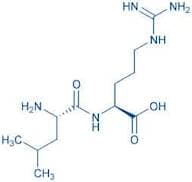
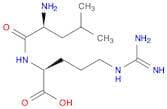
L-Leucyl-L-Arginin ist ein Dipeptid, das aus den Aminosäuren Leucin und Arginin besteht, die durch eine Peptidbindung verbunden sind. Es zeichnet sich durch seine Rolle in verschiedenen biologischen Prozessen aus, einschließlich der Proteinsynthese und der zellulären Signalübertragung. Diese Verbindung weist typische Eigenschaften von Peptiden auf, wie z.B. Löslichkeit in Wasser und Stabilität unter physiologischen Bedingungen. L-Leucyl-L-Arginin kann metabolische Wege beeinflussen und wurde auf seine potenziellen Auswirkungen auf die Immunfunktion und den Muskelstoffwechsel untersucht. Die Anwesenheit der basischen Aminosäure Arginin trägt zu seiner physiologischen Aktivität bei, da Arginin als Vorläufer für die Synthese von Stickstoffmonoxid bekannt ist, das eine entscheidende Rolle bei der Vasodilatation und der Regulierung des Blutflusses spielt. Darüber hinaus kann die hydrophobe Natur von Leucin die Wechselwirkungen des Peptids mit Zellmembranen und Proteinen beeinflussen. Insgesamt dient L-Leucyl-L-Arginin als wichtiges Molekül in der Biochemie und Pharmakologie, mit laufenden Forschungen, die seine therapeutischen Anwendungen untersuchen.
Formel:C12H25N5O3
InChl:InChI=1/C12H25N5O3/c1-7(2)6-8(13)10(18)17-9(11(19)20)4-3-5-16-12(14)15/h7-9H,3-6,13H2,1-2H3,(H,17,18)(H,19,20)(H4,14,15,16)
InChI Key:InChIKey=SENJXOPIZNYLHU-IUCAKERBSA-N
SMILES:[C@H](NC([C@H](CC(C)C)N)=O)(CCCNC(=N)N)C(O)=O
Synonyme:- 124: PN: WO2009132287 SEQID: 194 claimed protein
- 1707: PN: WO2007124090 PAGE: 83 claimed protein
- 175: PN: WO2011032181 SEQID: 194 unclaimed protein
- 182: PN: WO2009114815 SEQID: 194 unclaimed protein
- 205: PN: WO2010059829 SEQID: 223 unclaimed protein
- 26: PN: EP2161028 PAGE: 10 claimed protein
- 44: PN: WO2010045512 SEQID: 43 unclaimed protein
- 522: PN: WO2010124259 SEQID: 551 claimed protein
- 525: PN: WO2010124262 SEQID: 551 claimed protein
- 78: PN: US20070066537 PAGE: 17 claimed protein
- <span class="text-smallcaps">L</smallcap>-Arginine, <smallcap>L</span>-leucyl-
- <span class="text-smallcaps">L</smallcap>-Arginine, N<sup>2</sup>-<smallcap>L</span>-leucyl-
- <span class="text-smallcaps">L</smallcap>-Leucyl-<smallcap>L</span>-arginine
- Arginine, N<sup>2</sup>-<span class="text-smallcaps">L</smallcap>-leucyl-, <smallcap>L</span>-
- H-Leu-Arg-OH
- L-leucyl-N~5~-(diaminomethylidene)-L-ornithine
- leucyl-N~5~-(diaminomethylidene)ornithine
- Arginine, N2-L-leucyl-, L-
- L-Arginine, N2-L-leucyl-
- L-Arginine, L-leucyl-
- L-Leucyl-L-arginine
- Leu-Arg-OH
- L-Leu-L-Arg-OH
- leu-arg acetate
- Nα-L-Leucyl-L-arginine
- LEU-ARG ACETATE SALT
- H-LEU-ARG-OH ACETATE SALT
- leucylarginine
- Weitere Synonyme anzeigen
Sortieren nach
Reinheit (%)
0
100
|
0
|
50
|
90
|
95
|
100
4 Produkte.
H-Leu-Arg-OH
CAS:Bachem ID: 4003808.
Formel:C12H25N5O3Reinheit:> 98%Farbe und Form:White PowderMolekulargewicht:287.36Leucylarginine
CAS:Leucylarginine hinders antinociception induced by L-arginine.Formel:C12H25N5O3Reinheit:98%Farbe und Form:SolidMolekulargewicht:287.36H-Leu-Arg-OH acetate salt
CAS:H-Leu-Arg-OH acetate salt is a cyclase inhibitor that is used to treat cancer. It has been shown to inhibit soluble guanylate cyclase, which is an enzyme that converts guanosine triphosphate (GTP) into the second messenger molecule, cyclic guanosine monophosphate (cGMP). Inhibition of this enzyme results in a decrease in the production of cGMP and blood pressure. H-Leu-Arg-OH acetate salt also inhibits delta opioid receptors, which are found on the surface of cells in the brain. This drug binds competitively with delta opioid receptors and blocks the effect of endogenous or exogenous ligands such as enkephalins.
Formel:C12H25N5O3Reinheit:Min. 95%Farbe und Form:PowderMolekulargewicht:287.36 g/mol