CAS 26879-47-0
:L-Thymidin
Beschreibung:
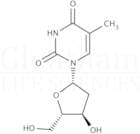
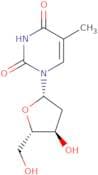
L-Thymidin, mit der CAS-Nummer 26879-47-0, ist ein Nukleosid, das eine entscheidende Rolle bei der Synthese von DNA spielt. Es besteht aus einer Thyminbasis, die an einen Desoxyribosezucker gebunden ist. Diese Verbindung zeichnet sich durch ihre Fähigkeit aus, an der Bildung von DNA-Strängen teilzunehmen, was sie für die zelluläre Replikation und Reparaturprozesse unerlässlich macht. L-Thymidin ist typischerweise ein weißes bis cremefarbenes kristallines Pulver, das in Wasser löslich ist und einen Schmelzpunkt aufweist, der je nach Form variiert. Es wird häufig in der Molekularbiologie und Biochemie als Substrat in verschiedenen enzymatischen Reaktionen und als Baustein in der DNA-Synthese verwendet. Darüber hinaus hat L-Thymidin Anwendungen in der pharmazeutischen Industrie, insbesondere bei der Entwicklung von antiviralen und krebsbekämpfenden Therapien. Seine biologische Aktivität wird durch seine strukturellen Eigenschaften beeinflusst, die es ihm ermöglichen, die natürlichen Nukleoside im DNA nachzuahmen, wodurch seine Einbindung in Nukleinsäuren während der Replikation erleichtert wird.
Formel:C10H14N2O6
InChl:InChI=1/C10H14N2O5/c1-5-3-12(10(16)11-9(5)15)8-2-6(14)7(4-13)17-8/h3,6-8,13-14H,2,4H2,1H3,(H,11,15,16)/t6-,7+,8+/m0/s1
Synonyme:- 1-beta-L-Ribofuranosylthymine
- 5-Methyl-1-beta-L-ribofuranosyl-2,4(1H,3H)-pyrimidinedione
- L-Thymidine
- 2,4(1H,3H)-PyriMidinedione, 5-Methyl-1-b-L-ribofuranosyl-
- L-5-Me-rU
- Telbivudine Impurity 14
Sortieren nach
Reinheit (%)
0
100
|
0
|
50
|
90
|
95
|
100
5 Produkte.
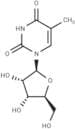
L-5-Methyluridine
CAS:<p>L-5-Methyluridine, an L-configuration of 5-Methyluridine, is an endogenous methylated nucleoside present in human fluids.</p>Formel:C10H14N2O6Farbe und Form:SolidMolekulargewicht:258.235-Methyl-L-uridine
CAS:<p>5-Methyl-L-uridine is an antiviral drug which belongs to a class of compounds called nucleoside analogues. It is used in the treatment of chronic hepatitis B and C, as well as for prevention of hepatitis A and B. 5-Methyl-L-uridine inhibits the virus by turning off the production of viral DNA and RNA, through interactions with the virus's polymerase chain reaction process. This drug also prevents protein synthesis in cells infected with viruses such as HIV, herpes simplex virus type 1, and influenza A virus. 5-Methyl-L-uridine is a prodrug that is converted to its active form, uridine monophosphate, by enzymes in the liver. The cytotoxic effects of 5-methyluridine on cancer cells have been shown to be due to inhibition of cellular DNA synthesis and repair pathways.</p>Formel:C10H14N2O6Reinheit:Min. 95%Farbe und Form:White PowderMolekulargewicht:258.23 g/mol