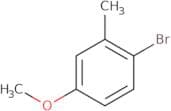
CAS 27060-75-9
:4-Brom-3-methylanisol
Beschreibung:
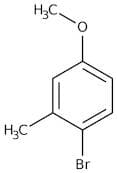
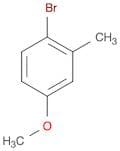
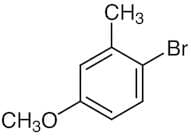
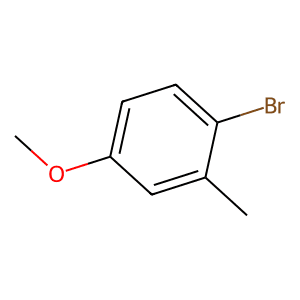
4-Brom-3-methylanisol, mit der CAS-Nummer 27060-75-9, ist eine organische Verbindung, die zur Klasse der aromatischen Ether gehört. Sie weist eine Methoxygruppe (-OCH3) und ein Bromatom auf, das an einen Benzolring gebunden ist, und zwar spezifisch an den Positionen 4 und 3. Diese Verbindung zeichnet sich durch ihre chemische Formel aus, die das Vorhandensein von Brom und einer Methylgruppe widerspiegelt, was zu ihren einzigartigen chemischen Eigenschaften beiträgt. Sie erscheint typischerweise als farblose bis blassgelbe Flüssigkeit mit einem charakteristischen aromatischen Geruch. 4-Brom-3-methylanisol ist bekannt für seine Anwendungen in der organischen Synthese und als Zwischenprodukt in der Herstellung verschiedener chemischer Verbindungen. Ihre Reaktivität wird durch die elektronenanziehende Natur des Bromatoms und die elektronenabgebende Eigenschaft der Methoxygruppe beeinflusst, was ihr Verhalten in elektrophilen aromatischen Substitutionsreaktionen beeinflussen kann. Darüber hinaus kann sie biologische Aktivität zeigen, was sie in der medizinischen Chemie und Forschung von Interesse macht. Sicherheitsvorkehrungen sollten beim Umgang mit dieser Verbindung getroffen werden, da sie potenziell toxisch ist und Auswirkungen auf die Umwelt haben kann.
Formel:C8H9BrO
InChl:InChI=1S/C8H9BrO/c1-6-5-7(10-2)3-4-8(6)9/h3-5H,1-2H3
InChI Key:InChIKey=BLZNSXFQRKVFRP-UHFFFAOYSA-N
SMILES:O(C)C1=CC(C)=C(Br)C=C1
Synonyme:- 1-Brom-4-methoxy-2-methylbenzol
- 1-Bromo-2-methyl-4-methoxybenzene
- 1-Bromo-4-methoxy-2-methylbenzene
- 2-Bromo-5-methoxytoluene
- 3-Methyl-4-bromoanisole
- 4-Bromo-3-methylphenyl methyl ether
- Anisole, 4-bromo-3-methyl-
- Benzene, 1-bromo-4-methoxy-2-methyl-
- 4-Bromo-3-methylanisole
Sortieren nach
Reinheit (%)
0
100
|
0
|
50
|
90
|
95
|
100
7 Produkte.
4-Bromo-3-methylanisole, 97%
CAS:This Thermo Scientific Chemicals brand product was originally part of the Alfa Aesar product portfolio. Some documentation and label information may refer to the legacy brand. The original Alfa Aesar product / item code or SKU reference has not changed as a part of the brand transition to Thermo Sci
Formel:C8H9BrOReinheit:97%Farbe und Form:Clear colorless to pale yellow, LiquidMolekulargewicht:201.06Benzene, 1-bromo-4-methoxy-2-methyl-
CAS:Formel:C8H9BrOReinheit:95%Farbe und Form:LiquidMolekulargewicht:201.06052-Bromo-5-methoxytoluene, min. 98%
CAS:Formel:C8H9BrOReinheit:min. 98%Farbe und Form:Clear, colorless liquidMolekulargewicht:201.062-Bromo-5-methoxytoluene
CAS:Formel:C8H9BrOReinheit:>97.0%(GC)Farbe und Form:White or Colorless to Almost white or Almost colorless powder to lump to clear liquidMolekulargewicht:201.064-Bromo-3-methylanisole
CAS:4-Bromo-3-methylanisoleFormel:C8H9BrOReinheit:97%Farbe und Form: clear. almost colourless liquidMolekulargewicht:201.06g/mol2-Bromo-5-methoxytoluene
CAS:2-Bromo-5-methoxytoluene is a synthetic organic compound that is used as a chemical intermediate for cellulose derivatives. It is generated by the Friedel-Crafts reaction of bromine with toluene in the presence of aluminum chloride. 2-Bromo-5-methoxytoluene has been shown to react with cellulose derivatives and other hydrogen bond acceptors. This reaction is followed by protonation, which yields a chromophore that changes color from yellow to orange. The mechanism of this reaction can be explained by an acid catalysis mechanism, which begins with protonation of the carbonyl group (C=O) and formyl group (HC=O) groups. This causes the formation of an enolate ion, which reacts with a protonated carbonyl group to yield a formyl cation and an enolate ion. The formyl cation then reacts with another protonFormel:C8H9OBrReinheit:Min. 95%Farbe und Form:PowderMolekulargewicht:201.06 g/mol