CAS 2715-68-6
:9-ethyladenin
Beschreibung:
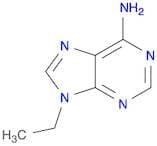
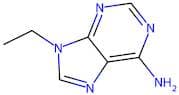
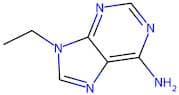
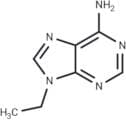
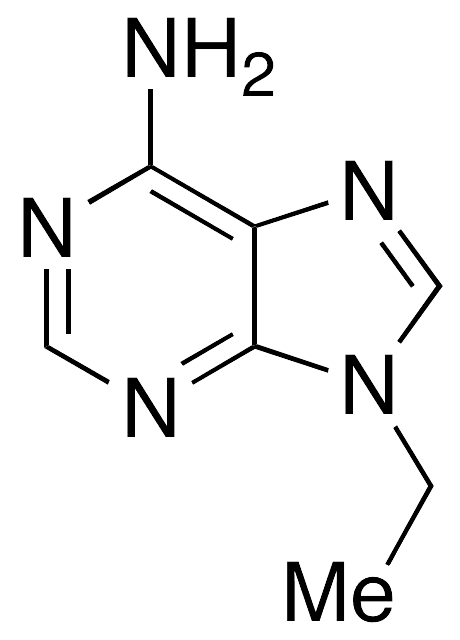
9-ethyladenin ist ein Purinderivat und ein Analogon der Adenin, das ein Schlüsselbestandteil der Nukleinsäuren ist. Seine chemische Struktur weist eine Ethylgruppe auf, die am Stickstoffatom in der 9-Position des Adeninrings angebracht ist. Diese Modifikation kann seine biologische Aktivität und Interaktionen mit Nukleinsäuren und Proteinen beeinflussen. 9-ethyladenin wird hauptsächlich auf seine potenziellen Rollen in der Biochemie und Molekularbiologie untersucht, insbesondere in Bezug auf den Nukleinsäurestoffwechsel und die Modulation von Enzymaktivitäten. Die Verbindung kann Eigenschaften aufweisen, wie z.B. ein Substrat oder Inhibitor für bestimmte Enzyme zu sein, und ihre strukturelle Ähnlichkeit mit Adenin ermöglicht es ihr, an verschiedenen biochemischen Wegen teilzunehmen. Darüber hinaus kann 9-ethyladenin in der Forschung verwendet werden, um die Auswirkungen der Alkylierung auf die Funktion und Stabilität von Nukleobasen zu untersuchen. Wie bei vielen chemischen Substanzen sollten Sicherheits- und Handhabungsvorschriften beachtet werden, da ihre biologischen Wirkungen und Toxizitätsprofile je nach Konzentration und Expositionsbedingungen variieren können.
Formel:C7H9N5
InChl:InChI=1/C7H9N5/c1-2-12-4-11-5-6(8)9-3-10-7(5)12/h3-4H,2H2,1H3,(H2,8,9,10)
SMILES:CCn1cnc2c(N)ncnc12
Synonyme:- N9-Ethyladenine
- Nsc 14580
- 9H-Purin-6-amine, 9-ethyl- (9CI)
- Adenine, 9-ethyl- (8CI)
- 9-ethyl-9H-purin-6-amine
- 9H-Purin-6-amine,9-ethyl
Sortieren nach
Reinheit (%)
0
100
|
0
|
50
|
90
|
95
|
100
7 Produkte.
9-Ethyladenine
CAS:9-Ethyladenine (6-Amino-9-ethylpurine) is a partially potent APRT (adenine phosphoribosyltransferase) inhibitor [1].Formel:C7H9N5Reinheit:99.35% - 99.37%Farbe und Form:SolidMolekulargewicht:163.189-Ethyl-9H-purin-6-amine
CAS:Formel:C7H9N5Reinheit:97%Farbe und Form:Liquid, No data available.Molekulargewicht:163.1849-Ethyl Adenine
CAS:Kontrolliertes ProduktApplications 9-Ethyl Adenine is used in the manipulation of osmium arene complexes in order to achieve cancel cell cytotoxicity. Its a derivative of Adenine (A280480), widespread throughout animal and plant tissues combined with niacinamide, d-ribose, and phosphoric acids; a constituent of nucleic acids and coenzymes, such as codehydrase I and II, adenylic acid, coalaninedehydrase. It is used in microbial determination of niacin; in research on heredity, virus diseases, and cancer.
References Peacock, A. et al.: J Am. Chem. Soc., 129, 3348 (2007); Philips, et al.: J. Pharmacol. Exp. Ther., 20, 104 (1952), Lambertucci, C., et al.: Bioorg. Med. Chem., 17, 2812 (2009),Formel:C7H9N5Farbe und Form:NeatMolekulargewicht:163.189-Ethyladenine
CAS:9-Ethyladenine is a molecule that belongs to the group of p2 type hydrogen bond. It has been shown to form intermolecular hydrogen bonds with other molecules, such as DNA and proteins. 9-Ethyladenine can also form intramolecular hydrogen bonds within its own structure. A number of crystal structures have been determined for 9-Ethyladenine and it has been shown to have an x-ray crystallographic symmetry. 9-Ethyladenine has shown that it is capable of repairing damaged DNA by interacting with the adenosine receptor, which may be due to its ability to bind with a specific region on the receptor.Formel:C7H9N5Reinheit:Min. 95%Molekulargewicht:163.18 g/mol