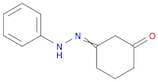
CAS 27385-45-1
:1,3-Cyclohexandion, 1-(2-phenylhydrazon)
Beschreibung:
1,3-Cyclohexandion, 1-(2-phenylhydrazon) ist eine organische Verbindung, die durch ihre Hydrazon-Funktionalgruppe gekennzeichnet ist, die aus der Reaktion von 1,3-Cyclohexandion mit Phenylhydrazin entsteht. Diese Verbindung erscheint typischerweise als Feststoff und ist bekannt für ihre potenziellen Anwendungen in der organischen Synthese und als Reagenz in verschiedenen chemischen Reaktionen. Sie weist einen Cyclohexanring mit zwei Ketongruppen an den Positionen 1 und 3 auf, was zu ihrer Reaktivität und Fähigkeit zur Bildung von Derivaten beiträgt. Die Anwesenheit der Phenylhydrazon-Gruppe verbessert ihre Eigenschaften und macht sie nützlich bei der Entwicklung von Farbstoffen und pharmazeutischen Produkten. Darüber hinaus kann diese Verbindung aufgrund ihrer strukturellen Konfiguration spezifische optische Eigenschaften aufweisen, die in der analytischen Chemie genutzt werden können. Wie bei vielen organischen Verbindungen ist es wichtig, sie mit Vorsicht zu behandeln, da ihre potenzielle Reaktivität und die Notwendigkeit geeigneter Sicherheitsprotokolle während der Verwendung berücksichtigt werden müssen.
Formel:C12H14N2O
InChl:InChI=1S/C12H14N2O/c15-12-8-4-7-11(9-12)14-13-10-5-2-1-3-6-10/h1-3,5-6,13H,4,7-9H2
InChI Key:InChIKey=ASBKHKGFGCNQJB-UHFFFAOYSA-N
SMILES:N(NC1=CC=CC=C1)=C2CC(=O)CCC2
Synonyme:- 1,3-Cyclohexanedione, 1-(2-phenylhydrazone)
- 1,3-Cyclohexanedione, mono(phenylhydrazone)
Sortieren nach
Reinheit (%)
0
100
|
0
|
50
|
90
|
95
|
100
3 Produkte.
3-(2-phenylhydrazin-1-ylidene)cyclohexan-1-one
CAS:Formel:C12H14N2OReinheit:95%Farbe und Form:SolidMolekulargewicht:202.2524(Z)-3-(2-Phenylhydrazono)cyclohexanone
CAS:The method involves refluxing ethanol with a solid acid catalyst and a condensation agent. The reaction is catalyzed by the acid catalyst, which can be either an inorganic or organic acid. The reaction time is typically 3 to 4 hours. Effective catalysts include aluminum chloride, zinc chloride, and titanium tetrachloride. Carvedilol is an effective product of this reaction because it has a high yield and a low production cost. Solid-acid catalysts are used for this synthesis because they have excellent stability in the presence of water and air and can be easily recovered from the reaction mixture. The reactants are heated at reflux until the desired product is formed. This process is typically carried out using a reflux apparatus equipped with an efficient condenser and an ice bath to maintain the temperature below boiling point. The yields of the desired product are typically high, ranging from 80% to 95%.Formel:C12H14N2OReinheit:Min. 95%Molekulargewicht:202.25 g/mol