CAS 27462-39-1
:6H-Purin-6-on, 2-amino-1,9-dihydro-9-b-D-xylopyranosyl-
Beschreibung:
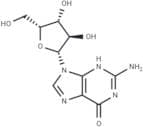
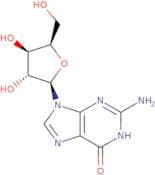
Die chemische Substanz, die als "6H-Purin-6-on, 2-amino-1,9-dihydro-9-b-D-xylofuranosyl-" mit der CAS-Nummer 27462-39-1 bekannt ist, ist ein Nukleosidderivat, spezifisch ein Purinnukleosid. Es weist eine Purinbase auf, die eine bicyclische Struktur aus fusionierten Imidazol- und Pyrimidinringen darstellt, und ist durch das Vorhandensein einer Aminogruppe an der Position 2 gekennzeichnet. Die Verbindung ist an eine Zuckereinheit gebunden, spezifisch an eine β-D-xylofuranosyl-Gruppe, die einen fünfgliedrigen Zuckerring darstellt. Diese Struktur ist in der Biochemie von Bedeutung, da sie eine Rolle bei der Bildung von Nukleotiden spielt, die die Bausteine von Nukleinsäuren wie DNA und RNA sind. Die Verbindung ist typischerweise an verschiedenen biologischen Prozessen beteiligt, einschließlich des Zellstoffwechsels und des genetischen Informationsübertrags. Ihre Eigenschaften können die Löslichkeit in Wasser und potenzielle Wechselwirkungen mit Enzymen und anderen Biomolekülen umfassen, was sie in der pharmazeutischen und biochemischen Forschung relevant macht.
Formel:C10H13N5O5
Synonyme:- Guanine,9-b-D-xylofuranosyl- (8CI)
- 9-b-D-Xylofuranosylguanine
- Nsc115607
Sortieren nach
Reinheit (%)
0
100
|
0
|
50
|
90
|
95
|
100
3 Produkte.
9-(b-D-Xylofuranosyl)guanine
CAS:9-(b-D-Xylofuranosyl)guanine is a Nucleoside Derivative - Xylo-nucleoside.Formel:C10H13N5O5Farbe und Form:SolidMolekulargewicht:283.24Ref: TM-TNU0267
5mgNachfragen10mgNachfragen25mgNachfragen50mgNachfragen100mgNachfragen500mgNachfragen9-(beta-D-Xylofuranosyl)guanine
CAS:9-(β-D-xylofuranosyl)guanine (9XG) is a trifluoride. It is an antiviral agent that inhibits the growth of herpes virus, in particular by methylating guanosine to 9-methylguanosine in the viral DNA. 9XG binds to the viral DNA and prevents its replication through the inhibition of RNA synthesis. The drug is active against many different types of viruses and has been shown to be effective against tissue cultures infected with herpes virus. 9XG is synthesized from guanosine and boron trifluoride etherate, which are reacted at -78 degrees Celsius for three days. This yields a mixture of compounds with various peracylation groups, which are then separated by chromatography.
Reinheit:Min. 95%