CAS 2769-71-3
:2,6-Dimethylphenylisocyanid
Beschreibung:
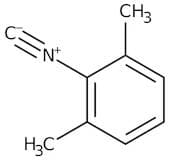
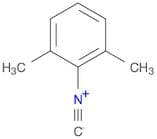
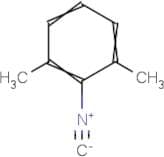
2,6-Dimethylphenylisocyanid, mit der CAS-Nummer 2769-71-3, ist eine organische Verbindung, die durch das Vorhandensein einer Isocyanid-Gruppe gekennzeichnet ist, die an einen 2,6-Dimethylphenylring gebunden ist. Diese Verbindung weist eine markante Struktur auf, die einen Phenylring umfasst, der an den Positionen 2 und 6 mit zwei Methylgruppen substituiert ist, was zu ihren einzigartigen chemischen Eigenschaften beiträgt. Isocyanide sind bekannt für ihren starken und oft unangenehmen Geruch und zeigen Reaktivität aufgrund der Anwesenheit der Isocyanid-Gruppe (-N≡C). Diese Verbindung wird typischerweise in der organischen Synthese verwendet, insbesondere bei der Bildung verschiedener stickstoffhaltiger Verbindungen und in der Entwicklung von Arzneimitteln. Ihre Reaktivität ermöglicht es ihr, an verschiedenen chemischen Reaktionen teilzunehmen, einschließlich nucleophiler Additionen und Cycloadditionen. Darüber hinaus kann 2,6-Dimethylphenylisocyanid spezifische physikalische Eigenschaften wie Löslichkeit in organischen Lösungsmitteln und einen relativ niedrigen Siedepunkt aufweisen, die häufige Merkmale von Isocyaniden sind. Sicherheitsvorkehrungen sollten beim Umgang mit dieser Verbindung getroffen werden, da sie potenzielle Toxizität und Reaktivität aufweist.
Formel:C9H9N
InChl:InChI=1/C9H10N/c1-7-5-4-6-8(2)9(7)10-3/h3-6H,1-2H3/q+1
InChI Key:InChIKey=DNJLFZHMJDSJFN-UHFFFAOYSA-N
SMILES:[N+](#[C-])C1=C(C)C=CC=C1C
Synonyme:- 1-Isocyano-2,6-dimethylbenzene
- 2,6-Dimethylisocyanobenzene
- 2,6-Dimethylphenylisonitrile
- 2,6-Xylene isonitrile
- 2,6-Xyleneisonitrile
- 2,6-Xylyl isocyanide
- 2,6-Xylyl isonitrile
- 2,6-dimethyl-N-methylidyneanilinium
- 2-Isocyanato-1,3-Dimethylbenzene
- 2-Isocyano-1,3-dimethylbenzene
- 2-m-Xylyl isocyanide
- Benzene, 2-isocyano-1,3-dimethyl-
- Benzene, 2-isocyano-1,3-dimethyl- (9CI)
- Nsc 141690
- 2,6-Dimethylphenyl isocyanide
- 2,6-Dimethylphenyl isocyanide
- VIC-M-XYLYL ISOCYANIDE
- HANSA ISN-0083
- RARECHEM AQ BD 0027
- Weitere Synonyme anzeigen
Sortieren nach
Reinheit (%)
0
100
|
0
|
50
|
90
|
95
|
100
5 Produkte.
2,6-Dimethylphenyl isocyanide
CAS:2,6-Dimethylphenyl isocyanate is used in the preparation of homoleptic metallaamidine complex, derivatized bets-cyclodextrins. It is used as chiral stationary phase in normal-phase liquid chromatography. It is also involved in the preparation of tris( 2,6-dimethylphenylimido)methylrhenium (VII) andFormel:C9H9NMolekulargewicht:131.18Benzene, 2-isocyano-1,3-dimethyl-
CAS:Formel:C9H9NReinheit:97%Farbe und Form:SolidMolekulargewicht:131.17452,6-Dimethylphenyl isocyanide
CAS:2,6-Dimethylphenyl isocyanideFormel:C9H9NReinheit:97%Farbe und Form: yellow solidMolekulargewicht:131.17g/mol2-Isocyano-1,3-dimethyl-benzene
CAS:2-Isocyano-1,3-dimethyl-benzene is an organic compound that is used to synthesize other compounds. It has a redox potential of -0.6 volts and a crystallography of orthorhombic with a space group of Pbca. It reacts with nitrogen atoms in the reaction solution to form stable complexes and can react with copper ions to form a copper complex. 2-Isocyano-1,3-dimethyl-benzene has been shown to undergo transfer reactions with molybdenum in the presence of xylene as solvent and ammonia gas as a catalyst. This chemical reaction mechanism leads to the formation of an isocyanide intermediate, which then reacts with water molecules to create an aminium ion and hydrogen cyanide. Titration calorimetry experiments have shown that 2-isocyano-1,3-dimethylbenzene has an enthalpy change of -2Formel:C9H9NReinheit:Min. 95%Molekulargewicht:131.17 g/mol