CAS 27848-81-3
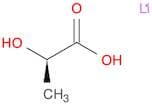
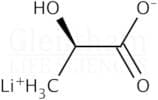
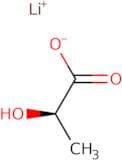
:Propansäure, 2-hydroxy-, Monolithiumsalz, (2R)-
Beschreibung:
Propansäure, 2-hydroxy-, Monolithiumsalz, (2R)-, auch bekannt als Lithium-2-Hydroxypropanoat, ist eine chemische Verbindung, die durch ihre Lithiumsalzform der 2-Hydroxypropansäure (Milchsäure) gekennzeichnet ist. Diese Verbindung erscheint typischerweise als weißes kristallines Feststoff und ist aufgrund des ionischen Lithiumanteils in Wasser löslich. Sie weist Eigenschaften auf, die typisch für Carbonsäuren sind, einschließlich der Fähigkeit, Protonen (H+) in Lösung zu spenden, obwohl die Anwesenheit des Lithiumions ihre Acidität und Reaktivität beeinflussen kann. Die Bezeichnung (2R) weist auf ihre spezifische Stereochemie hin, die ihre biologische Aktivität und Wechselwirkungen beeinflussen kann. Diese Verbindung ist in verschiedenen Bereichen von Interesse, einschließlich Biochemie und Pharmazie, wo sie eine Rolle in Stoffwechselprozessen spielen oder als Vorläufer bei der Synthese anderer Verbindungen dienen kann. Ihre Stabilität, Löslichkeit und Reaktivität machen sie zu einer wertvollen Substanz sowohl in der Forschung als auch in industriellen Anwendungen.
Formel:C3H6O3·Li
InChl:InChI=1S/C3H6O3.Li/c1-2(4)3(5)6;/h2,4H,1H3,(H,5,6);/t2-;/m1./s1
InChI Key:InChIKey=MCPIIUKZBQXOSD-HSHFZTNMSA-N
SMILES:[C@H](C(O)=O)(C)O.[Li]
Synonyme:- <span class="text-smallcaps">D</span>-Lactic acid lithium salt
- Lactic acid, monolithium salt, <span class="text-smallcaps">D</span>-
- Lithium <span class="text-smallcaps">D</span>-lactate
- Propanoic acid, 2-hydroxy-, monolithium salt, (2R)-
- Propanoic acid, 2-hydroxy-, monolithium salt, (R)-
- lithium (2R)-2-hydroxypropanoate
- D-Lactic acid lithium salt
- Lithium D-(-)-lactate
- Lithium D-lactate
- Lactic acid, monolithium salt, D-
Sortieren nach
Reinheit (%)
0
100
|
0
|
50
|
90
|
95
|
100
4 Produkte.
Lithium D-lactate
CAS:Formel:CH3CH(OH)CO2LiReinheit:≥ 96.0%Farbe und Form:White powderMolekulargewicht:96.01D-Lactic acid lithium
CAS:D(+)-Lactic acid lithium salt is a dipolar molecule with an activation energy of about 44 kJ/mol. It has been studied by NMR techniques and found to have a resonance in the range of 1.8-2.0 ppm, which is characteristic of protons on the oxygen atom. The proton magnetic resonance (PMR) study showed that the d-lactate resonances were very broad and shifted to higher frequencies, whereas the l-lactate resonances were sharp and shifted to lower frequencies. This may be due to the different number of protons on each type of lactate molecule. The magnetic resonance (NMR) study showed that lithium salt was a radical with a spin density distribution around 2.6 ppm in the nmr spectrum.
Formel:C3H6O3•LiReinheit:Min. 95%Farbe und Form:PowderMolekulargewicht:97.02 g/molRef: 3D-FF168657
Ausgelaufenes produkt