CAS 28094-15-7
:6-Hydroxydopaminhydrochlorid
Beschreibung:
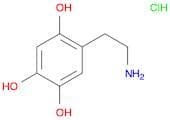
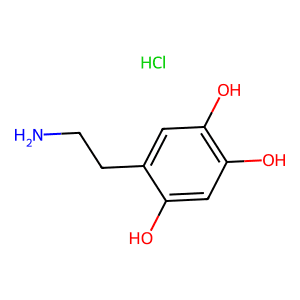
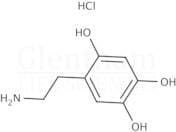
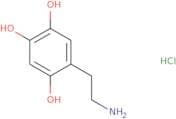
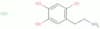
6-Hydroxydopaminhydrochlorid ist eine synthetische organische Verbindung, die hauptsächlich in der neurowissenschaftlichen Forschung verwendet wird, insbesondere zur Untersuchung neurodegenerativer Erkrankungen und der Mechanismen neuronalen Schadens. Es ist ein Derivat von Dopamin, das durch das Vorhandensein einer Hydroxylgruppe an der Position 6 des aromatischen Rings gekennzeichnet ist. Diese Verbindung ist bekannt für ihre neurotoxischen Eigenschaften, die selektiv dopaminergische Neuronen schädigen, was sie wertvoll für die Erstellung von Tiermodellen der Parkinson-Krankheit macht. In ihrer Hydrochlorid-Form ist sie ein weißes bis off-white kristallines Pulver, das in Wasser löslich ist und somit die Verwendung in biologischen Experimenten erleichtert. Die Verbindung wird typischerweise mit Vorsicht behandelt, da sie toxische Wirkungen auf Zellen und potenzielle Umweltgefahren hat. Darüber hinaus ist es wichtig zu beachten, dass 6-Hydroxydopamin oxidativen Stress induzieren kann und häufig in Studien verwendet wird, die die Rolle von oxidativem Schaden im neuronalen Zelltod untersuchen. Bei der Arbeit mit dieser Substanz in Laborumgebungen sollten geeignete Sicherheitsprotokolle befolgt werden.
Formel:C8H11NO3·ClH
InChl:InChI=1S/C8H11NO3.ClH/c9-2-1-5-3-7(11)8(12)4-6(5)10;/h3-4,10-12H,1-2,9H2;1H
InChI Key:InChIKey=QLMRJHFAGVFUAC-UHFFFAOYSA-N
SMILES:C(CN)C1=C(O)C=C(O)C(O)=C1.Cl
Synonyme:- 1,2,3-Benzenetriol, 4-(2-aminoethyl)-, hydrochloride
- 1,2,4-Benzenetriol, 5-(2-aminoethyl)-, hydrochloride
- 1,2,4-Benzenetriol, 5-(2-aminoethyl)-, hydrochloride (1:1)
- 2,4,5-Trihydroxyphenethylamine hydrochloride
- 4-(2-Aminoethyl)-1,2,3-benzenetriol hydrochloride
- 5-(2-Aminoethyl)-1,2,4-benzenetriol hydrochloride
- 5-(2-Aminoethyl)Benzene-1,2,4-Triol Hydrochloride (1:1)
- 6-Hydroxydopamine chloride
- 6-Hydroxydopamine hydrochloride
- Nsc 233898
- Oxidopamine HCl
- Oxidopamine hydrochloride
- Weitere Synonyme anzeigen
Sortieren nach
Reinheit (%)
0
100
|
0
|
50
|
90
|
95
|
100
8 Produkte.
Oxidopamine (hydrochloride)
CAS:Formel:C8H12ClNO3Reinheit:95%Farbe und Form:SolidMolekulargewicht:205.6388Oxidopamine hydrochloride
CAS:Oxidopamine hydrochloride (6-Hydroxydopamine hydrochloride) is an neurotransmitter dopamine antagonist.Formel:C8H12ClNO3Reinheit:98.34% - 99.85%Farbe und Form:Physical Description Beige Solid (Ntp 1992)Molekulargewicht:205.646-Hydroxydopaminehydrochloride
CAS:6-HydroxydopaminehydrochlorideReinheit:95%Molekulargewicht:205.64g/mol6-Hydroxydopamine hydrochloride
CAS:Formel:(HO)3C6H2CH2CH2NH2·HClReinheit:≥ 97.0%Farbe und Form:Off-white to brown powderMolekulargewicht:205.645-(2-Aminoethyl)benzene-1,2,4-triol hydrochloride
CAS:5-(2-Aminoethyl)benzene-1,2,4-triol hydrochloride (MPP+) is a neurotoxin that inhibits the synthesis of dopamine and other neurotransmitters in dopaminergic neurons. MPP+ is generated by the oxidation of l-dopa, an amino acid precursor of the neurotransmitter dopamine. MPP+ causes oxidative injury to dopaminergic neurons by affecting their mitochondria. The inhibition of mitochondrial function leads to neuronal death and Parkinson's disease. MPP+ has been shown to be cytotoxic for pluripotent cells, such as embryonic stem cells, which are important for regenerative medicine. In addition, MPP+ has been shown to cause lesions in the brain and induce cell death in a model system using rat striatum neurons and astrocytes. This agent also inhibits polymerase chain reaction (PCR), which can be used as a diagnostic tool for Parkinson's disease.Formel:C8H12ClNO3Reinheit:Min. 95%Farbe und Form:PowderMolekulargewicht:205.64 g/mol