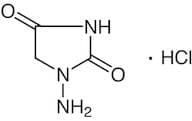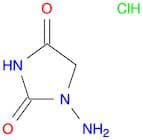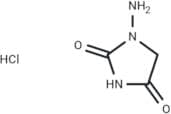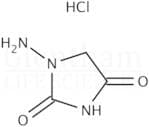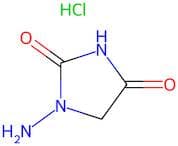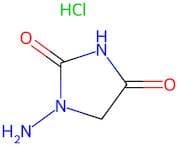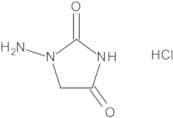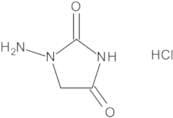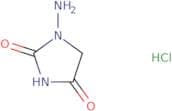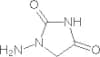
CAS 2827-56-7
:1-Aminohydantoinhydrochlorid
- 1-Amino-2,4-imidazolidinedione monohydrochloride
- 1-Aminohydantoin Hydrochloride
- 1-Aminoimidazolidine-2,4-dione hydrochloride
- 1-Amino hydatoin chloride
- 2,4-Imidazolidinedione, 1-amino-, hydrochloride (1:1)
- 2,4-Imidazolidinedione, 1-amino-, monohydrochloride
- Hydantoin, 1-amino-, hydrochloride
1-Aminohydantoin Hydrochloride
CAS:Formel:C3H5N3O2·HClReinheit:>98.0%(T)Farbe und Form:White to Light yellow powder to crystalMolekulargewicht:151.551-Aminoimidazolidine-2,4-dione hydrochloride
CAS:Formel:C3H6ClN3O2Reinheit:95%Farbe und Form:SolidMolekulargewicht:151.551-Aminohydantoin hydrochloride
CAS:1-Aminohydantoin HCl, a metabolite of furantoin, binds to proteins, releases in acid, and is detectable in meat/milk for drug residue tests.Formel:C3H6ClN3O2Reinheit:99.64%Farbe und Form:Pale Yellow PowderMolekulargewicht:151.551-Aminohydantoin hydrochloride
CAS:1-Aminohydantoin hydrochlorideFormel:C3H6ClN3O2Reinheit:≥98%Molekulargewicht:151.551-Aminohydantoin hydrochloride
CAS:1-Aminohydantoin hydrochlorideReinheit:97%Molekulargewicht:151.55g/mol1-Amino Hydantoin HCl
CAS:Formel:C3H5N3O2·HClFarbe und Form:White To Off-White SolidMolekulargewicht:115.09 36.46GB/T21311-2007 Nitrofuran Metabolites Mixture 345 100 µg/mL in Methanol
CAS:Kontrolliertes ProduktFarbe und Form:Mixture1-Amino Hydantoin Hydrochloride
CAS:Kontrolliertes ProduktStability Unstable in Solution
Applications A metabolite of Nitrofuran.Environmental contaminants; Food contaminants; Heat processing contaminants
References Tribalat, L., et al.: Anal. Bioanal. Chem., 386, 2168 (2006), Chu, P., et al.: J. Agric. Food Chem., 55, 2129 (2007),Formel:C3H5N3O2·ClHFarbe und Form:NeatMolekulargewicht:151.551-Aminohydantoin hydrochloride
CAS:1-Aminohydantoin hydrochloride is an intermediate in the synthesis of the aminohydantoins, a class of drugs used to treat epilepsy. It is also used as a reagent for preparing monoclonal antibodies. 1-Aminohydantoin hydrochloride is prepared by reacting hydrochloric acid with hydrazine and sodium citrate, followed by purification using distillation and recrystallization. 1-Aminohydantoin hydrochloride can be used to determine the presence of chloride ions in animal tissues by measuring its chemical shift on a mass spectrometer. This drug has been shown to inhibit oxidative DNA damage in rat kidneys, which may be due to its ability to suppress reactive oxygen species production.
Formel:C3H6ClN3O2Farbe und Form:PowderMolekulargewicht:151.55 g/mol