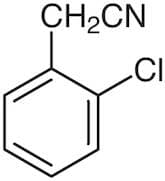
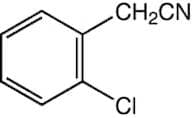
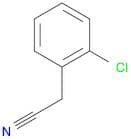
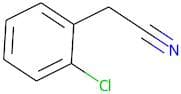
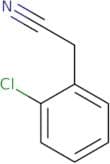
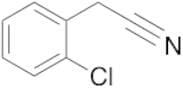
CAS 2856-63-5
:(2-Chlorphenyl)acetonitril
- (2-Chlorophenyl)acetonitrile
- (O-Chlorophenyl)acetonitrile
- 2-(2-Chlorophenyl)Acetonitrile
- 2-Chlorobenzeneacetonitrile
- 2-Chlorophenylacetonitrile
- Acetonitrile, (o-chlorophenyl)-
- Benzeneacetonitrile, 2-chloro-
- NSC 39462
- O-chlorobenzyl cyanide
- Occn
- Ortho Chlorobenzyl Cyanide
- o-Chlorobenzyl nitrile
- o-Chlorophenylacetonitrile
- Weitere Synonyme anzeigen
2-Chlorobenzyl Cyanide
CAS:Formel:C8H6ClNReinheit:>98.0%(GC)Farbe und Form:White or Colorless to Light yellow powder to lump to clear liquidMolekulargewicht:151.592-Chlorophenylacetonitrile, 98+%
CAS:This Thermo Scientific Chemicals brand product was originally part of the Alfa Aesar product portfolio. Some documentation and label information may refer to the legacy brand. The original Alfa Aesar product / item code or SKU reference has not changed as a part of the brand transition to Thermo SciFormel:C8H6ClNReinheit:98+%Farbe und Form:Clear colorless, LiquidMolekulargewicht:151.59Benzeneacetonitrile, 2-chloro-
CAS:Formel:C8H6ClNReinheit:98%Farbe und Form:LiquidMolekulargewicht:151.59292-Chlorophenylacetonitrile
CAS:2-ChlorophenylacetonitrileFormel:C8H6ClNReinheit:97%Farbe und Form: clear. faint yellow solidMolekulargewicht:151.59g/mol2-Chlorobenzyl cyanide
CAS:2-Chlorobenzyl cyanide (2CBA) is a disinfectant that has been used as an alternative to chlorine. It is not only effective against bacteria, but also against fungi, viruses, and parasites. 2CBA functions by the aerobic photooxidation of cells in water or air. In addition to its antimicrobial activity, 2CBA is also toxic to human ovary cells at high concentrations.
2CBA has a number of isomers, which differ in their solubility and ph-optimum. The most common form of 2CBA is the cis form, which has a higher solubility than the trans form. The cis form can be synthesized from benzyl chloride and sodium cyanide with sulfonation as the final step in production.
2CBA has an optimum ph value of 5-6 for its disinfectant activity; however, it can be used at a concentration of 1% at pH values below 5 or above 7Formel:C8H6ClNReinheit:Min. 95%Farbe und Form:Colorless PowderMolekulargewicht:151.59 g/mol2-Chlorobenzyl Cyanide
CAS:Kontrolliertes ProduktApplications 2-Chlorobenzyl cyanide was used in the synthesis of clopidogrel, platelet aggregation inhibitor. It can also be used to synthesize non-peptide CCR1 receptor antagonists.
Not a dangerous good if item is equal to or less than 1g/ml and there is less than 100g/ml in the package
References Huang, Y., et al.: Anhui Med. Pharm. J., 6, 007 (2009); Ng, H., et al.: J. Med. Chem., 42, 4680 (1999)Formel:C8H6ClNFarbe und Form:NeatMolekulargewicht:151.59