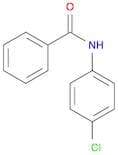
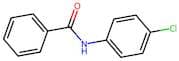
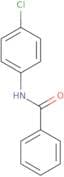
CAS 2866-82-2
:N-(4-Chlorphenyl)benzamid
Beschreibung:
N-(4-Chlorphenyl)benzamid, mit der CAS-Nummer 2866-82-2, ist eine organische Verbindung, die durch ihre Amidfunktionalität und aromatische Struktur gekennzeichnet ist. Sie weist einen Benzamid-Kern auf, an dem eine 4-Chlorphenylgruppe am Stickstoffatom des Amids angebracht ist. Diese Verbindung erscheint typischerweise als Feststoff bei Raumtemperatur und ist in organischen Lösungsmitteln wie Ethanol und Dimethylsulfoxid löslich, hat jedoch eine begrenzte Löslichkeit in Wasser aufgrund ihrer hydrophoben aromatischen Ringe. Die Anwesenheit des Chloratoms erhöht ihre Lipophilie und kann ihre biologische Aktivität beeinflussen. N-(4-Chlorphenyl)benzamid ist in verschiedenen Bereichen von Interesse, einschließlich der medizinischen Chemie, wo sie als Gerüst für die Arzneimittelentwicklung oder als potenzielles Zwischenprodukt in der organischen Synthese dienen kann. Ihre chemischen Eigenschaften, wie Schmelzpunkt, Siedepunkt und Reaktivität, können je nach den spezifischen Bedingungen und der Reinheit der Probe variieren. Sicherheitsvorkehrungen sollten beim Umgang mit dieser Verbindung beachtet werden, wie bei vielen organischen Chemikalien, aufgrund der potenziellen Toxizität und der Umweltauswirkungen.
Formel:C13H10ClNO
InChl:InChI=1S/C13H10ClNO/c14-11-6-8-12(9-7-11)15-13(16)10-4-2-1-3-5-10/h1-9H,(H,15,16)
InChI Key:InChIKey=PJFPJLMLHHTWDZ-UHFFFAOYSA-N
SMILES:C(NC1=CC=C(Cl)C=C1)(=O)C2=CC=CC=C2
Synonyme:- Benzamide, N-(4-chlorophenyl)-
- Benzanilide, 4′-chloro-
- N-(4-Chlorophenyl)-benzamide
- N-(p-Chlorophenyl)benzamide
- N-Benzoyl-4-chloroaniline
- NSC 83620
- 4′-Chlorobenzanilide
Sortieren nach
Reinheit (%)
0
100
|
0
|
50
|
90
|
95
|
100
4 Produkte.
N-(4-Chlorophenyl)benzamide
CAS:Formel:C13H10ClNOReinheit:95%Farbe und Form:SolidMolekulargewicht:231.6776N-(4-Chlorophenyl)benzenecarboxamide
CAS:N-(4-Chlorophenyl)benzenecarboxamide (PCBAA) is a reactive amide. It is used to prepare the corresponding acid chloride, which can be reacted with alcohols or amines to form esters and amides respectively. The rate of the reaction between PCBAA and water is linearly dependent on the concentration of PCBAA. The reaction is first order in both reactants and second order overall. The theory behind this chemical reaction is called nucleophilic attack theory, in which a nucleophile attacks an electrophilic carbon atom in an organic molecule. This mechanism occurs when a nucleophile such as water or alcohol attacks the carbonyl group of PCBAA, leading to a nucleophilic addition.Formel:C13H10ClNOReinheit:Min. 95%Molekulargewicht:231.68 g/mol