CAS 28705-96-6
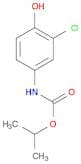
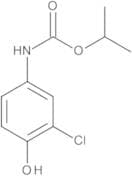
:Propan-2-yl (3-chlor-4-hydroxyphenyl)carbamat
- Carbamic acid, (3-chloro-4-hydroxyphenyl)-, 1-methylethyl ester
propan-2-yl N-(3-chloro-4-hydroxyphenyl)carbamate
CAS:Formel:C10H12ClNO3Farbe und Form:SolidMolekulargewicht:229.66024-Hydroxychlorpropham
CAS:Kontrolliertes ProduktApplications 4-Hydroxychlorpropham is an intermediate in synthesizing 4-Hydroxychlorpropham Sulfate Sodium Salt (H825075), which is a chemical herbicide used in the protection of crops. It also maintains the ability to induce mitochondrial dysfunction in rat hepatocytes.
References EPA.: Fed. Reg., 72, 37646 (2007); Nakagawa, Y. et al.: Toxicol., 200, 123 (2004);Formel:C10H12ClNO3Farbe und Form:NeatMolekulargewicht:229.664-Hydroxychlorpropham-d7
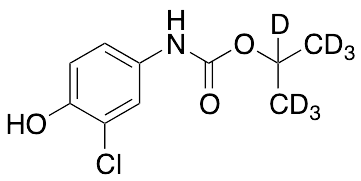
CAS:Kontrolliertes ProduktApplications 4-Hydroxychlorpropham-d7 is an intermediate in the synthesis of 4-Hydroxychlorpropham-d7 Sulfate Sodium Salt (H825077). 4-Hydroxychlorpropham-d7 Sulfate Sodium Salt is derived from Isopropanol-d7 (I822752), which is a deuterated alcohol used in the study of lignite liquefaction. 4-Hydroxychlorpropham-d7 is also the labelled analogue of 4-Hydroxychlorpropham (H825078). 4-Hydroxychlorpropham is an intermediate in synthesizing 4-Hydroxychlorpropham Sulfate Sodium Salt (H825075), which is a chemical herbicide used in the protection of crops. It also maintains the ability to induce mitochondrial dysfunction in rat hepatocytes.
References Kuznetov, P.N. et al.: Fuel, 70, 559 (1991); EPA.: Fed. Reg., 72, 37646 (2007); Nakagawa, Y. et al.: Toxicol., 200, 123 (2004)Formel:C10H5D7ClNO3Farbe und Form:NeatMolekulargewicht:236.7Propan-2-yl N-(3-chloro-4-hydroxyphenyl)carbamate
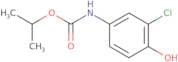
CAS:Propan-2-yl N-(3-chloro-4-hydroxyphenyl)carbamate is a phenolic compound that has been used as a substrate in studies of the metabolism of reactive electrophiles by rat hepatocytes. It is found in incubations with rat liver microsomes and mitochondria. The reaction product has been identified as propan-2-ol, which is an alcohol. Propan-2-yl N-(3-chloro-4-hydroxyphenyl)carbamate also inhibits atpase activity in rat hepatocytes and glutathione conjugates are formed when it interacts with glutathione.Formel:C10H12ClNO3Reinheit:Min. 95%Molekulargewicht:229.66 g/mol