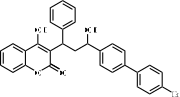
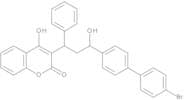
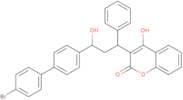
![2H-1-Benzopyran-2-one, 3-[3-(4′-bromo[1,1′-biphenyl]-4-yl)-3-hydroxy-1-phenylpropyl]-4-hydroxy-](/_next/image/?url=https%3A%2Fstatic.cymitquimica.com%2Fcas-image%2Fthumb-webp%2F310142-2h-1-benzopyran-2-one-3-3-4-bromo-11-biphenyl-4-yl-3-hydroxy-1-phenylpropyl-4-hydroxy.webp&w=3840&q=75)
CAS 28772-56-7
:2H-1-Benzopyran-2-on, 3-[3-(4'-bromo[1,1'-biphenyl]-4-yl)-3-hydroxy-1-phenylpropyl]-4-hydroxy-
- 2H-1-Benzopyran-2-one, 3-[3-(4′-bromo[1,1′-biphenyl]-4-yl)-3-hydroxy-1-phenylpropyl]-4-hydroxy-
- 3-[3-(4'-bromobiphenyl-4-yl)-3-hydroxy-1-phenylpropyl]-2-hydroxy-4H-chromen-4-one
- 3-[3-(4'-bromobiphenyl-4-yl)-3-hydroxy-1-phenylpropyl]-4-hydroxy-2H-chromen-2-one
- 3-[3-(4′-Bromo[1,1′-biphenyl]-4-yl)-3-hydroxy-1-phenylpropyl]-4-hydroxy-2H-1-benzopyran-2-one
- Bromadiolone
- Coumarin, 3-[α-[p-(p-bromophenyl)-β-hydroxyphenethyl]benzyl]-4-hydroxy-
- Hemus AB
- Ratonil
- Roban
- Maki
Bromadiolone (Mixture of Diastereomers)
CAS:Formel:C30H23BrO4Farbe und Form:White To Off-White SolidMolekulargewicht:527.41Rodenticides Mixture 248 100 µg/mL in Acetonitrile
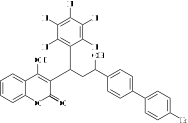
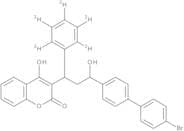
CAS:Kontrolliertes ProduktFormel:C31H23BrO3Farbe und Form:MixtureMolekulargewicht:523.42Bromadiolone-d5 (Mixture of Diasteromers)
CAS:Kontrolliertes ProduktFormel:C30D5H18BrO4Farbe und Form:NeatMolekulargewicht:532.44Bromadiolone
CAS:Kontrolliertes ProduktApplications Bromadiolone is an anticoagulant rodenticide used on non-crop areas.
Not a dangerous good if item is equal to or less than 1g/ml and there is less than 100g/ml in the package
References Cherry, L., et al.: Toxicologist, 2, 108 (1992), Park, B., et al.: Biochem. Pharmacol., 31, 3635 (1992), Thijssen, H., et al.: Pestic Sci., 43, 73 (1995), Howald, G., et al.: Conserv. Biol., 21, 1258 (2007),Formel:C30H23BrO4Farbe und Form:WhiteMolekulargewicht:527.41Bromadiolone
CAS:Bromadiolone NA is a rodenticide that is used in the treatment of rodents in wastewater treatment. Bromadiolone NA has been shown to inhibit the mitochondrial membrane potential, which leads to the release of cytochrome C and activation of caspase 3. Bromadiolone NA also has antioxidative properties that protect against oxidative injury and its metabolites have been found to inhibit human serum albumin. This compound has been used as an antimicrobial agent to control biofilm formation and prevent microbial growth. The mode of action for bromadiolone is through the inhibition of chitosan polymerization, which prevents bacterial attachment and biofilm formation on surfaces. Bromadiolone NA was also shown to bind with DNA, inhibiting replication and transcription.
Formel:C30H23BrO4Reinheit:Min. 95%Farbe und Form:PowderMolekulargewicht:527.41 g/mol