CAS 288-35-7
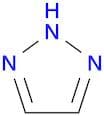
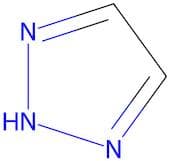
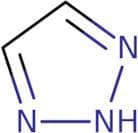
:2H-1,2,3-Triazol
Beschreibung:
2H-1,2,3-Triazol ist eine fünfgliedrige heterocyclische Verbindung, die durch ihre einzigartige Ringstruktur mit zwei Stickstoffatomen und drei Kohlenstoffatomen gekennzeichnet ist. Es handelt sich um einen farblosen bis hellgelben Feststoff bei Raumtemperatur, dessen Schmelzpunkt je nach Reinheit und Form variiert. Diese Verbindung ist bekannt für ihre Stabilität und relativ geringe Reaktivität, was sie in verschiedenen Anwendungen nützlich macht, einschließlich Pharmazeutika, Agrochemikalien und als Ligand in der Koordinationschemie. 2H-1,2,3-Triazol kann aufgrund der Anwesenheit von Stickstoffatomen an Wasserstoffbrückenbindungen teilnehmen, was ihre Löslichkeit in polaren Lösungsmitteln erhöht. Sie ist auch bekannt für ihre Fähigkeit, stabile Komplexe mit Metallionen zu bilden, was in der Katalyse und Materialwissenschaft von Wert ist. Darüber hinaus wurden Derivate von 2H-1,2,3-Triazol auf ihre potenziellen biologischen Aktivitäten, einschließlich antimikrobieller und fungizider Eigenschaften, untersucht. Ihre CAS-Nummer, 288-35-7, wird zur Identifizierung in chemischen Datenbanken und regulatorischen Kontexten verwendet. Insgesamt ist 2H-1,2,3-Triazol eine vielseitige Verbindung von erheblicher Bedeutung sowohl in der Forschung als auch in industriellen Anwendungen.
Formel:C2H3N3
InChl:InChI=1S/C2H3N3/c1-2-4-5-3-1/h1-2H,(H,3,4,5)
InChI Key:InChIKey=QWENRTYMTSOGBR-UHFFFAOYSA-N
SMILES:C=1C=NNN1
Synonyme:- 2,5-Diazapyrrole
- 2H-1,2,3-Triazole
- 2H-Triazole
- Osotriazole
Sortieren nach
Reinheit (%)
0
100
|
0
|
50
|
90
|
95
|
100
6 Produkte.
2H-1,2,3-Triazole
CAS:2H-1,2,3-Triazole is a drug that belongs to the class of antiretroviral drugs. It has been shown to bind to Toll-like receptor 4 (TLR4) and inhibit HIV replication in vitro. 2H-1,2,3-Triazole is used as part of an active antiretroviral therapy for postprandial blood glucose control and for congestive heart failure. In addition, it inhibits the production of proinflammatory cytokines by binding to toll-like receptor 4 (TLR4) which is expressed on macrophages. 2H-1,2,3-Triazole can also be used as an active analogue for coumarin derivatives such as warfarin and dicoumarol. The conformational properties of this drug are similar to those of coumarin derivatives and it binds to the same site on the enzyme as these drugs do. This binding prevents the formation of anFormel:C2H3N3Reinheit:Min. 95%Molekulargewicht:69.07 g/mol