CAS 29086-41-7
:1,1-Bis(bromomethyl)cyclopropan
Beschreibung:
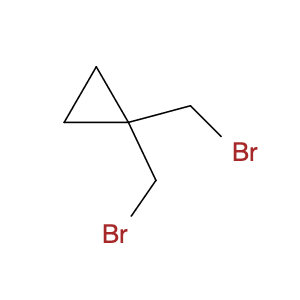
1,1-Bis(bromomethyl)cyclopropan ist eine organische Verbindung, die durch ihre einzigartige Cyclopropanstruktur gekennzeichnet ist, die aus einem dreigliedrigen Kohlenstoffring besteht. Das Vorhandensein von zwei Brommethylgruppen, die an dasselbe Kohlenstoffatom des Cyclopropanrings gebunden sind, beeinflusst erheblich seine Reaktivität und Eigenschaften. Diese Verbindung ist typischerweise eine farblose bis blassgelbe Flüssigkeit und ist bekannt für ihre hohe Reaktivität aufgrund der Anwesenheit von Bromatomen, die an verschiedenen Substitutions- und Additionsreaktionen teilnehmen können. Sie wird häufig als Zwischenprodukt in der organischen Synthese verwendet, insbesondere bei der Herstellung komplexerer Moleküle. Die Verbindung ist licht- und feuchtigkeitsempfindlich, was sorgfältige Handhabung und Lagerbedingungen erfordert. Darüber hinaus kann sie Gesundheitsrisiken darstellen, einschließlich Toxizität und potenzieller Karzinogenität, was angemessene Sicherheitsmaßnahmen während der Verwendung erforderlich macht. Ihre Anwendungen können sich auf Bereiche wie Pharmazie und Agrochemikalien erstrecken, wo sie als Baustein für komplexere chemische Strukturen dient.
Formel:C5H8Br2
InChl:InChI=1S/C5H8Br2/c6-3-5(4-7)1-2-5/h1-4H2
InChI Key:InChIKey=GJCHFNVRRQTXHL-UHFFFAOYSA-N
SMILES:C(Br)C1(CBr)CC1
Synonyme:- 1,1-Bis(bromomethyl)cyclopropane
- 1,1-Di(bromomethyl)cyclopropane
- Cyclopropane, 1,1-bis(bromomethyl)-
Sortieren nach
Reinheit (%)
0
100
|
0
|
50
|
90
|
95
|
100
4 Produkte.
1,1-bis(bromomethyl)cyclopropane
CAS:Formel:C5H8Br2Reinheit:96%Farbe und Form:LiquidMolekulargewicht:227.92501,1-bis-(Bromomethyl)cyclopropane
CAS:1,1-bis-(Bromomethyl)cyclopropaneReinheit:95%Molekulargewicht:227.93g/mol1,1-Bis(bromomethyl)cyclopropane
CAS:Formel:C5H8Br2Reinheit:96%Farbe und Form:OilMolekulargewicht:227.9271,1-Bis(bromomethyl)cyclopropane
CAS:1,1-Bis(bromomethyl)cyclopropane (1,1-BMC) is a brominated derivative of the cyclopropane molecule that has been used as a tracer to investigate atmospheric reactions. 1,1-BMC can be used as an anion indicator in electrochemical experiments because it is sensitive to the charge on the electrode surface. Kinetic studies have shown that 1,1-BMC reacts with ozone at low concentrations and with hydrogen peroxide at high concentrations. This reactivity is consistent with the sensitivity of 1,1-BMC to anions. The sensitivity of 1,1-BMC may be due to its ability to form enamines or imines when exposed to ozone or hydrogen peroxide. As a result of these reactions, 1,1-BMC becomes oxidized and forms positive charges that are detected by voltmeters. This electrochemical analysis technique has been applied to air samples from the troposphereFormel:C5H8Br2Reinheit:Min. 95%Molekulargewicht:227.94 g/mol