CAS 2909-84-4
:Benzenamin, 2,4-bis(1,1-dimethylethyl)-
Beschreibung:
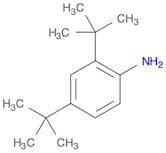
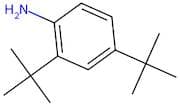
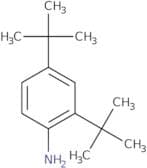
Benzenamin, 2,4-bis(1,1-dimethylethyl)-, auch bekannt als 2,4-di-tert-butylanilin, ist eine organische Verbindung, die durch ihre Aminfunktionalgruppe, die an einen Benzolring gebunden ist, gekennzeichnet ist, der an den Positionen 2 und 4 zusätzlich durch tert-Butylgruppen substituiert ist. Diese Struktur verleiht eine signifikante sterische Hinderung, die ihre Reaktivität und physikalischen Eigenschaften beeinflusst. Die Verbindung ist typischerweise eine farblose bis blassgelbe Flüssigkeit oder ein Feststoff, abhängig von Temperatur und Reinheit. Sie ist bekannt für ihre geringe Löslichkeit in Wasser, aber gute Löslichkeit in organischen Lösungsmitteln, was sie in verschiedenen chemischen Anwendungen nützlich macht. Benzolamin-Derivate werden häufig als Zwischenprodukte in der Synthese von Farbstoffen, Arzneimitteln und Agrochemikalien eingesetzt. Darüber hinaus verbessert die Anwesenheit der tert-Butylgruppen ihre thermische Stabilität und Widerstandsfähigkeit gegen Oxidation. Sicherheitsüberlegungen umfassen den vorsichtigen Umgang, da potenzielle reizende Eigenschaften bestehen, sowie die Notwendigkeit geeigneter persönlicher Schutzausrüstung während der Verwendung.
Formel:C14H23N
Synonyme:- 2,4-Di-tert-butyl aniline
Sortieren nach
Reinheit (%)
0
100
|
0
|
50
|
90
|
95
|
100
4 Produkte.
2,4-Di-tert-butylaniline
CAS:Formel:C14H23NReinheit:98%Farbe und Form:LiquidMolekulargewicht:205.33912,4-di-tert-Butylaniline hydrochloride
CAS:<p>The reaction mechanism of 2,4-di-tert-butylaniline hydrochloride is the alkylation of anilines with protonated tert-butyl chloride. This reaction proceeds by a substitution process in which one or more hydrogen atoms are replaced by the substituent. The selectivity of this reaction depends on the parameters and conditions used to carry it out. The reaction can be carried out under autogenous conditions or with the addition of a catalyst such as nickel (Ni), palladium (Pd) or platinum (Pt). The product obtained can be modified by changing the catalyst, solvent, temperature, pressure and other parameters. Reaction kinetics is affected by additives such as water, alcohols and acids that may be added during the reaction process. The size and shape of nanoparticles can also affect kinetic properties.<br>2,4-di-tert-Butylaniline hydrochloride has been shown to have high activity for organic synthesis in hom</p>Formel:C14H24ClNReinheit:Min. 95%Farbe und Form:White PowderMolekulargewicht:241.8 g/mol