CAS 29162-73-0
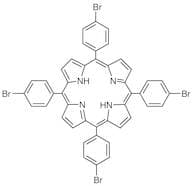
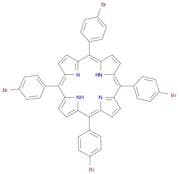
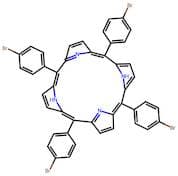
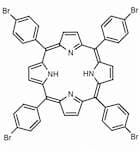
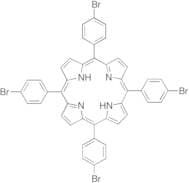
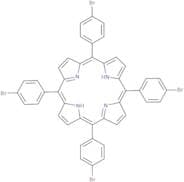
:5,10,15,20-tetrakis(4-bromphenyl)porphyrin
5,10,15,20-Tetrakis(4-bromophenyl)porphyrin
CAS:Formel:C44H26Br4N4Reinheit:>95.0%(HPLC)Farbe und Form:Purple to Dark purple powder to crystalMolekulargewicht:930.34Meso-tetra (p-bromophenyl) porphine
CAS:Formel:C44H26Br4N4Reinheit:97%Farbe und Form:SolidMolekulargewicht:930.3200Meso-Tetra (P-Bromophenyl) Porphine
CAS:Meso-Tetra (P-Bromophenyl) PorphineReinheit:95%Molekulargewicht:930.32g/molTetra(p-bromophenyl)porphyrin
CAS:Tetra(p-bromophenyl)porphyrin (compound 5c), a fluorescent dye, is employed in synthesizing perfluoroalkyl-substituted tetrakisphenylporphyrins [1].Formel:C44H26Br4N4Farbe und Form:SolidMolekulargewicht:930.32meso-Tetra (p-Bromophenyl) Porphine
CAS:Kontrolliertes ProduktApplications meso-Tetra (p-Bromophenyl) Porphine is a synthetic halogenated porphyrin.
Formel:C44H26Br4N4Farbe und Form:NeatMolekulargewicht:930.32Tetrabromophenyl-porphyrin
CAS:Tetrabromophenyl-porphyrin (TBP) is a synthetic molecule that interacts with aldehydes in the presence of light. This interaction results in the formation of a phenyl radical and an excited state, which leads to the production of carbon dioxide and water. TBP is used as a catalyst for these reactions because it is more stable than other molecules that are typically used. The catalytic effect of TBP can be studied by means of spectroscopies and microscopy techniques. The crystal x-ray diffraction technique was used to analyze the molecular structure of TBP by determining the distances between atoms in its molecules. It was discovered that TBP has two phenyl groups and four bromine atoms per porphyrin ring. Diffraction techniques were also used to study how light interacts with TBP molecules, showing that they have strong optical properties when adsorbed on surfaces.
Formel:C44H26N4Br4Reinheit:Min. 95%Molekulargewicht:930.32 g/mol