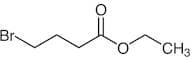
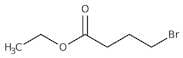
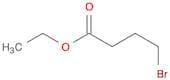
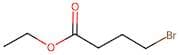
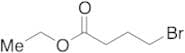
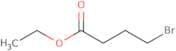
CAS 2969-81-5
:Ethyl-4-brombutyrat
- 1-Bromo-3-(carboethoxy)propane
- 3-(Ethoxycarbonyl)propyl bromide
- 4-Bromobutanoic acid ethyl ester
- 4-Bromobutirato De Etilo
- 4-Bromobutyrate D'Ethyle
- 4-Bromobutyric acid ethyl ester
- Butanoate, 4-Bromo-, Ethyl
- Butanoic acid, 4-bromo-, ethyl ester
- Butyric acid, 4-bromo-, ethyl ester
- Ethyl 4-Bromobutanoate
- Ethyl γ-bromobutyrate
- Ethyl-4-brombutyrat
- Nsc 133462
- γ-Bromobutyric acid ethyl ester
- Weitere Synonyme anzeigen
Ethyl 4-Bromobutyrate
CAS:Formel:C6H11BrO2Reinheit:>97.0%(GC)Farbe und Form:Colorless to Light yellow clear liquidMolekulargewicht:195.06Ethyl 4-bromobutyrate, 98%
CAS:Ethyl 4-bromobutyrate is used as a building block for the preparation of firefly luciferase inhibitor-conjucated peptide derivatives. It finds application in the synthesis of poly(2,6,-dimethyl-1,4-phehylene oxide) and thieno(2,3-b)-azepin-4-ones. This Thermo Scientific Chemicals brand product was oFormel:C6H11BrO2Reinheit:98%Farbe und Form:Clear colorless to pale yellow, LiquidMolekulargewicht:195.06Butanoic acid, 4-bromo-, ethyl ester
CAS:Formel:C6H11BrO2Reinheit:97%Farbe und Form:LiquidMolekulargewicht:195.0543Ref: IN-DA002Z4S
5g20,00€10g20,00€50g24,00€25g26,00€100g29,00€200g41,00€250g41,00€500g52,00€1kg79,00€5kg214,00€Ethyl 4-bromobutyrate
CAS:Formel:C6H11BrO2Reinheit:≥ 98.5%Farbe und Form:Colourless to light yellow liquidMolekulargewicht:195.05Ethyl 4-bromobutanoate
CAS:Ethyl 4-bromobutanoateFormel:C6H11BrO2Reinheit:98%Farbe und Form: clear. almost colourless liquidMolekulargewicht:195.05g/molEthyl 4-Bromobutanoate
CAS:Kontrolliertes ProduktApplications Ethyl 4-Bromobutanoate is a building block which has been used as a reactant for the preparation of firefly luciferase inhibitor-conjugated peptide derivatives.
References Poutiainen, P.K., et. al.: Bioconjugate Chem., 25, 4 (2014)Formel:C6H11BrO2Farbe und Form:NeatMolekulargewicht:195.054-Bromobutyric acid ethyl ester
CAS:4-Bromobutyric acid ethyl ester is a potent antitumor agent that has been shown to inhibit the proliferation of tumor cells in vitro and in vivo. It is a monoclonal antibody with high specificity for tumor cells and can be used as an anticancer agent. 4-Bromobutyric acid ethyl ester binds to the surface of tumor cells and triggers an acylation reaction, which results in the formation of a covalent bond between the molecule and the lipid membrane of the cell. This leads to cell death by apoptosis. 4-Bromobutyric acid ethyl ester has also been shown to have chemical stability, as well as biological properties such as locomotor activity.
Formel:C6H11BrO2Reinheit:Min. 95%Farbe und Form:Colorless Clear LiquidMolekulargewicht:195.05 g/molRef: 3D-FB29734
Ausgelaufenes produkt