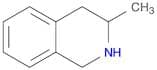
CAS 29726-60-1
:3-Methyl-1,2,3,4-tetrahydroisochinolin
Beschreibung:
3-Methyl-1,2,3,4-tetrahydroisochinolin ist eine bicyclische organische Verbindung, die zur Klasse der Isoquinoline gehört, die von der Isoquinolinstruktur abgeleitet sind. Diese Verbindung weist ein Tetrahydroisoquinolin-Gerüst auf, was darauf hinweist, dass sie eine partielle Hydrierung durchlaufen hat, was zu einem gesättigten Ringsystem führt. Die Anwesenheit einer Methylgruppe an der Position 3 trägt zu ihren einzigartigen chemischen Eigenschaften und ihrer Reaktivität bei. Sie ist typischerweise eine farblose bis blassgelbe Flüssigkeit oder ein Feststoff, abhängig von ihrer Reinheit und Form. Die Verbindung ist bekannt für ihre potenziellen biologischen Aktivitäten, einschließlich Wirkungen auf das zentrale Nervensystem, und wurde für ihre Rolle in der medizinischen Chemie, insbesondere bei der Entwicklung von Arzneimitteln, untersucht. Ihre molekulare Struktur ermöglicht verschiedene Modifikationen funktioneller Gruppen, was sie zu einem vielseitigen Zwischenprodukt in der organischen Synthese macht. Darüber hinaus kann 3-Methyl-1,2,3,4-tetrahydroisochinolin in organischen Lösungsmitteln löslich sein, und ihre Stabilität kann durch Umweltfaktoren wie Temperatur und Licht beeinflusst werden.
Formel:C10H13N
InChl:InChI=1/C10H13N/c1-8-6-9-4-2-3-5-10(9)7-11-8/h2-5,8,11H,6-7H2,1H3
SMILES:CC1Cc2ccccc2CN1
Synonyme:- 1,2,3,4-Tetrahydro-3-methylisoquinoline
- Isoquinoline, 1,2,3,4-Tetrahydro-3-Methyl-
Sortieren nach
Reinheit (%)
0
100
|
0
|
50
|
90
|
95
|
100
2 Produkte.
3-Methyl-1,2,3,4-tetrahydroisoquinoline
CAS:<p>3-Methyl-1,2,3,4-tetrahydroisoquinoline (3MT) is a chiral compound that can be used as a drug. It has been shown to have affinity for the striatal dopamine receptor and inhibitory potency against the pressor response in rats. 3MT may also be able to reverse tachyphylaxis when administered with selegiline. The toxicities of 3MT are similar to those of other drugs that act on the same receptor, such as atropine and selegiline. 3MT is not active against bacterial infections because it does not disrupt the cell membrane and does not have an effect on the synthesis of proteins.</p>Formel:C10H13NReinheit:Min. 95%Molekulargewicht:147.22 g/mol