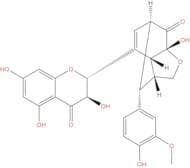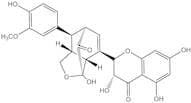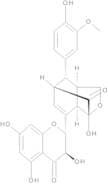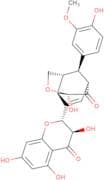
CAS 29782-68-1
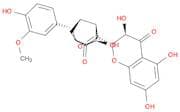
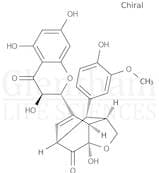
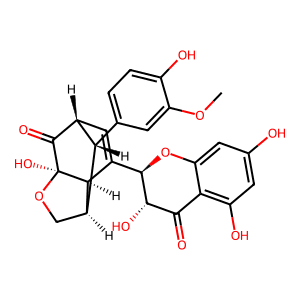
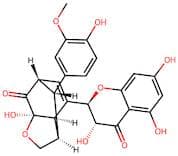
:Silydianin
Beschreibung:
Silydianin ist eine Flavonolignan-Verbindung, die hauptsächlich aus der Mariendistel-Pflanze, Silybum marianum, gewonnen wird. Es ist einer der aktiven Bestandteile von Silymarin, einem Komplex von Flavonoiden, der für seine hepatoprotektiven Eigenschaften bekannt ist. Silydianin zeigt antioxidative Aktivität, die hilft, freie Radikale zu neutralisieren und den oxidativen Stress in Leberzellen zu reduzieren. Diese Verbindung wird oft auf ihre potenziellen therapeutischen Effekte bei Lebererkrankungen, einschließlich Hepatitis und Zirrhose, untersucht, da sie die Leberregeneration fördern und die Leberfunktion verbessern kann. Darüber hinaus wurde Silydianin auf seine entzündungshemmenden und zytoprotektiven Effekte untersucht, die zu seinen allgemeinen Gesundheitsvorteilen beitragen. Die Substanz zeichnet sich typischerweise durch ihre Löslichkeit in organischen Lösungsmitteln und ihre begrenzte Löslichkeit in Wasser aus, was für viele Flavonoide typisch ist. Ihre pharmakologischen Eigenschaften und das Sicherheitsprofil machen sie zu einem interessanten Thema in der Kräutermedizin und in Nahrungsergänzungsmitteln, die darauf abzielen, die Lebergesundheit zu unterstützen.
Formel:C25H22O10
InChl:InChI=1S/C25H22O10/c1-33-16-4-9(2-3-14(16)27)18-11-7-12(20-13(18)8-34-25(20,32)24(11)31)23-22(30)21(29)19-15(28)5-10(26)6-17(19)35-23/h2-7,11,13,18,20,22-23,26-28,30,32H,8H2,1H3/t11-,13-,18+,20+,22+,23-,25-/m1/s1
InChI Key:InChIKey=CYGIJEJDYJOUAN-JSGXPVSSSA-N
SMILES:O[C@@]12[C@@]3([C@@]([C@H]([C@@](C=C3[C@H]4OC=5C(C(=O)[C@@H]4O)=C(O)C=C(O)C5)(C1=O)[H])C6=CC(OC)=C(O)C=C6)(CO2)[H])[H]
Synonyme:- (+)-2,3alpha,3aalpha,7a-Tetrahydro-7aalpha-hydroxy-8-(4-hydroxy-3-methoxyphenyl)-4-(3alpha,5,7-trihydroxy-4-oxo-2beta-chromanyl)-3,6-methanobenzofuran-7(6alphaH)-one
- (3R,3aR,6R,7aR)-7a-hydroxy-8-(4-hydroxy-3-methoxyphenyl)-4-[(2R,3R)-3,5,7-trihydroxy-4-oxo-3,4-dihydro-2H-chromen-2-yl]-2,3,3a,7a-tetrahydro-3,6-methano-1-benzofuran-7(6H)-one
- (3R,3aR,6R,7aR,8R)-4-[(2R,3R)-3,4-Dihydro-3,5,7-trihydroxy-4-oxo-2H-1-benzopyran-2-yl]-2,3,3a,7a-tetrahydro-7a-hydroxy-8-(4-hydroxy-3-methoxyphenyl)-3,6-methanobenzofuran-7(6H)-one
- (3R,3aR,6R,7aR,8R)-7a-hydroxy-8-(4-hydroxy-3-methoxyphenyl)-4-[(2R)-3,5,7-trihydroxy-4-oxo-3,4-dihydro-2H-chromen-2-yl]-2,3,3a,7a-tetrahydro-3,6-methano-1-benzofuran-7(6H)-one
- 3,6-Methanobenzofuran-7(6H)-one, 4-(3,4-dihydro-3,5,7-trihydroxy-4-oxo-2H-1-benzopyran-2-yl)-2,3,3a,7a-tetrahydro-7a-hydroxy-8-(4-hydroxy-3-methoxyphenyl)-, [3R-[3α,3aβ,4(2R*,3R*),6α,7aβ,8R*]]-
- 3,6-Methanobenzofuran-7(6H)-one, 4-[(2R,3R)-3,4-dihydro-3,5,7-trihydroxy-4-oxo-2H-1-benzopyran-2-yl]-2,3,3a,7a-tetrahydro-7a-hydroxy-8-(4-hydroxy-3-methoxyphenyl)-, (3R,3aR,6R,7aR,8R)-
- 3,6-Methanobenzofuran-7(6αH)-one, 2,3α,3aα,7a-tetrahydro-7aα-hydroxy-8-(4-hydroxy-3-methoxyphenyl)-4-(3α,5,7-trihydroxy-4-oxo-2β-chromanyl)-, (+)-
- 7a-hydroxy-8-(4-hydroxy-3-methoxyphenyl)-4-(3,5,7-trihydroxy-4-oxo-3,4-dihydro-2H-chromen-2-yl)-2,3,3a,7a-tetrahydro-3,6-methano-1-benzofuran-7(6H)-one
- Silidianin [INN]
- Silidianina
- Silidianina [INN-Spanish]
- Silidianine
- Silidianine [INN-French]
- Silidianinum
- Silidianinum [INN-Latin]
- Weitere Synonyme anzeigen
Sortieren nach
Reinheit (%)
0
100
|
0
|
50
|
90
|
95
|
100
12 Produkte.
Silydianin
CAS:Aromatic heterocyclic compounds with oxygen hetero-atom(s) only, nesoiFormel:C25H22O10Farbe und Form:Yellow PowderMolekulargewicht:482.1213(3R,3Ar,6R,7Ar,8R)-7A-Hydroxy-8-(4-Hydroxy-3-Methoxyphenyl)-4-((2R,3R)-3,5,7-Trihydroxy-4-Oxochroman-2-Yl)-3,3A,6,7A-Tetrahydro-3,6-Methanobenzofuran-7(2H)-One
CAS:(3R,3Ar,6R,7Ar,8R)-7A-Hydroxy-8-(4-Hydroxy-3-Methoxyphenyl)-4-((2R,3R)-3,5,7-Trihydroxy-4-Oxochroman-2-Yl)-3,3A,6,7A-Tetrahydro-3,6-Methanobenzofuran-7(2H)-OneReinheit:95%Molekulargewicht:482.44g/molSilydianin
CAS:Silydianin, an active constituent of Silybium marianum, has inhibitory effect on on the in vitro production and release of oxidative products. Silydianin has possible antiinflammatory activity, which regulates caspase-3 activation, affects cell membranes and acts as a free radical scavenger.Formel:C25H22O10Reinheit:95%~99%Molekulargewicht:482.441Silydianin
CAS:Silydianin inhibits UGT, OATP1B1, OATP1B3 in HEK293 cells, and OATP2B1 in MDCK2 cells.Formel:C25H22O10Reinheit:98.01% - 98.56%Farbe und Form:SolidMolekulargewicht:482.44Silydianin
CAS:Oxygen-heterocyclic compoundFormel:C25H22O10Reinheit:≥ 95.0 % (HPLC)Farbe und Form:PowderMolekulargewicht:482.44Silydianin
CAS:Kontrolliertes ProduktApplications Silydianin is an active constituent of Silybium marianum and is known the exhibit anti-inflammatory activity which regulates caspase-3 activation which affects cell membranes and acts as a free radical scavenger.
References Zlelinska-Przyyjemska, M., et al.: Phytother. Res., 20, 115 (2006); Milan, M., et al.L Anal. Chimica. Acta., 486, 125 (2003); Liu, Y.Z., et al.: Chin. Herb. Med., 4, 237 (2012);Formel:C25H22O10Farbe und Form:Off-WhiteMolekulargewicht:482.44Silydianin
CAS:Silydianin is a flavonolignan compound, which is derived from the seeds of the milk thistle plant, Silybum marianum. Its primary mode of action involves antioxidant properties and inhibition of lipid peroxidation. Silydianin contributes to the stabilization of cell membranes, thereby preventing toxins from entering liver cells, and also stimulates the activity of ribosomal RNA, promoting liver cell regeneration.Formel:C25H22O10Reinheit:Min. 95.0 Area-%Molekulargewicht:482.44 g/mol