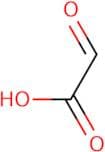
CAS 298-12-4
:Glyoxylsäure
Beschreibung:
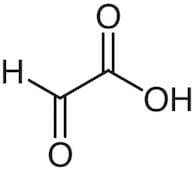
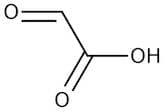
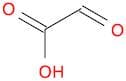
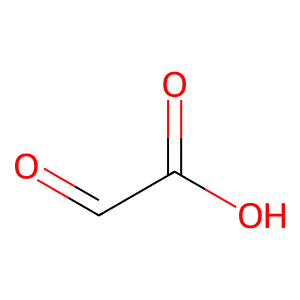
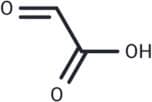
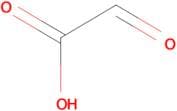
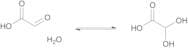
Glyoxylsäure, mit der CAS-Nummer 298-12-4, ist eine einfache organische Verbindung, die durch ihre Struktur als Dicarbonylverbindung gekennzeichnet ist und sowohl eine Aldehyd- als auch eine Carbonsäurefunktionalität aufweist. Es handelt sich um eine farblose bis blassgelbe Flüssigkeit mit einem stechenden Geruch und es ist hoch wasserlöslich, was es zu einem vielseitigen Reagenz in verschiedenen chemischen Reaktionen macht. Glyoxylsäure ist bekannt für seine Reaktivität, insbesondere in Kondensationsreaktionen, und wird häufig in der Synthese verschiedener organischer Verbindungen, einschließlich Aminosäuren und Arzneimitteln, verwendet. Es kann auch als Reduktionsmittel wirken und ist an der Bildung von Glyoxylat-Derivaten beteiligt. In Bezug auf die Sicherheit wird Glyoxylsäure als gefährlich angesehen, mit potenziellen Reizwirkungen auf Haut, Augen und Atemwege, was angemessene Handhabungsvorkehrungen erforderlich macht. Seine Anwendungen erstrecken sich auf die Bereiche Biochemie, Landwirtschaft und die Herstellung von Farbstoffen und Duftstoffen, was seine Bedeutung sowohl in industriellen als auch in Laborumgebungen unterstreicht.
Formel:C2H2O3
InChl:InChI=1/C2H2O3/c3-1-2(4)5/h1H,(H,4,5)/p-1
InChI Key:InChIKey=HHLFWLYXYJOTON-UHFFFAOYSA-N
SMILES:C(C=O)(O)=O
Synonyme:- 2-Oxoacetic acid
- Acetic acid, 2-oxo-
- Acide glyoxylique
- Acido Glioxilico
- Carboxyformaldehyde
- Formylcarboxylic acid
- Formylformic acid
- Glyoxalic acid
- Glyoxo High Pure 50
- Glyoxylic Acid
- Glyoxylsaeure
- Glyoxylsaure
- Nsc 27785
- Oxalaldehydic acid
- Oxoacetic acid
- Oxoethanoic acid
- α-Ketoacetic acid
- Acetic acid, oxo-
- Glyoxalate
- glyoxylate
- oxoacetate
- Aldehydoformicacid
- 2-Oxoethanoic Acid
- oxo-acetic acid
- Formic acid, formyl-
- Formylformic
- glyoxylicacid(50%orless)
- formyl-formicaci
- alpha-ketoaceticacid
- oxo-aceticaci
- GA
- oxalaldehydicacid
- OCHCOOH
- alpha-Ketoacetic acid
- kyselinaglyoxylova
- Kyselina glyoxylova
- Weitere Synonyme anzeigen
Sortieren nach
Reinheit (%)
0
100
|
0
|
50
|
90
|
95
|
100
12 Produkte.
Glyoxylic Acid (ca. 50% in Water, ca. 9mol/L)
CAS:Formel:C2H2O3Farbe und Form:Colorless to Light orange to Yellow clear liquidMolekulargewicht:74.04Glyoxylic acid, 50% w/w aq. soln.
CAS:This Thermo Scientific Chemicals brand product was originally part of the Alfa Aesar product portfolio. Some documentation and label information may refer to the legacy brand. The original Alfa Aesar product / item code or SKU reference has not changed as a part of the brand transition to Thermo SciFormel:C2H2O3Farbe und Form:Clear colorless to yellow, LiquidMolekulargewicht:74.04Glyoxylic acid solution, 50% in water
CAS:Formel:C2H2O3Reinheit:%Farbe und Form:LiquidMolekulargewicht:74.0355Glyoxylic acid, 50% in water
CAS:Formel:OHCCO2HFarbe und Form:Colourless to light yellow liquidMolekulargewicht:74.04Glyoxalic acid
CAS:Glyoxalic acid is an organic compound. It is both an aldehyde and a carboxylic acid.Formel:C2H2O3Farbe und Form:SoildMolekulargewicht:74.04Glyoxylic acid (ca. 50% in Water, ca. 9mol/L)
CAS:Reinheit:95.0%Farbe und Form:LiquidMolekulargewicht:74.03500366210938Glyoxylic Acid (50% aqueous solution)
CAS:Applications Glyoxylic Acid is used as a reagent in the synthesis of N-{[6-chloro-4-(2,6-dimethoxyphenyl)quinazolin-2-yl]carbonyl}-L-leucine, a novel nonpeptide chemotype selective for neurotensin receptor 2. Also used as a reagent in the synthesis of elemonic acid derivatives as Pin1 inhibitors.
References Thomas, J.B., et al.: Bioorg. Med. Chem. Lett., 25, 292 (2015); Li, X., et al.: Bioorg. Med. Chem. Lett., 24, 5612 (2014)Formel:C2H2O3Farbe und Form:Colourless LiquidMolekulargewicht:74.04Glyoxylic acid - 50% aqueous solution
CAS:Glyoxylic acid is a dicarboxylic acid that can be found in the human body. It is oxidized to glyoxylate, which is then converted to oxalate by enzymes. Glyoxylic acid is a product of glycolysis, and has been shown to have antioxidant properties. Glyoxylic acid has been shown to inhibit the production of peptide hormones such as ACTH and TRH, as well as infectious diseases such as AIDS and malaria. It also has an effect on biochemical properties such as the redox potentials. The optimum extraction process for this compound is by ion-exchange chromatography with aqueous solvent. X-ray diffraction data can be used to identify this compound. The reaction mechanism for glyoxylic acid involves two steps: oxidation at carbon 2 followed by elimination at carbon 3. This chemical can be detected using analytical methods such as spectrophotometry or x-ray photoelectron spectroscopy (XPSFormel:C2H2O3Reinheit:Min. 95%Farbe und Form:Clear LiquidMolekulargewicht:74.04 g/mol