CAS 29953-71-7
:trans-3-Indolacrylsäure
Beschreibung:
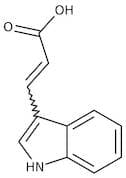
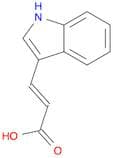
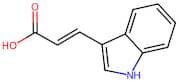
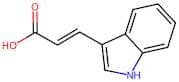
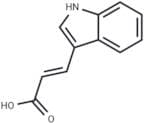
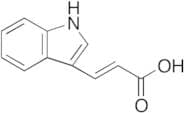
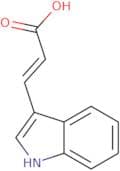
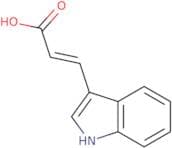
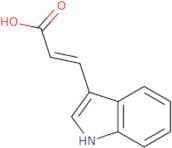
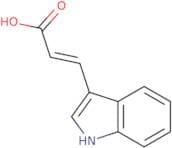
trans-3-Indolacrylsäure ist eine organische Verbindung, die durch ihre Indol- und Acrylsäure-Moieties gekennzeichnet ist. Sie weist eine trans-Konfiguration auf, die ihre räumliche Anordnung und folglich ihre chemische Reaktivität und biologische Aktivität beeinflusst. Die Verbindung ist typischerweise ein weißer bis schmutzig-weißer Feststoff und in organischen Lösungsmitteln löslich, was ihre amphiphile Natur widerspiegelt, die durch die Anwesenheit sowohl hydrophober Indol- als auch hydrophiler Carbonsäuregruppen bedingt ist. trans-3-Indolacrylsäure hat in verschiedenen Bereichen, insbesondere in der medizinischen Chemie, Interesse geweckt, aufgrund seiner potenziellen entzündungshemmenden und krebsbekämpfenden Eigenschaften. Es wirkt als Modulator biologischer Wege, einschließlich derjenigen, die an Zellproliferation und Apoptose beteiligt sind. Darüber hinaus ermöglicht die strukturelle Ähnlichkeit mit anderen biologisch aktiven Verbindungen eine weitere Erforschung im Bereich der Arzneimittelgestaltung und -entwicklung. Die Stabilität und Reaktivität der Verbindung können durch Faktoren wie pH und Temperatur beeinflusst werden, was sie zu einem interessanten Thema sowohl für die synthetische als auch für die angewandte Chemieforschung macht.
Formel:C11H9NO2
InChl:InChI=1S/C11H9NO2/c13-11(14)6-5-8-7-12-10-4-2-1-3-9(8)10/h1-7,12H,(H,13,14)/b6-5+
InChI Key:InChIKey=PLVPPLCLBIEYEA-AATRIKPKSA-N
SMILES:C(=C/C(O)=O)\C=1C=2C(NC1)=CC=CC2
Synonyme:- (2E)-1-(Aminooxy)-3-(1H-indol-3-yl)prop-2-en-1-one
- (2E)-3-(1H-Indol-3-yl)-2-propenoic acid
- (E)-3-(1H-Indol-3-yl)-2-propenoic acid
- (E)-3-(1H-Indol-3-yl)prop-2-enoic acid
- 2-Propenoic acid, 3-(1H-indol-3-yl)-, (2E)-
- 2-Propenoic acid, 3-(1H-indol-3-yl)-, (E)-
- 2-propen-1-one, 1-(aminooxy)-3-(1H-indol-3-yl)-, (2E)-
- Indole-3-acrylic acid, (E)-
- Indole-3-crylic acid
- amino (E)-3-(1H-indol-3-yl)prop-2-enoate
- trans-3-Indoleacrylic acid
- trans-Indole-3-acryic acid
- Weitere Synonyme anzeigen
Sortieren nach
Reinheit (%)
0
100
|
0
|
50
|
90
|
95
|
100
13 Produkte.
trans-Indole-3-acrylic acid, 98+%
CAS:It is an important raw material and intermediate used in organic synthesis, pharmaceuticals, agrochemicals. This Thermo Scientific Chemicals brand product was originally part of the Alfa Aesar product portfolio. Some documentation and label information may refer to the legacy brand. The original AlfFormel:C11H9NO2Reinheit:98+%Farbe und Form:Pale cream to cream to brown, Crystals or powder or crystalline powderMolekulargewicht:187.2trans 3-Indoleacrylic acid
CAS:Formel:C11H9NO2Reinheit:95%Farbe und Form:SolidMolekulargewicht:187.1947(2E)-3-(1H-Indol-3-yl)acrylic acid
CAS:(2E)-3-(1H-Indol-3-yl)acrylic acidReinheit:98%Molekulargewicht:187.19g/moltrans-3-Indoleacrylic acid
CAS:trans-3-Indoleacrylic acid (trans-IAA) is a Tryptophan metabolite.Formel:C11H9NO2Reinheit:97.25% - 99.51%Farbe und Form:White To Light Yellow PowderMolekulargewicht:187.19trans-Indole-3-acrylic acid
CAS:Formel:C11H9NO2Reinheit:≥ 98.0%Farbe und Form:White to beige solidMolekulargewicht:187.20trans-Indole-3-acrylic Acid
CAS:Applications trans-Indole-3-acrylic Acid is a regent used as a matrix for MALDI-TOF mass spectroscopy in order to characterize polyphenols.
References Madrigal-Carballo, S., et al.: Int Food Res J, 20, 2023-2034 (2013)Formel:C11H9NO2Farbe und Form:NeatMolekulargewicht:187.19trans-3-Indoleacrylic acid
CAS:Trans-3-indoleacrylic acid (TIAA) is a metabolite that is produced by the degradation of tryptophan. TIAA has been shown to have a matrix effect on cells, which influences their energy production and regulation. TIAA has also been shown to be involved in the synthesis of proteins, such as the signal peptide and polymerase chain reaction (PCR). TIAA may also be involved in transcription activators and metabolic disorders. The effects of TIAA are most likely due to its ability to inhibit synthetase activity.Formel:C11H9NO2Farbe und Form:PowderMolekulargewicht:187.19 g/molIndole-3-acrylic acid
CAS:Indole-3-acrylic acid is a versatile building block that can be used to synthesize complex compounds. It is also a reagent and speciality chemical, as well as a useful building block. Indole-3-acrylic acid can be used in the production of a number of chemicals, such as pharmaceuticals, agrochemicals, and dyes. This compound may also be used as an intermediate or reaction component in organic synthesis. The CAS number for indole-3-acrylic acid is 29953-71-7.Formel:C11H9NO2Molekulargewicht:187.20 g/molIndole-3-acrylic acid, 98.0%+
CAS:Indole-3-acrylic acid (IAA) is a fine chemical that can be used as a versatile building block in research. It is an intermediate for the synthesis of other chemicals and has been used as a reaction component in the synthesis of complex compounds. IAA is also a useful building block for the preparation of high quality reagents. Its CAS number is 29953-71-7.Formel:C11H9NO2Molekulargewicht:187.20 g/molIndole-3-acrylic acid, 99.5%+
CAS:Please enquire for more information about Indole-3-acrylic acid, 99.5%+ including the price, delivery time and more detailed product information at the technical inquiry form on this page
Formel:C11H9NO2Molekulargewicht:187.20 g/mol