


CAS 29964-62-3
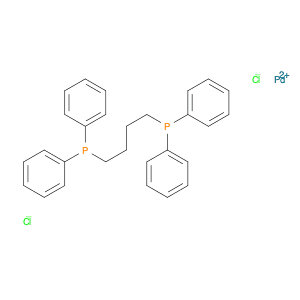
:Bis(diphenylphosphino)butanpalladiumdichlorid
Beschreibung:
Bis(diphenylphosphino)butanpalladiumdichlorid, mit der CAS-Nummer 29964-62-3, ist ein Koordinationskomplex, der ein Palladiumzentrum aufweist, das an zwei Diphenylphosphin-Liganden und zwei Chloridionen koordiniert ist. Diese Verbindung zeichnet sich durch ihre Verwendung in der Katalyse aus, insbesondere in Kreuzkopplungsreaktionen wie den Suzuki- und Stille-Reaktionen, die in der organischen Synthese zur Bildung von Kohlenstoff-Kohlenstoff-Bindungen von entscheidender Bedeutung sind. Die Anwesenheit der Diphenylphosphin-Liganden erhöht die Stabilität und Reaktivität des Palladiumzentrums, wodurch es zu einem effektiven Katalysator wird. Typischerweise ist diese Verbindung bei Raumtemperatur ein Feststoff und kann in organischen Lösungsmitteln löslich sein. Ihre Reaktivität kann durch Faktoren wie die elektronischen Eigenschaften der Liganden und die Reaktionsbedingungen beeinflusst werden. Sicherheitsvorkehrungen sollten beim Umgang mit dieser Verbindung getroffen werden, da Palladiumkomplexe toxisch sein können und gemäß den entsprechenden Labor-Sicherheitsprotokollen behandelt werden sollten.
Formel:C28H28Cl2P2Pd
InChl:InChI=1/C28H28P2.2ClH.Pd/c1-5-15-25(16-6-1)29(26-17-7-2-8-18-26)23-13-14-24-30(27-19-9-3-10-20-27)28-21-11-4-12-22-28;;;/h1-12,15-22H,13-14,23-24H2;2*1H;/q;;;+2/p-2
SMILES:c1ccc(cc1)P(CCCCP(c1ccccc1)c1ccccc1)c1ccccc1.Cl.Cl.[Pd]
Synonyme:- [1,4-Bis(diphenylphosphino)butane]palladium(II) dichloride
- 1,4-Bis(diphenylphosphino)butane-palladium(II) chloride
- Butane-1,4-Diylbis(Diphenylphosphane)-Dichloropalladium (1:1)
Sortieren nach
Reinheit (%)
0
100
|
0
|
50
|
90
|
95
|
100
8 Produkte.
[1,4-Bis(diphenylphosphino)butane]palladium(II) Dichloride
CAS:Formel:C28H28Cl2P2PdReinheit:>96.0%(T)Farbe und Form:White to Light yellow to Green powder to crystalMolekulargewicht:603.80Dichloro[bis(1,4-diphenylphosphino)butane]palladium(II), Pd 17.6%
CAS:Dichloro[bis(1,4-diphenylphosphino)butane]palladium(II) is used for the catalysis of styrene carbonylation, coupling of alkyl Grignard reagents with organic halides, selective monoalkylation of organic polyhalides, and modification of the dihalovinyl moiety of synthetic pyrethroids. This Thermo ScieFormel:C28H28Cl2P2PdReinheit:17.6%Molekulargewicht:603.80Dichloro[1,4-bis(diphenylphosphino)butane]palladium(II), 99%
CAS:Dichloro[1,4-bis(diphenylphosphino)butane]palladium(II), 99%
Formel:C28H28Cl2P2PdReinheit:99%Farbe und Form:light-yellow pwdr.Molekulargewicht:603.801,4-Bis(diphenylphosphino)butane-palladium(II) chloride
CAS:Formel:C28H30Cl2P2PdReinheit:98%Farbe und Form:SolidMolekulargewicht:605.8113Dichloro[bis(1,4-diphenylphosphino)butane]palladium(II)
CAS:Dichloro[bis(1,4-diphenylphosphino)butane]palladium(II)Reinheit:98%Farbe und Form:SolidMolekulargewicht:603.80g/molDichloro[1,4-bis(Diphenylphosphino)Butane]Palladium(II) extrapure, 98%
CAS:Formel:C28H28Cl2P2PMolekulargewicht:603.8[1,4-Bis(diphenylphosphino)butane]palladium(II) Dichloride
CAS:Kontrolliertes Produkt[1,4-Bis(diphenylphosphino)butane]palladium(II) dichloride (PdCl2(DPPB)) is a covalent catalyst that is used in the cross-coupling of styrene with chlorides. It has been shown to be a very effective catalyst for this reaction and yields high yields. The use of this catalyst allows for the quantification of the phosphine ligand that is used in the reaction. [1,4-Bis(diphenylphosphino)butane]palladium(II) dichloride has also been shown to be an efficient catalyst for other reactions, such as solvents and diphosphine ligands.Formel:C28H28Cl2P2PdReinheit:Min. 95%Molekulargewicht:603.79 g/mol
![[1,4-Bis(diphenylphosphino)butane]palladium(II) Dichloride](/_next/image/?url=https%3A%2Fstatic.cymitquimica.com%2Fproducts%2F3B%2Fthumb%2FB2031.jpg&w=3840&q=75)

![Dichloro[bis(1,4-diphenylphosphino)butane]palladium(II), Pd 17.6%](/_next/image/?url=https%3A%2Fstatic.cymitquimica.com%2Fproducts%2F02%2Fthumb%2F044971.jpg&w=3840&q=75)

![Dichloro[1,4-bis(diphenylphosphino)butane]palladium(II), 99%](/_next/image/?url=https%3A%2Fstatic.cymitquimica.com%2Fproducts%2F08%2Fthumb%2F46-0468.jpg&w=3840&q=75)


![Dichloro[bis(1,4-diphenylphosphino)butane]palladium(II)](/_next/image/?url=https%3A%2Fstatic.cymitquimica.com%2Fproducts%2F54%2Fthumb%2FOR931969.jpg&w=3840&q=75)


![Dichloro[1,4-bis(diphenylphosphino)butane]palladium (II)](/_next/image/?url=https%3A%2Fstatic.cymitquimica.com%2Fproducts%2F10%2Fthumb%2FF551798.jpg&w=3840&q=75)

![[1,4-Bis(diphenylphosphino)butane]palladium(II) Dichloride](/_next/image/?url=https%3A%2Fstatic.cymitquimica.com%2Fproducts%2F3D%2Fthumb%2FFB60968.jpg&w=3840&q=75)
