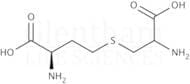
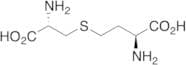
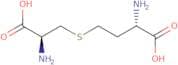
![S-[(2S)-2-amino-2-carboxyethyl]-L-homocysteine](/_next/image/?url=https%3A%2Fstatic.cymitquimica.com%2Fcas-image%2Fthumb-webp%2F318110-s-2s-2-amino-2-carboxyethyl-l-homocysteine.webp&w=3840&q=75)
CAS 2998-83-6
:S-[(2S)-2-amino-2-carboxyethyl]-L-homocystein
Beschreibung:
S-[(2S)-2-amino-2-carboxyethyl]-L-homocystein, auch bekannt als Homocystein-Thiolacton, ist ein schwefelhaltiges Aminosäurederivat, das eine bedeutende Rolle in verschiedenen biochemischen Prozessen spielt. Es ist eine nicht-proteinogene Aminosäure, was bedeutet, dass sie nicht in Proteine eingebaut wird, sondern an Stoffwechselwegen beteiligt ist. Diese Verbindung weist eine Thiolgruppe auf, die zu ihrer Reaktivität und biologischen Funktionen beiträgt, insbesondere im Kontext der zellulären Signalübertragung und Redoxreaktionen. Homocystein wird hauptsächlich aus dem Metabolismus von Methionin produziert und kann in Cystein umgewandelt oder remethyliert werden, um Methionin zu bilden, was es zu einem wichtigen Zwischenprodukt im Aminosäurestoffwechsel macht. Erhöhte Homocysteinwerte sind mit Herz-Kreislauf-Erkrankungen und anderen Gesundheitsproblemen verbunden, was ihre Bedeutung in der klinischen Biochemie unterstreicht. Die Verbindung kommt typischerweise in ihrer L-Form vor, die biologisch aktiv ist, und ihre Struktur umfasst sowohl eine Aminogruppe als auch eine Carbonsäuregruppe, was zu ihrer Klassifizierung als Aminosäure beiträgt.
Formel:C7H14N2O4S
InChl:InChI=1/C7H14N2O4S/c8-4(6(10)11)1-2-14-3-5(9)7(12)13/h4-5H,1-3,8-9H2,(H,10,11)(H,12,13)/t4-,5+/m0/s1
Synonyme:- DL-Allocystathionine
Sortieren nach
Reinheit (%)
0
100
|
0
|
50
|
90
|
95
|
100
3 Produkte.
D-Allocystathionine
CAS:Kontrolliertes ProduktFormel:C7H14N2O4SFarbe und Form:NeatMolekulargewicht:222.26D-Allocystathionine
CAS:D-Allocystathionine is a natural organic compound that contains a sulfur atom and two thiol groups. It is an intermediate in the synthesis of cysteine from methionine. D-Allocystathionine is also an inhibitor of fibrinogen, which can be used as a therapeutic agent for the treatment of cardiovascular disease. D-Allocystathionine binds to the active site of enzymes that contain disulfide bonds, such as phaeochromogenes and lysosomal enzymes. This binding prevents the oxidation of sulfhydryl groups to form disulfides, thereby inhibiting their activity.Formel:C7H14N2O4SReinheit:Min. 95%Farbe und Form:PowderMolekulargewicht:222.26 g/mol