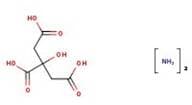
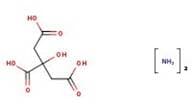
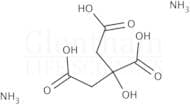
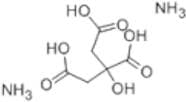
CAS 3012-65-5
:Diammoniumcitrat
Beschreibung:
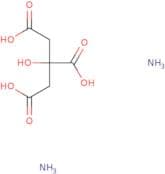
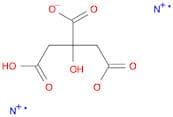
Diammoniumcitrat ist eine anorganische Verbindung mit der Formel (NH4)2C6H6O7, die häufig als Dünger und Lebensmittelzusatzstoff verwendet wird. Sie erscheint als weißes kristallines Feststoff, das hochlöslich in Wasser ist, was sie effektiv für Anwendungen macht, die eine schnelle Verfügbarkeit von Nährstoffen erfordern. Die Verbindung entsteht durch die Reaktion von Zitronensäure mit Ammoniak, was zu einem Salz führt, das sowohl Stickstoff- als auch Citrat-Ionen liefert, die das Pflanzenwachstum fördern und die Bodenqualität verbessern können. Diammoniumcitrat zeichnet sich durch seine Fähigkeit aus, als Chelatbildner zu wirken, was hilft, Metallionen in Lösung zu stabilisieren, was in verschiedenen landwirtschaftlichen und industriellen Prozessen von Vorteil ist. Darüber hinaus gilt es als sicher für die Verwendung in Lebensmitteln und entspricht den regulatorischen Standards. Seine hygroskopische Natur ermöglicht es ihm, Feuchtigkeit aus der Umgebung aufzunehmen, was seine Lagerung und Handhabung beeinflussen kann. Insgesamt wird Diammoniumcitrat für seine doppelte Rolle bei der Bereitstellung essentieller Nährstoffe und der Verbesserung der Bioverfügbarkeit anderer Elemente in verschiedenen Anwendungen geschätzt.
Formel:C6H8O7·2H3N
InChl:InChI=1S/C6H8O7.2H3N/c7-3(8)1-6(13,5(11)12)2-4(9)10;;/h13H,1-2H2,(H,7,8)(H,9,10)(H,11,12);2*1H3
InChI Key:InChIKey=YXVFQADLFFNVDS-UHFFFAOYSA-N
SMILES:C(CC(O)=O)(CC(O)=O)(C(O)=O)O.N
Synonyme:- 1,2,3-Propanetricarboxylic acid, 2-hydroxy-, ammonium salt (1:2)
- 1,2,3-Propanetricarboxylic acid, 2-hydroxy-, diammonium salt
- 2-Hydroxy-1,2,3-propanetricarboxylic acid, diammonium salt
- AmmCitrate
- Ammonium citrate
- Ammonium citrate ((NH<sub>4</sub>)<sub>2</sub>O<sub>7</sub>C<sub>6</sub>H<sub>6</sub>)
- Ammonium citrate, dibasic
- Ammonium hydrogen citrate
- Ammonium monohydrogen citrate
- Ammonium monohydrogencitrat
- Citrate diammonium hydrogen
- Citric acid, diammonium salt
- Diammonium 2-hydroxy-1,2,3-propanetricarboxylate
- Diammonium 3-Carboxy-3-Hydroxypentanedioate
- Diammonium citrate (secondary)
- Diammonium hydrogen 2-hydroxypropane-1,2,3-tricarboxylate
- Diammonium hydrogen citrate
- Dibasic ammonium citrate
- Microstop
- Triammonium 2-Hydroxypropane-1,2,3-Tricarboxylate
- Weitere Synonyme anzeigen
Sortieren nach
Reinheit (%)
0
100
|
0
|
50
|
90
|
95
|
100
8 Produkte.
Citric acid diammonium salt, ACS, 98.0-103.0%
CAS:Citric acid diammonium salt is used in pharmaceuticals, rust proofing, cotton printing and plasticizers. It is also used as a reagent for the determination of phosphate in fertilizers, and as a buffering agent, chelating agent and source of nitrogen in chicken food supplements. This Thermo ScientifiFormel:C6H14N2O7Reinheit:98.0-103.0%Molekulargewicht:226.19Citric acid diammonium salt, 99+%
CAS:Citric acid diammonium salt is used in pharmaceuticals, rust proofing, cotton printing and plasticizers. It is used as a reagent for the determination of phosphate in fertilizers, and as a buffering agent, chelating agent and source of nitrogen in chicken food supplements. This Thermo Scientific CheFormel:C6H14N2O7Reinheit:99+%Farbe und Form:White or colorless, Crystals or crystalline powder or powderMolekulargewicht:226.19di-Ammonium hydrogen citrate
CAS:Formel:C6H14N2O7Reinheit:98.0 - 103.0 %Farbe und Form:White crystalline powder or crystalsMolekulargewicht:226.19Diammonium Hydrogen Citrate Anhydrous (Ammonium Citrate Dibasic) ACS, 98%
CAS:Formel:C6H14N2O7Reinheit:min. 98%Farbe und Form:White, Crystalline compound, Clear, ColourlessMolekulargewicht:226.18Ammonium citrate dibasic
CAS:Formel:C6H14N2O7Reinheit:99.0%Farbe und Form:LiquidMolekulargewicht:226.185Diammonium hydrogen citrate
CAS:Diammonium hydrogen citrate is a nutrient solution that contains copper chloride, sodium citrate, and hydrogen fluoride. It is used in surface methodology to separate hydroxyl groups from the surface of an object. Diammonium hydrogen citrate has been shown to be effective in enhancing iron homeostasis in skin cells. It also has been shown to have anti-malarial properties that are due to its ability to chelate copper ions and prevent the formation of free radicals. The reaction solution can be used for the synthesis of diammonium citrate, which is a monoclonal antibody.Formel:C6H14N2O7Reinheit:Min. 95%Farbe und Form:White PowderMolekulargewicht:226.18 g/mol