CAS 3030-06-6
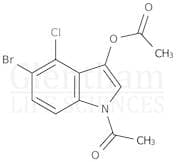
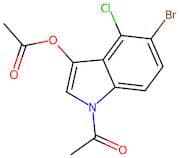
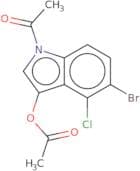
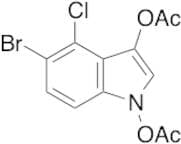
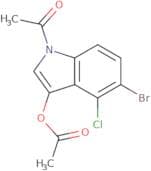
:1-Acetyl-5-brom-4-chlor-1H-indol-3-ylacetat
Beschreibung:
1-Acetyl-5-brom-4-chlor-1H-indol-3-ylacetat, mit der CAS-Nummer 3030-06-6, ist eine chemische Verbindung, die zur Familie der Indole gehört und durch ihre komplexe aromatische Struktur gekennzeichnet ist. Diese Verbindung weist ein Brom- und ein Chlor-Substituenten im Indolring auf, was ihre Reaktivität und biologische Aktivität beeinflussen kann. Das Vorhandensein der funktionellen Gruppen Acetyl und Acetat deutet darauf hin, dass sie Eigenschaften aufweisen könnte, die typisch für acetylierte Verbindungen sind, wie erhöhte Lipophilie und Potenzial für biologische Aktivität. Die Halogen-Substituenten können auch einzigartige elektronische Eigenschaften verleihen, die potenziell die Wechselwirkung der Verbindung mit biologischen Zielen beeinflussen. Diese Verbindung könnte aufgrund ihrer strukturellen Merkmale von Interesse in der medizinischen Chemie und Forschung sein, die zu verschiedenen pharmakologischen Effekten führen könnten. Darüber hinaus würde ihre Synthese und Charakterisierung typischerweise Standardtechniken der organischen Chemie umfassen, einschließlich Halogenierungs- und Acetylierungsreaktionen. Insgesamt stellt 1-Acetyl-5-brom-4-chlor-1H-indol-3-ylacetat ein vielseitiges Gerüst für weitere chemische Erkundungen und potenzielle Anwendungen in der Arzneimittelentwicklung dar.
Formel:C12H9BrClNO3
InChl:InChI=1S/C12H9BrClNO3/c1-6(16)15-5-10(18-7(2)17)11-9(15)4-3-8(13)12(11)14/h3-5H,1-2H3
InChI Key:InChIKey=DSHQTSIXXYZXGR-UHFFFAOYSA-N
SMILES:O(C(C)=O)C=1C=2C(N(C(C)=O)C1)=CC=C(Br)C2Cl
Synonyme:- Indol-3-ol, 1-acetyl-5-bromo-4-chloro-, acetate (ester)
- Ethanone, 1-[3-(acetyloxy)-5-bromo-4-chloro-1H-indol-1-yl]-
- Indoxyl, 1-acetyl-5-bromo-4-chloro-, acetate
- Indol-3-ol, 1-acetyl-5-bromo-4-chloro-, acetate
- 1H-Indol-3-ol, 1-acetyl-5-bromo-4-chloro-, acetate (ester)
Sortieren nach
Reinheit (%)
0
100
|
0
|
50
|
90
|
95
|
100
8 Produkte.
1-Acetyl-5-bromo-4-chloro-3-indolyl Acetate
CAS:Formel:C12H9BrClNO3Reinheit:>98.0%(GC)Farbe und Form:White to Yellow to Orange powder to crystalMolekulargewicht:330.56Ethanone, 1-[3-(acetyloxy)-5-bromo-4-chloro-1H-indol-1-yl]-
CAS:Formel:C12H9BrClNO3Reinheit:98%Farbe und Form:SolidMolekulargewicht:330.56185-Bromo-4-chloroindolyl-1,3-diacetate
CAS:5-Bromo-4-chloroindolyl-1,3-diacetateReinheit:98%Molekulargewicht:330.56g/mol5-Bromo-4-chloroindolyl 1,3-diacetate
CAS:5-Bromo-4-chloroindolyl 1,3-diacetate (5BCDA) is a clinical response predictor of postoperative radiotherapy. It is an acr20 response predictor for the diagnosis of chronic hepatitis C and the disease activity index in women with genital herpes. 5BCDA has been found to be effective in reducing levels of IL-17a and IL-17f, which are cytokines that are important for immune responses. 5BCDA has also been shown to be effective in treating infectious diseases such as malaria and tuberculosis.Formel:C12H9BrClNO3Reinheit:Min. 95%Farbe und Form:Off-White PowderMolekulargewicht:330.57 g/mol1-Acetyl-5-bromo-4-chloro-1H-indol-3-yl acetate
CAS:Formel:C12H9BrClNO3Reinheit:98%Molekulargewicht:330.565-Bromo-4-chloro-3-indolyl-1,3-diacetate
CAS:Kontrolliertes ProduktStability Moisture, Temperature, Light sensitive
Applications 5-Bromo-4-chloro-3-indolyl-1,3-diacetate (cas# 3030-06-6) is a compound useful in organic synthesis.Formel:C12H9BrClNO3Farbe und Form:NeatMolekulargewicht:330.565-Bromo-4-chloro-3-indoxyl-1,3-diacetate
CAS:5-Bromo-4-chloro-3-indoxyl-1,3-diacetate (BCID) is a potent and selective inhibitor of the tyrosine kinase enzyme. BCID has been shown to inhibit the growth of various cell cultures in vitro including murine and human cells. BCID has been shown to be an effective inhibitor of TNF-α production in murine models for asthma and allergic rhinitis. The drug has also been shown to reversibly inhibit the activity of the enzyme without affecting its ability to bind substrate or to regenerate active enzyme form inactive enzyme, indicating that it does not act as a suicide inhibitor.
Formel:C12H9BrClNO3Reinheit:Min. 98.0 Area-%Molekulargewicht:330.56 g/molRef: 3D-B-7120
Ausgelaufenes produkt

![Ethanone, 1-[3-(acetyloxy)-5-bromo-4-chloro-1H-indol-1-yl]-](/_next/image/?url=https%3A%2Fstatic.cymitquimica.com%2Fproducts%2FIN%2Fthumb%2FDA002ZKC.jpg&w=3840&q=75)