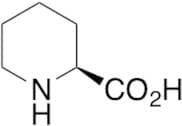
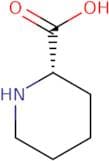
CAS 3105-95-1
:L-Pipecolinsäure
Beschreibung:
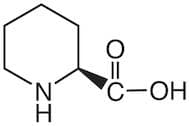
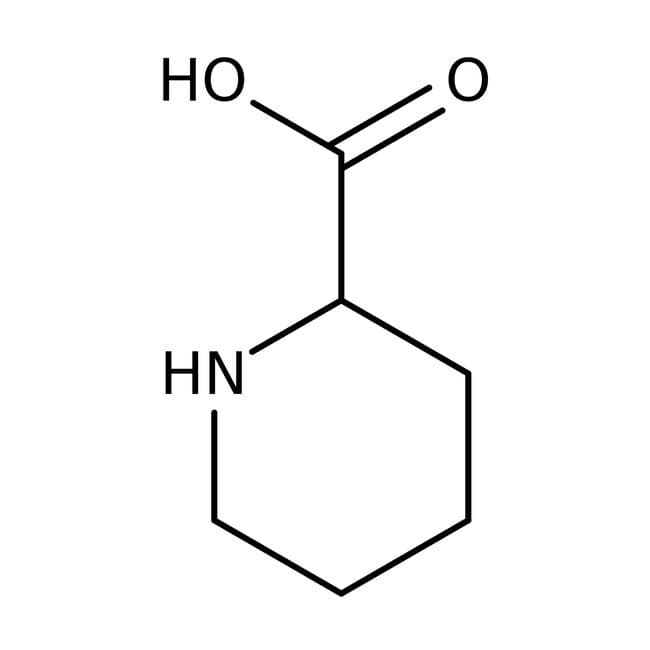
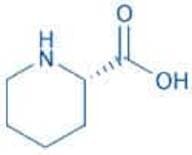
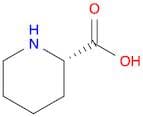
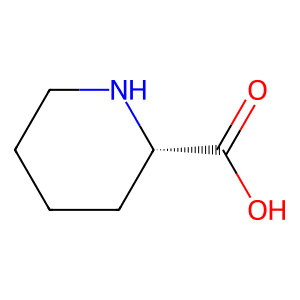
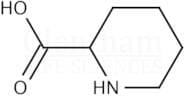
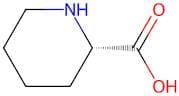
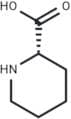
L-Pipecolinsäure ist eine zyklische Aminosäure, die durch ihre sechsgliedrige Piperidinringstruktur gekennzeichnet ist, die eine Carbonsäurefunktion enthält. Es handelt sich um eine natürlich vorkommende Verbindung, die häufig in verschiedenen biologischen Systemen zu finden ist und eine Rolle im Stoffwechsel von Lysin spielt. Die chemische Formel von L-Pipecolinsäure ist C6H11NO2, was auf die Anwesenheit von Kohlenstoff-, Wasserstoff-, Stickstoff- und Sauerstoffatomen hinweist. Diese Verbindung ist typischerweise ein weißer bis off-white kristalliner Feststoff und in Wasser löslich, was ihre polare Natur aufgrund der Carbonsäuregruppe widerspiegelt. L-Pipecolinsäure ist bekannt für seine Beteiligung an mehreren biochemischen Wegen, einschließlich seiner potenziellen Rolle als Signalmolekül und in der Synthese anderer bioaktiver Verbindungen. Darüber hinaus hat es in der pharmazeutischen Forschung Interesse geweckt wegen seiner potenziellen therapeutischen Anwendungen, insbesondere im Kontext neurologischer Störungen. Seine Eigenschaften, wie Schmelzpunkt und spezifische Reaktivität, können je nach Umweltbedingungen und Reinheit variieren.
Formel:C6H11NO2
InChl:InChI=1S/C6H11NO2/c8-6(9)5-3-1-2-4-7-5/h5,7H,1-4H2,(H,8,9)/t5-/m0/s1
InChI Key:InChIKey=HXEACLLIILLPRG-YFKPBYRVSA-N
SMILES:C(O)(=O)[C@@H]1CCCCN1
Synonyme:- (-)-Pipecolic acid
- (-)-Pipecolinic acid
- (2S)-2-Piperidinecarboxylic acid
- (2S)-Piperidin-1-ium-2-carboxylate
- (2S)-piperidine-2-carboxylate
- (2S)-piperidine-2-carboxylic acid
- (S)-(-)-2-Piperidinecarboxylic Acid
- (S)-(-)-Pipecolic acid
- (S)-Pipecolinic acid
- (S)-Piperidine-2-carboxylic acid
- 2-Piperidinecarboxylic acid (2S)-
- 2-Piperidinecarboxylic acid, (S)-
- <span class="text-smallcaps">L</span>-(-)-Pipecolic acid
- <span class="text-smallcaps">L</span>-Homoproline
- <span class="text-smallcaps">L</span>-Pipecolinic acid
- <span class="text-smallcaps">L</span>-Piperidine-2-carboxylic acid
- L(-)-2-Pipecolinic acid
- L(-)-Pipecolinic Acid
- L-Homoproline
- NSC 93089
- Weitere Synonyme anzeigen
Sortieren nach
Reinheit (%)
0
100
|
0
|
50
|
90
|
95
|
100
11 Produkte.
L-Pipecolic Acid
CAS:Formel:C6H11NO2Reinheit:>98.0%(T)(HPLC)Farbe und Form:White to Light yellow powder to crystalMolekulargewicht:129.16L-Pipecolinic acid, 99%
CAS:L-Pipecolinic acid is involved in synaptic transmission in the central nervous system. It is also used as pharmaceutical intermediate. This Thermo Scientific Chemicals brand product was originally part of the Alfa Aesar product portfolio. Some documentation and label information may refer to the legFormel:C6H11NO2Reinheit:99%Farbe und Form:White to cream, PowderMolekulargewicht:129.16H-Homopro-OH
CAS:High enantioselectivies could be achieved (> 98% ee) when choosing L-pipecolic acid as catalyst for asymmetric Mannich reactions.Formel:C6H11NO2Reinheit:> 99%Farbe und Form:WhitishMolekulargewicht:129.162-Piperidinecarboxylic acid, (2S)-
CAS:Formel:C6H11NO2Reinheit:97%Farbe und Form:SolidMolekulargewicht:129.1570(L)-Pipecolinic acid
CAS:(L)-Pipecolinic acidFormel:C6H11NO2Reinheit:98%Farbe und Form: pale yellow solidMolekulargewicht:129.15703g/molL-Pipecolic acid
CAS:L-Pipecolic acid, a lysine metabolite, builds up in infants with peroxisomal genetic disorders like Zellweger syndrome.Formel:C6H11NO2Reinheit:99.75% - 99.92%Farbe und Form:SolidMolekulargewicht:129.16L-Pipecolic Acid
CAS:Applications Pipecolic acid is involved in synaptic transmission in the central nervous system. The l-form occurs in plants.
References Nomura Y., et al.: Neurochem. Res., 6, 391 (1981),Formel:C6H11NO2Farbe und Form:NeatMolekulargewicht:129.16Pipecolic acid
CAS:Pipecolic acid is a metabolite of tryptophan that has been shown to inhibit the proliferation of pluripotent cells in vitro. Pipecolic acid was also shown to have a significant effect on the reaction mechanism of dinucleotide phosphate, which is essential for the synthesis of DNA and RNA. Pipecolic acid can be synthesized from picolinic acid through an amide bond formation. This compound is also found in wild-type strains as well as cancerous and infectious strains of bacteria. Pipecolic acid inhibits bacterial growth by binding to the active site of specific enzymes, such as methionine adenosyltransferase and ribonucleotide reductase, leading to the inhibition of protein synthesis and cell division. It has been shown to inhibit leukemia inhibitory factor (LIF) activity in vitro, suggesting that it may be involved in urinary infections. Pipecolic acid can also be prepared using preparative high-performance liquid chromatography (preparFormel:C6H11NO2Reinheit:Min. 95%Farbe und Form:White PowderMolekulargewicht:129.16 g/mol