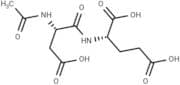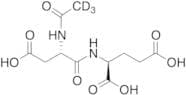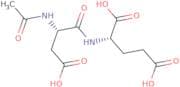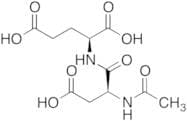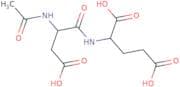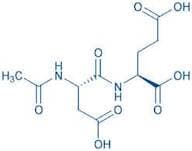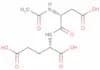
CAS 3106-85-2
:N-Acetylaspartylglutaminsäure
Beschreibung:
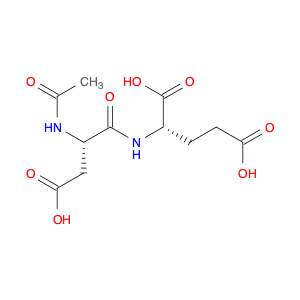
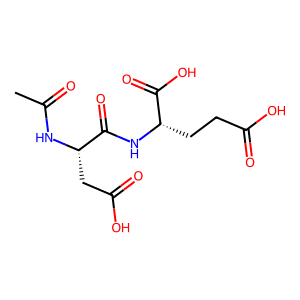
N-Acetylaspartylglutaminsäure, allgemein bekannt als NAAG, ist ein natürlich vorkommendes Dipeptid, das aus den Aminosäuren N-Acetylaspartat und Glutamat besteht. Es wird als Neurotransmitter klassifiziert und spielt eine bedeutende Rolle im zentralen Nervensystem, insbesondere bei der Modulation der synaptischen Übertragung und der Neuroprotektion. NAAG ist bekannt dafür, auf metabotrope Glutamatrezeptoren zu wirken und verschiedene physiologische Prozesse zu beeinflussen, einschließlich der Schmerzempfindung und der Neuroplastizität. Die Substanz ist in Wasser löslich und zeigt Stabilität unter physiologischen Bedingungen, was sie für die Forschung in der Neurobiologie und potenzielle therapeutische Anwendungen relevant macht. Ihre CAS-Nummer, 3106-85-2, wird zur Identifizierung in chemischen Datenbanken verwendet. Das Engagement von NAAG bei neurodegenerativen Erkrankungen und sein Potenzial als Biomarker für bestimmte neurologische Bedingungen sind Bereiche der laufenden Forschung, die seine Bedeutung in den Grundlagen- und angewandten Wissenschaften hervorheben.
Formel:C11H16N2O8
InChl:InChI=1S/C11H16N2O8/c1-5(14)12-7(4-9(17)18)10(19)13-6(11(20)21)2-3-8(15)16/h6-7H,2-4H2,1H3,(H,12,14)(H,13,19)(H,15,16)(H,17,18)(H,20,21)/t6-,7-/m0/s1
InChI Key:InChIKey=OPVPGKGADVGKTG-BQBZGAKWSA-N
SMILES:[C@@H](C(N[C@@H](CCC(O)=O)C(O)=O)=O)(CC(O)=O)NC(C)=O
Synonyme:- <span class="text-smallcaps">L</smallcap>-Glutamic acid, N-(N-acetyl-<smallcap>L</span>-α-aspartyl)-
- <span class="text-smallcaps">L</smallcap>-Glutamic acid, N-acetyl-<smallcap>L</span>-α-aspartyl-
- Ac-Asp-Glu-OH
- Acetyl-α-<span class="text-smallcaps">L</span>-aspartylglutamic acid
- Glutamic acid, N-(N-acetyl-<span class="text-smallcaps">L</smallcap>-aspartyl)-, <smallcap>L</span>-
- Isospaglumic Acid
- N-(N-Acetylaspartyl)glutamic acid
- N-Acetyl-<span class="text-smallcaps">L</smallcap>-aspartyl-<smallcap>L</span>-glutamic acid
- N-Acetyl-<span class="text-smallcaps">L</smallcap>-α-aspartyl-<smallcap>L</span>-glutamic acid
- N-Acetyl-α-<span class="text-smallcaps">L</smallcap>-aspartyl-<smallcap>L</span>-glutamic acid
- N-Acetyl-α-aspartylglutamic acid
- N-Acetylaspartylglutamic acid
- N-acetyl-D-alpha-aspartyl-L-glutamic acid
- N-acetyl-L-alpha-aspartyl-L-glutamic acid
- N-acetyl-alpha-aspartylglutamic acid
- α-Spaglumic acid
- L-Glutamic acid, N-acetyl-L-α-aspartyl-
- Glutamic acid, N-(N-acetyl-L-aspartyl)-, L-
- N-Acetyl-L-α-aspartyl-L-glutamic acid
- Weitere Synonyme anzeigen
Sortieren nach
Reinheit (%)
0
100
|
0
|
50
|
90
|
95
|
100
10 Produkte.
L-Glutamic acid, N-acetyl-L-α-aspartyl-
CAS:Formel:C11H16N2O8Reinheit:95%Farbe und Form:SolidMolekulargewicht:304.2533(S)-2-((S)-2-Acetamido-3-Carboxypropanamido)Pentanedioic Acid
CAS:(S)-2-((S)-2-Acetamido-3-Carboxypropanamido)Pentanedioic AcidReinheit:95%Molekulargewicht:304.25g/molN-Acetyl-Asp-Glu
CAS:Formel:C11H16N2O8Reinheit:≥ 95.0%Farbe und Form:White to off-white powderMolekulargewicht:304.25Spaglumic acid
CAS:Spaglumic acid (N-Acetylaspartylglutamic acid) is a neuropeptide found in millimolar concentrations in the brain.Formel:C11H16N2O8Reinheit:99.92%Farbe und Form:White PowderMolekulargewicht:304.25Spaglumic Acid-d3
CAS:Kontrolliertes ProduktStability Hygroscopic
Applications Spaglumic Acid-d3 is the isotope labelled analogue of Spaglumic Acid, a marker of neuronal integrity and was used in the detection of therapeutic values of antidrepressant treatments.
References Taylor, M.J., et al.: Int. J. Neuropharmacol., 15, 1541 (2012); Shi, D.X., et al.: J. Neurochem., 123, 971 (2012); Sun,W., et al.: Science., 339, 197 (2013);Formel:C11H13D3N2O8Farbe und Form:NeatMolekulargewicht:307.27N-Acetyl-L-aspartyl-L-glutamic acid
CAS:N-Acetyl-L-aspartyl-L-glutamic acid is an amino acid that is used as a substrate in the biochemical assay for glutamate. It is also used to measure brain functions. NAAG is a low potency agonist of the NMDA receptor, which may contribute to neuronal death. NAAG is used as a model system to study bowel disease and eosinophil cationic protein. It has been shown to be effective in vitro against cancer cells and fungi. The structural analysis of NAAG has revealed that it contains an acidic group on its side chain, which can be detected with a pH indicator such as phenol red or bromocresol purple.Formel:C11H16N2O8Reinheit:Min. 95 Area-%Farbe und Form:White Off-White PowderMolekulargewicht:304.25 g/molSpaglumic Acid
CAS:Kontrolliertes ProduktApplications Spaglumic Acid is a marker of neuronal integrity and was used in the detection of therapeutic values of antidrepressant treatments.
References Taylor, M.J., et al.: Int. J. Neuropharmacol., 15, 1541 (2012); Shi, D.X., et al.: J. Neurochem., 123, 971 (2012); Sun,W., et al.: Science., 339, 197 (2013);Formel:C11H16N2O8Farbe und Form:NeatMolekulargewicht:304.25Ac-Asp-Glu • H2O
CAS:Ac-Asp-Glu • H2O is a water soluble molecule that belongs to the class of inhibitors. It has been shown to inhibit the polymerase chain reaction and is used as an analytical method for detecting DNA sequences. Ac-Asp-Glu • H2O induces neuronal death in the caudate putamen, thereby causing bowel disease, by inhibiting energy metabolism. This compound also inhibits the synthesis of proteins in the hippocampus, which leads to reduced locomotor activity and eosinophil cationic protein production. Ac-Asp-Glu • H2O is acidic and its concentration–time curve shows a bell shape. The half life of this compound is six hours.Formel:C11H16N2O8•H2OReinheit:Min. 95%Molekulargewicht:322.28 g/molAc-Asp-Glu-OH
CAS:An endogenous dipeptide with high affinity for a brain glutamate receptor. NAAG is the most abundant peptide neurotransmitter in the mammalian central nervous system.Formel:C11H16N2O8Reinheit:> 99%Farbe und Form:White PowderMolekulargewicht:304.26